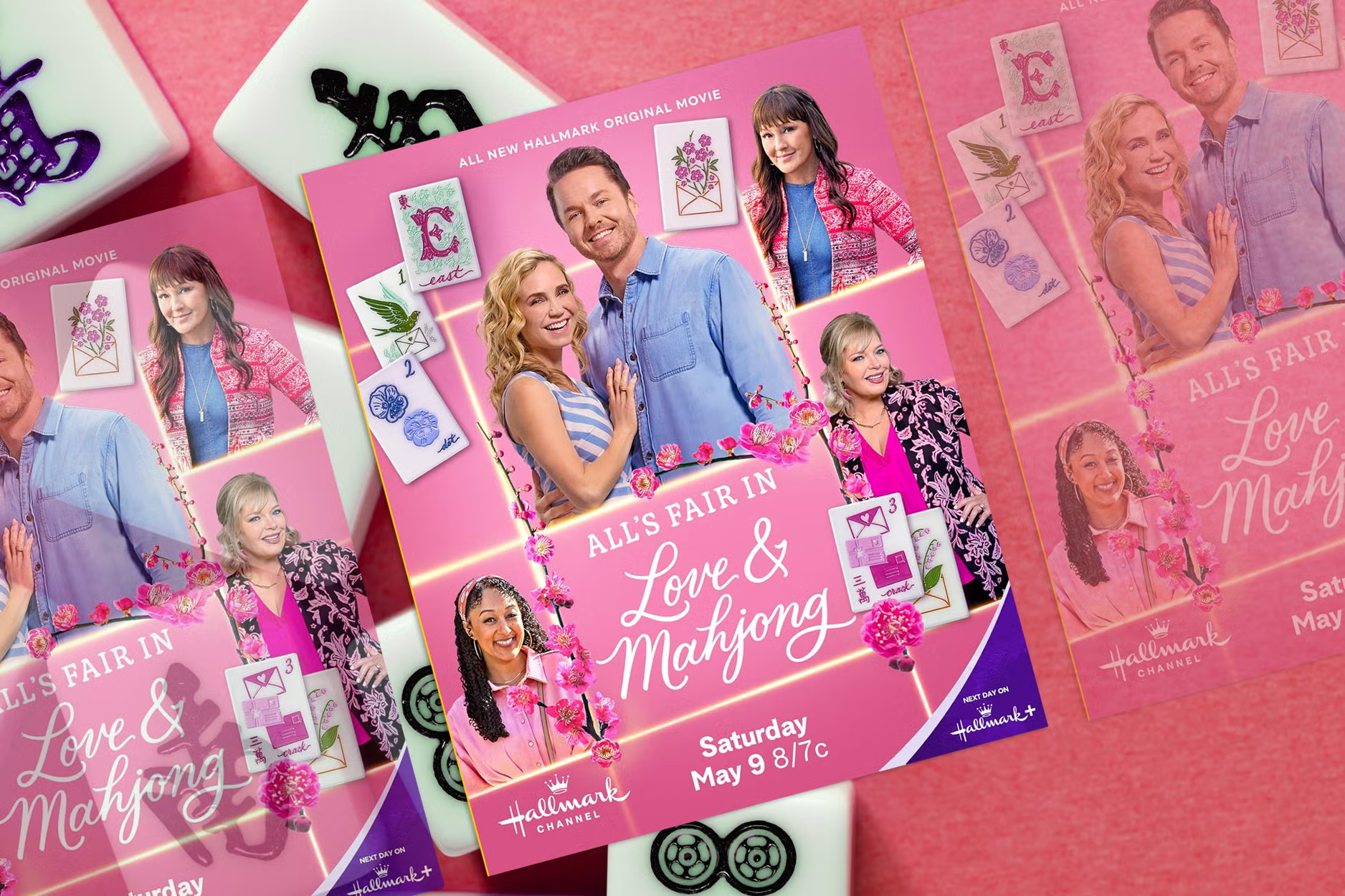
A new Hallmark movie about mah jongg is coming, and well, people have feelings.
Last week, Hallmark announced that a new movie, titled “All’s Fair in Love and Mahjong” with the tagline “Every tile leads to a new connection,” will be premiering on the Hallmark channel May 9, 2026. As their website describes, the rom-com will tell the story of Ronni, “a school nurse [who] finds unexpected hope through teaching Mahjong, the centuries‑old Chinese game that helps her build community and open her heart again.”
But many Instagram commenters are not feeling the love.
On Hallmark’s post announcing the movie and many subsequent reels and reactions, would-be viewers are upset at just how white this movie appears to be based on the poster. Others have pointed out that May is AAPI (Asian American & Pacific Islander) Awareness Month, making the release of a movie about a game of Chinese origins with seemingly little involvement from the Chinese community especially upsetting.
“Y’all couldn’t even use [a] traditional mahjong set or what? Or work with an Asian owned company? Are there Asian writers on your team? How much of this cast is Chinese and is it a Chinese leading story?” actress TJ Lee commented on Hallmark’s post. “Cause this poster is giving yall didn’t put thought into this all this.”
“OK, I get, mah jongg is super trending, and everyone is talking about mah jongg,” Chinese Jewish influencer Amy Albertson shared in her own Instagram reel, “but sorry… love the diversity play here, but I think you’re missing a key person. Hallmark, mah jongg is Chinesse. Where’s the Asian person?”
To be fair to Hallmark, Yan-Kay Crystal Lowe, who plays Shelley in the film, is indeed Chinese Canadian and speaks Cantonese. But to some, like Albertson, including Lowe feels more like an afterthought than a genuine engagement with the game’s Chinese roots.
In the movie, Shelley is one of a group of four friends who have a mah jongg night together. They include Tamera Mowry-Housley, who plays Carly, Melissa Peterman who plays Melissa, and protagonist Ronni, played by Fiona Gubelmann, who discovers that she’s actually a very gifted mahj teacher and falls for Ben (Paul Campbell). The movie is part of the channel’s May for Moms line-up (Ronni is a divorced mom).
The history of mah jongg is long and fascinating. The game, which was first invented in China in the 1850s, came to America in the early 20th century, where it became a beast all of its own — American Mah Jongg was standardized in 1937 by a group helmed by American Jewish women and popularized in Jewish spaces like Catskills resorts and Jewish community centers. The film does not seem to have any Jewish representation in its cast, though one of its writers, Nina Weinman, appears to be Jewish.
Since the pandemic, mah jongg has experienced a boom in America. Some of this boom has taken place in spaces where its Asian and Jewish roots are celebrated, but mostly it’s been divorced from both its original Chinese roots and the way Jewish Americans helped make it into a phenomenon here.
Looking at the first photos from “All’s Fair in Love and Mahjong,” the outfits and spaces appear reminiscent of the Southern resurrection of mah jongg helmed mostly by white women — the images are full of floral dresses, white blazers, tailored outfits perfect for a nice luncheon or tony bridal shower, pristine event halls and fancy graphics.
Some online have taken issue with the particular mahj tiles featured on the poster. The line of tiles created specifically for the film are called Miss Heirloom and were designed by Miss Mahjong, a non-Asian-owned brand. They lack some of the traditional Chinese symbols and imagery that are so ubiquitous, feeling like an added layer of erasure.
Back in 2021, Kveller talked with history professor Annelise Heinz, author of “Mahjong: A Chinese Game and the Making of Modern American Culture,” about the complicated history of mah jongg, including the question of appropriation when it comes to the American history of the game.
“I would also urge contemporary American mah jongg players not to try to exempt themselves from the history of mah jongg that is tied up with racism,” she said then. “This isn’t about throwing the baby out with the bathwater, but it is about reckoning with the history that continues to be intertwined with ongoing stereotypes, commercialization and commodification of Asian Americans. We really need to listen to people’s experiences and reckon with the pain that has been caused.”
We still don’t know how, or if, Hallmark will reckon with mah jongg’s origins and roots, but the conversation the movie has already stirred up does make it clear that there is indeed a lot of pain to contend with.
We’re hosting a Jewish Mah Jongg Festival in NYC this June! Get your tickets here.
Creating Jewish Connection All Year. We may have closed the door on Passover, but our doors stay open thanks to you! Your support ensures that laughter, community, and Jewish joy remain accessible for all.