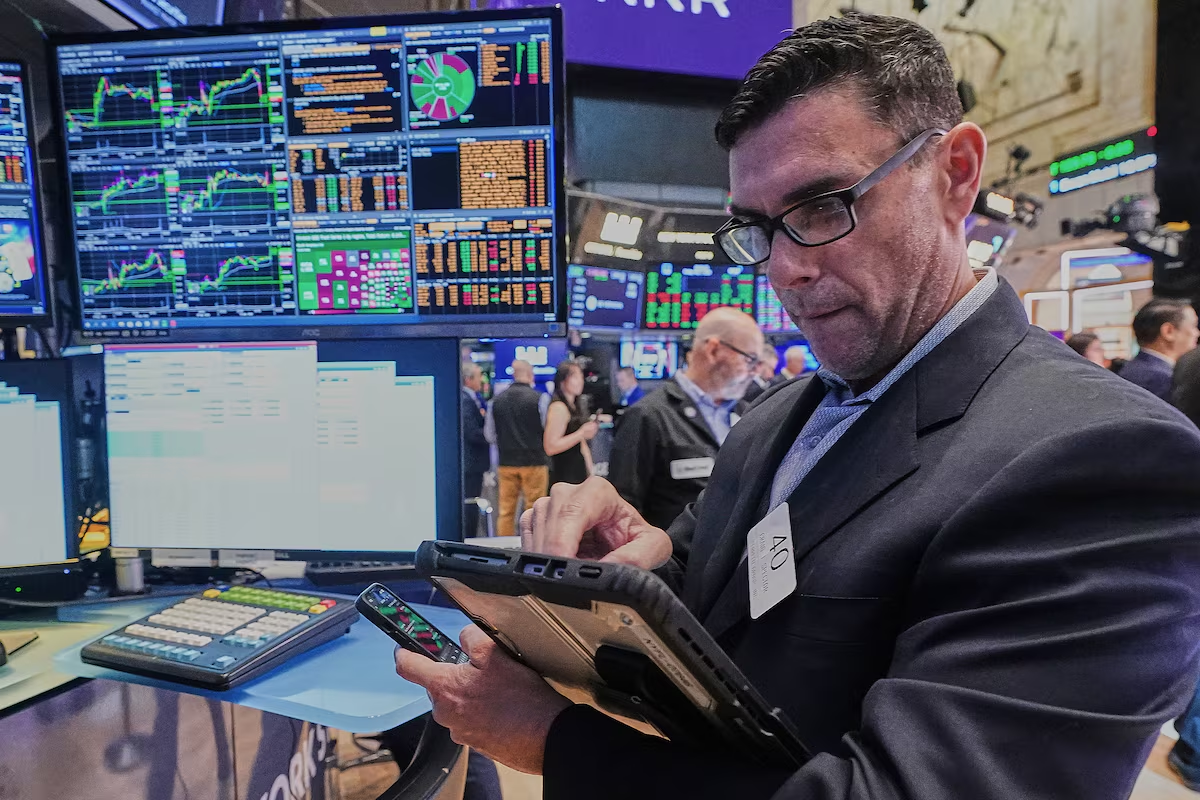
A trader works on the floor of the New York Stock Exchange, May 1.Richard Drew/The Associated Press
The greatest bull market in history is widely considered to be 1982 to 2000, when the advent of personal computers and the internet age drove 20-per-cent annual returns for nearly two decades.
Hot on its heels, and closing the gap every day, is what we’re living through now.
Welcome to the Roaring 2020s, when the only thing rising faster than sea levels is the stock market. From climate change to regime change, it’s been a decade of utter chaos so far.
The financial constant through it all has been a powerful uptrend in stock prices. Canadian and U.S. equity benchmarks are up by roughly 140 per cent since the end of 2019.
Now, track those gains back to early 2009, when the bull market really got started. This golden age for investing, now in its 18th year, has generated annual returns of 17 per cent in the S&P 500, on average. The S&P/TSX Composite Index gained 13 per cent a year over that time, including dividends.
The average Canadian stock investor has earned far less than that. They park their savings in underperforming mutual funds with high fees. They get spooked by market sell-offs. They trade too much. And they risk letting a generational investing opportunity pass them by.
You don’t have to believe the market is unsinkable. The world is a scary place right now, and a booming stock market is tough to reconcile. But letting fear get in the way of participating in a bull market for the ages would be a colossal mistake.
Here’s how to make the most of it, while it lasts.
Lean in
On paper, there have been plenty of good reasons to bail out of the stock market over the last six years: a pandemic that killed millions, the collapse of the global supply chain, the most severe inflation in a generation, a rupture of the world trade framework and now the world’s worst-ever energy security crisis.
All of which proved to be opportunities to get on the bandwagon. Judging by the numbers, many couldn’t stomach the ride.
Above all else, the retail investor experience over the long term has been “defined by missed opportunity,” said U.S. research firm Dalbar, which has for years been measuring just how much investors cheat themselves out of.
Dalbar estimates the average American equity-fund investor sacrificed about a quarter of the returns the S&P 500 generated over the past decade.
Leaning in doesn’t mean taking excessive risks. But investors shouldn’t let fear shrink their stock market exposure below where it ought to be. Those with an investing horizon of about seven years or longer can afford to be aggressive.
VOO and chill
An extreme passive approach to stock investing is to plow one’s money into a major index fund and ignore the market noise.
VOO is the ticker for the Vanguard S&P 500 ETF, the enormous U.S. exchange-traded fund that has close to US$1-trillion in assets under management. Hence, “VOO and chill” has become shorthand for a minimalist buy-and-hold mantra.
For Canadian investors, the more appropriate vehicle may be the iShares Core Equity ETF Portfolio, or something similar.
The idea is the same. Drive your investment fees as close to zero as possible. Forget market timing. Ignore the news. And capture as much of the bull market as possible, no matter what.
For those not planning on retiring before 2033 or so, it can make a lot of sense. Let the magic of compounding do its work while other investors argue about timing.
Opinion: Markets keep hitting highs – and nobody’s sure why. What to do with your portfolio
Few Canadian investors choose this route. Passively managed stock funds have a market share of just 23 per cent in Canada, according to a PWL Capital report. Most investor money sits in funds that try to beat the market by picking individual stocks. While the vast majority fail to do so, they still charge fees that are more than quadruple their passive equivalents, on average.
Sell-offs are the price of admission
It’s not fun watching your money disappear. Since 2009, there have been at least eight major sell-offs in the S&P/TSX Composite Index of at least 10 per cent.
Each one felt like it could be the start of something dark and different. It’s easy to catastrophize in these moments. Modern portfolio tools let us watch our nest eggs shrink in real time.
Enduring these corrections when your instincts are telling you to retreat is usually rewarded handsomely. Investors who succumb to panic then face the very difficult decision of when to get back in.
What if you missed out?
Seeing the stock market ring in record-highs while you’re on the sidelines can’t feel great. Obviously buying low is no longer an option. Who wants to tap into the stock market at its peak?
The thing is, record-highs are usually a good sign. And there’s lots of research showing that money invested at market peaks does just as well over the long term as money invested at any other time. Not being in the market is probably going to cost you.
Don’t worry too much about being precise. Bull markets like these reward participation above all else.