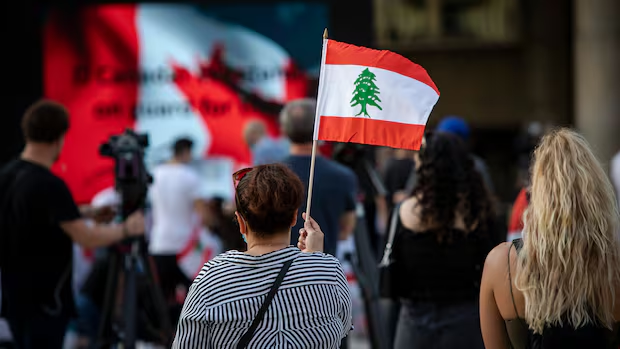
Although Israel’s invasion of Lebanon is happening half a world away, it hits close to home for members of Nova Scotia’s Lebanese community.
“Lebanon, for us, is not distant,” said Wadih Fares, the honourary consul of Lebanon in Halifax.
“I mean, we are so connected, you know, we have families, our home. It’s part of our identity.”
Nova Scotia, and Halifax in particular, has a large community of people of Lebanese descent, dating back to the late 1800s.
Fares, who moved to Nova Scotia as a teenager, has extended family in Lebanon living in and around Beirut. He said “they’re scared, even though they’re not immediately affected.”
“Some of us have families in the war zone, and some of us have families that have been displaced,” Fares said, speaking about the Lebanese community in Halifax. “So we’re really reaching out, checking on them, and offering support every way we can.”
Beirut has been hit by Israeli bombardments, but much of the fighting is concentrated in Lebanon’s south, where sweeping evacuation orders have been issued.
Over 1.1 million people, about a fifth of the population, have been displaced within Lebanon since the start of the conflict. According to Lebanese authorities, 1,461 people have been killed. Nineteen civilians have been killed in Israel, according to Israel’s ambulance service.
Since October 2023, Hezbollah’s cross-border attacks have displaced tens of thousands of people in northern Israel from their homes.
Israel’s invasion began after Hezbollah, the Iran-backed paramilitary group, fired rockets into its territory on March 2 in reaction to the U.S.-Israel attack on Iran. Israel says it needs to create a secure zone to stop the attacks and allow residents to return.
Israel’s defence minister has said Israel will occupy all of southern Lebanon up to the Litani River, about 30 kilometres north of Israel’s border, to provide a “defensive buffer.”
Hezbollah is one of several political groups in Lebanon, and doesn’t have the support of the broader Lebanese government.
“This is not a war that the people of Lebanon or the country of Lebanon want,” Fares said. “I mean, we’re not really involved in this.”
‘We’ve been dealing with this for 60 years’
Jad Ghiz moved to Canada from Lebanon when he was 16. Since then, his parents have moved back, and now live in Beirut.
He said that war was something that they, and other Lebanese, are used to.
“Life goes on as usual. We’ve been dealing with this for 60 years,” he said. “You still got to go and work, still got to go feed your family. That’s the thing about war. People forget that you still have to go into work.”
But he said he’s still angry about the war and doesn’t think that Israel’s claim of a need to occupy Lebanon’s south is justified.
“They [Israel] have been doing this for decades,” he said. “Hezbollah is just the new excuse that they’re using to occupy land.”
Occupants of south told not to return
Israel occupied south Lebanon from 1982 to 2000, a move it said was necessary to defend northern Israel. Today, those who live in the region are being told not to return.
“The return of more than 600,000 residents of southern Lebanon who fled north will be completely prohibited south of the Litani until safety and security of northern Israeli residents is ensured,” said Israel Katz, the Israeli defence minister.
“That’s the area of like half of Nova Scotia,” Ghiz said. “And the entire population of the HRM being booted out of their home.”
“It’s a settler colonial expansion project,” said Joanna Ghiz, Jad’s sister. “It’s very, very, very troublesome for, mostly, Muslim families.”
Mayors and officials of Christian-majority villages report receiving calls from the IDF telling them that Christians and Druze can remain in the future Israeli-occupied zone. But the IDF has reportedly ordered all Shia Muslims — who make up the vast majority of southern Lebanon’s population — to leave, and warned Christians not to harbour them at risk to their own homes and lives. CBC News asked the Israeli government about those orders, but didn’t receive a response.
Joanna said that she thinks the implication that all Shias are linked to Hezbollah is a tactic to justify Israel’s continued occupation.
What should Canada be doing?
Fares, when asked what he thinks Canada’s reaction to the invasion should be, said that while diplomacy is a good step, the situation might be beyond the reach of any de-escalation efforts Canada could attempt.
“They can push to negotiate a solution out of this,” he said. “But we all know what we are dealing with, and it’s easier said than done.”
Jad Ghiz said he thinks Canada should do more in the face of the war, comparing Israel’s actions to Russia’s invasion of Ukraine.
“There’s so many actions that Canada can do, like send relief, but [Prime Minister Mark Carney] was just watching Israel do the same thing that Russia did at a fraction of the size,” he said.
“That’s very nice of Carney to say some really nice words here and there, but it’s like, join the sanction list, join the countries that are sanctioning Israel.”
Carney has condemned Israel’s attacks as an “illegal invasion” and called for a ceasefire.
“From a practical perspective, the government of Lebanon has banned Hezbollah, is trying to take action against Hezbollah and their terrorist activities and their threats to Israel,” Carney told reporters on March 31.
“That is the reported justification for this invasion. So, we condemn it.”
The Centre for Israel and Jewish Affairs said in a social media post it is “deeply concerned” by Carney’s comments, given that Hezbollah is a “terrorist proxy of the Iranian regime and a global threat.”
“The government of Lebanon has repeatedly demonstrated that it is either unable or unwilling to rein [the group] in — failing to meet its pledge to disarm Hezbollah by the end of 2025,” the post said.
“Civilians in northern Israel cannot be expected to live indefinitely under the constant threat of Iranian-backed missile fire.”
Canada also released a joint statement with France, Italy, Germany and the U.K. on March 16 which called on Hezbollah to cease its attacks on civilians and immediately disarm.
“That’s the typical kind of response,” said Joanna Ghiz. “But unfortunately, Canada is complicit in arming Israel.”
Direct arms shipments to Israel have not been approved by the Canadian government since January 2024, but a loophole exists that allows arms exports to the United States to be shipped to countries that would otherwise be blocked.
Data uncovered by several non-profits shows what appear to be Canadian weapon parts and ammunition making their way to Israel through American airports.
MPs rejected a bill that would close the loophole in March.
Israeli Prime Minister Benjamin Netanyahu said Wednesday that the ceasefire between the U.S. and Iran would not stop the invasion in Lebanon.
MORE TOP STORIES