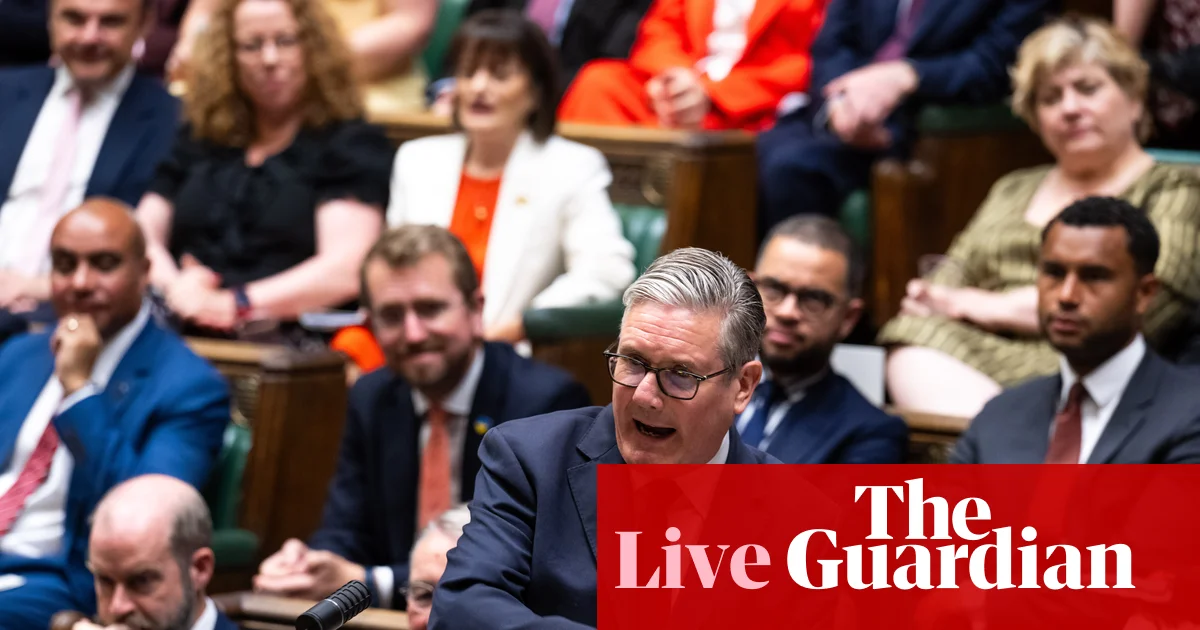
PMQs – snap verdict
There aren’t many advantages to being forced out of your job if you are prime minister, but knowing that you will never have to face another PMQs is one clear bonus. Among the many reasons why it is such an ordeal is the fact that, as PM, you get blamed for everything. In part that is because the opposition parties will always be critical, regardless of whether or not that’s fair, but mostly it’s just a facet of leadership.
Today Keir Starmer sounded more fed up about this than usual. As he hit back at his critics, he was more withering and disdainful than usual. And, as a result, better than usual too.
He slapped down Dave Doogan, the SNP leader at Westminster, with ease, forcefully and effectively. (See 12.30pm.) And when Lee Anderson from Reform UK asked a question, Starmer briskly addressed it before devoting most of his answer to a hatchet job on Nigel Farage. (See 12.42pm.)
But it was Kemi Badenoch who seemed to wind Starmer up the most. As expected, she devoted all her questions to the defence investment plan (Dip). Her problem, though, was that while Starmer might be prepared to listen to criticism of his record on defence spending from the chief of the defence staff, or from Lord Robertson, or from the Nato secretary general, he is not minded to accept the same lectures from her party given its own record on this issue.
Starmer rightly accused her of “faux outrage”. In his second response to her, he said:
Their record is cutting spending. My record is raising it to £300bn, and rising.
Their record is cutting frigates by a quarter, cutting minehunters by a half and leaving 47 of 49 defence programmes delayed or over budget. My record is the biggest boost to defence investment since the 1980s.
Their record is missing army recruitment targets every year for 14 years. We’ve given our armed forces the biggest pay rise for 20 years and increased funding by £15bn a year.
In his third response to her, he said:
What did they actually do? They cut defence – 2.5% down to 2.3% in their 14 long years. And what did they do on welfare? They put the bill up by £88bn. So no lectures from them.
And in his fourth, he said:
They won’t defend their record because they can’t. They won’t apologise for it because they’d have to admit what we all know is a total failure. They just try to pretend the 14 years they were in power never really happened.
Collectively, all this made an impact. Starmer had a point, and he was making it with punch and passion.
Badenoch was a bit less aggressive than usual, but perhaps she is losing interest. It was interesting to note that, at one point, she started training her fire on Andy Burnham. (See 12.21pm.) He is the opponent who matters to her now.
Key events
Early evening summary
-
Keir Starmer has suggested Andy Burnham borrow billions more to cover the hole in the government’s Defence Investment Plan (Dip), in a move which economists say would severely reduce Burnham’s headroom against his fiscal rules. As Kiran Stacey and Alexandra Topping report, the prime minister said at PMQs that his successor – who is very likely to be the Makerfield MP – should use the headroom to fund a £4.7bn gap in defence spending over the next four years. Starmer unveiled the Dip on Tuesday with an extra £15bn for weapons systems such as nuclear missiles and drones, but without having allocated money for all of the additional spending. He told MPs:
[The funding gap is] about £1bn a year over four years. Because of the decisions at the last budget, we’ve got headroom of £22bn. That is precisely so we can take decisions like this.
Government sources say this would make little difference to the government’s fiscal position, given the Office for Budget Responsibility calculated earlier this year ministers had space to borrow an additional £22bn before hitting their limits. However economists say that the Iran war has already severely squeezed the government’s space to borrow more, and funding the defence investment plan would reduce it further.
-
A government-backed flood reinsurer will cap payouts, amid fears poorer households are subsidising flood insurance for some of the richest. As the Press Association reports, the new claim limit is one of several reforms to Flood Re announced by water minister Emma Hardy in the Commons. She said a river flood last year resulted in a single claim worth more than £3m to Flood Re – to cover a quad garage, indoor swimming pool, jacuzzi, gym, music room, den, outdoor artificial turf, padle court and five-a-side football pitch. Hardy told MPs:
Without reform to Flood Re, we will continue to have a system where the average and low-income households are subsidising flood insurance for the richest households in the country.
For a full list of all the stories covered on the blog today, do scroll through the list of key event headlines near the top of the blog.
Rayner accuses Whitehall of ‘institutional resistance’ to fiscal devolution
On the subject of devolution, Angela Rayner, the former deputy PM, will tell the New Economics Foundation in a speech tonight that, when she was in power, the Whitehall system opposed fiscal devolution.
According to Emilio Casalicchio in his London Playbook PM briefing for Politico, Rayner will say:
There was institutional resistance to fiscal devolution throughout my time in office.
But we have shown it can be overcome. We faced them down in announcing an overnight visitor levy. We can do so again.
Andy Burnham may have heard this story too. In his speech in Manchester on Monday, he said:
And let me say this very directly: the days of Whitehall fighting the devolution of power into the regions and nations are over, for good.
Vince Cable, the Lib Dem business secretary in the 2010-15 coalition government, has written a thoughtful critique of Andy Burnham’s devolution plans in a post on his Substack blog. He points out that there is an inherent tension between wanting devolution and wanting “good growth in every postcode”.
Here is an extract.
But let me be more generous and imagine that Manchesterism is just the first step towards something big in devolution: more freedoms for elected mayors and for councils to spend and raise revenue; less power for Whitehall to impose policies and priorities. Would that help to revive the economy and raise overall living standards and public satisfaction as Andy Burnham believes? Quite possibly; but not necessarily. If a powerful tier of regional government is built up at the expense of local government it may have the opposite effect, producing a different form of centralisation. More devolution may be at the cost of more ‘post-code lotteries’; indeed it is the point of devolution to allow more variety and experiment. Successful city regions may produce dynamic city centres at the expense of surrounding small towns and suburbs. Devolved government may produce worse outcomes by pursuing wrong-headed policies. Critics of the Nationalist government in Scotland argue that experimentation with a new school curriculum may have damaged school performance – at least as measured in PISA scores.
The NAHT union, which represents school leaders, is more positive about the teachers’ pay award than the NEU. (See 4.42pm.) It has issued this statement from Paul Whiteman, its general secretary. He said:
We are pleased the review body and government have listened to NAHT and other unions, agreeing that an above-inflation pay uplift is required.
Although there remains some way to go to achieve our aim of restoring the value of pay to 2010 levels, this represents another step in the right direction so long as we don’t see a big spike in inflation.
The big drop in real-terms salaries since 2010 has coincided with increased responsibilities and pressure – putting this right is essential if we are serious about ensuring our children have the first-rate teachers and school leaders they deserve.
It is helpful that the government is bringing some additional funding to support schools, but we need to be clear that this is not a fully-funded award and it will mean more pressure on already stretched budgets. There is very little headroom in existing budgets and talk of ‘maximising value’ is deeply unhelpful.
NEU teaching union considering strike ballot after schools told pay award for teachers won’t be fully funded
The UK’s largest education union is “considering all options”, including launching a formal ballot for industrial action, following the announcement that schools will need to partially fund teacher pay rises, the Press Association reports. PA says:
The government has accepted the recommendations of the school teachers’ review body (STRB) for teachers to receive a 3.5% pay rise from September and a 3% increase from the same time in 2027.
But the Department for Education (DfE) said schools will have to find the first 1% of each pay award.
Unions had called for any pay increase to be fully funded after the DfE suggested in its evidence to the STRB in October that teachers’ pay should rise by 6.5% across 2026/27, 2027/28 and 2028/29.
Earlier this year, the National Education Union (NEU) said it would launch a formal ballot for strike action in October if the Government failed to make a fully funded, above-inflation pay offer.
Today, following the government’s teacher pay announcement, a spokesperson for the NEU told the Press Association: “We are considering all options.”
Additional funding of £1.8bn will be provided to schools over two years to support pay rises for teachers and support staff and an additional £485m will be provided to colleges and further education providers over the same timeframe.
The DfE also announced that academy trust executives’ pay will be capped at £174,000 from September.
Daniel Kebede, general secretary of the NEU, said in a statement: “A partially funded settlement still means cuts to education, and the NEU will never accept that.
“Schools are being asked to find £460m from budgets already at breaking point.
“This is the equivalent of 8,300 school staff: 3,900 teachers and 4,400 support staff. Ministers cannot claim to want more teachers while overseeing such a drastic reduction in numbers next year.
“In Makerfield, in Andy Burnham’s constituency, that means 40 schools being forced to find £866,842 collectively from their own budgets simply to meet the government’s requirement to fund part of this pay award.”
There have been a lot of reports saying Andy Burnham is being urged to give a job to David Miliband, the former cabinet minister who lost the Labour leadership to his brother Ed in 2010 and who for the last 13 years has been running the International Rescue Committee, a global charity based in the US. But today the Times is reporting with more confidence that Miliband is now expected “to play a significant role” in a Burnham administration.
But, in their story, Oliver Wright, Steven Swinford and Patrick Maguire say making Miliband foreign secretary, the job he did under Gordon Brown, would be problematic for his brother. They report:
The irony is that this time it could be David who ends up thwarting Ed’s political ambitions. David is said to have his eye on returning as foreign secretary. Ed wants to be chancellor.
The dilemma is simple — can Burnham really afford to put two Milibands in great offices of state? “You cannot have more Milibands than women in the top jobs. That kind of thing matters,” one cabinet minister said.
They also say that Ed Miliband was one of the people urging Burnham to give a job to David. The two brothers are said to have a much better relationship now than they did after Ed stymied his elder brother’s ambitions in 2010, and Ed knows that David is more progressive than people who stereotype him as a Blairite would assume.
Darren Jones suggests Burnham’s devolution will only work properly if involves central government getting smaller
Andy Burnham has made it clear that, when he becomes PM, he wants to see significant devolution of power to English regions.
In a speech to the Re:State thinktank today, Darren Jones, the chief secretary to the PM said that Burnham was right to say there is “overcentralisation of power and bureaucracy in Westminster”. But he said devolution of power should be accompanied by a reduction in the number of officials working for central government in London.
He said:
When I ask the question: ‘As we’ve devolved things to combined authorities have we reduced the headcount in London by a commensurate amount?’ No, headcount has increased.
And I just say to Whitehall, with the direction of where the political winds are blowing, I think this is a clear warning: devolution must mean devolution, not duplication.
In the past, we’ve gone down the path of replicating checks, both in the regions and in Westminster, creating more state rather than more power in those regions.
So, for this to truly work, Westminster must trust local leaders to make the right decisions and instead of an almost parental relationship, we need to actually devolve power and accountability across the country.
Jones said that “if you’re really committed to devolution, you should see a change in the shape of London departments”.
Asked if the government would have to think about which departments remained in existence if there was genuine devolution to the UK’s nations and regions, he replied:
I think in the long run, probably yes. I think in the short-to-medium term, I would expect them to at least change shape or shrink.
Small boat arrivals in first half of 2026 down 41% on total for first half of 2025, figures show
The number of migrants who arrived in the UK after crossing the English Channel in the first half of the year fell sharply compared with the same period in 2025, the Press Association reports. PA says:
Some 11,884 migrants arrived in the six months from the start of January to the end of June, according to the latest Home Office data.
This is 41% lower than the total that had reached the UK by this point last year, which was 19,982.
It is also down 12% on the 13,489 who arrived in the first six months of 2024.
The steep drop is likely to reflect a number of factors including the weather, the supply of small boat parts, government policy, and the flow of migrants into Europe from elsewhere in the world.
In April, the home secretary, Shabana Mahmood, signed a three-year agreement with French authorities to pay £662m to support beach patrols as part of efforts to drive down arrivals.
Mahmood is also seeking to overhaul the asylum system to deter crossings and deport people easier, including proposed changes to make refugee status temporary.
Looking further back, this year’s figure for January-June of 11,884 is 4% higher than the equivalent number in 2023 (11,433) and 7% below the figure in 2022 (12,747).
While the number of arrivals has fallen so far this year, the number of migrants arriving per boat has climbed to a new high, averaging 65 per craft over January to June.
The average across the whole of last year was 62 migrants per craft, while the figure for January-June 2025 was 58.
Some 2,742 migrants arrived last month after crossing the Channel, the lowest number for June since 2021.