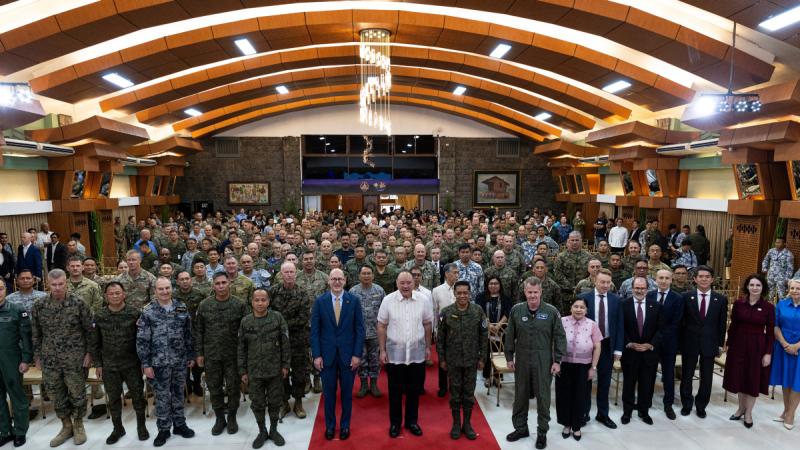
Australia stood shoulder to shoulder with the Philippines, the United States, New Zealand, Canada, Japan and France at Camp Aguinaldo, Manila, to close out the largest-ever Exercise Balikatan on May 8.
For three weeks, the seven nations worked together to enhance military cooperation and collective readiness, strengthen military-to-military ties and build on multinational interoperability.
Commander of the Australian Contingent for Balikatan Lieutenant Colonel Ben Woolmer said the success of the exercise was evident in the continued deepening of relationships between nations.
“Balikatan in Tagalog means shoulder to shoulder, and that’s exactly what we’ve done here on this exercise – we’ve been working shoulder to shoulder with many partners, principally the Armed Forces of the Philippines,” Lieutenant Colonel Woolmer said.
“By doing that, we establish friendships, and through establishing those friendships we build trust. Trust in each other, trust in each other’s military capabilities, and we learn from each other.”
Over the three-week period, about 400 ADF personnel participated in live-fire scenarios focused on coastal defence, undertook skills and knowledge exchanges in jungle survival, weapons handling and field medical treatment, strengthened cyber defence skills, deepened air and missile defence tactics, and embedded with United States infantry and high mobility artillery rocket system (HIMARS) units to improve integration and interoperability.
Balikatan also achieved multiple milestones for the ADF, with the first-ever deployment to the exercise of a combined Anzac call sign in Combat Team Jackal and the first time a Royal Australian Navy major fleet unit participated with the inclusion of HMAS Toowoomba.
‘We know we are stronger when we are working together.’
Chief of the Defence Force Admiral David Johnston said Australia’s ongoing commitment to Balikatan and the relationship with the Philippines showed the strength of commitment to the stability and security of the region.
“We’ve been part of this exercise since 2014 and we’ve seen it grow over that time,” Admiral Johnston said.
“In 2026, we’ve had our largest ADF contribution to this exercise and that’s a reflection of the importance of partnerships, and in particular, partnerships in this region.
“We know we are stronger when we are working together.”
At the closing ceremony for Balikatan, Chief of Staff of the Armed Forces of the Philippines General Romeo S. Brawner Jr emphasised the importance of trust and interoperability that exercises like Balikatan helped to build.
“Balikatan is about strengthening the ability to respond together in real, complex conditions,” General Brawner Jr said.
“In today’s security environment, readiness cannot be improvised, interoperability cannot be developed overnight, trust cannot be built only in moments of crisis – these must already exist before they are needed.
“That is why exercises like Balikatan remain important. They sharpen coordination, they strengthen resiliency, they improve decision-making processes across domains and across forces. And they reinforce the understanding that security in a region is a shared responsibility.”
Balikatan is an annual training exercise conducted between the Armed Forces of the Philippines and the United States. Now in its 41st year, it is one of the longest-running and most significant military exercises in the Indo-Pacific.
More than 17,000 personnel participated in Balikatan this year, with Canada and New Zealand joining as participants for the first time.
Australia has participated in Balikatan since 2014, enhancing its ability to respond effectively to shared regional challenges and support a stable, secure and resilient Indo-Pacific region.