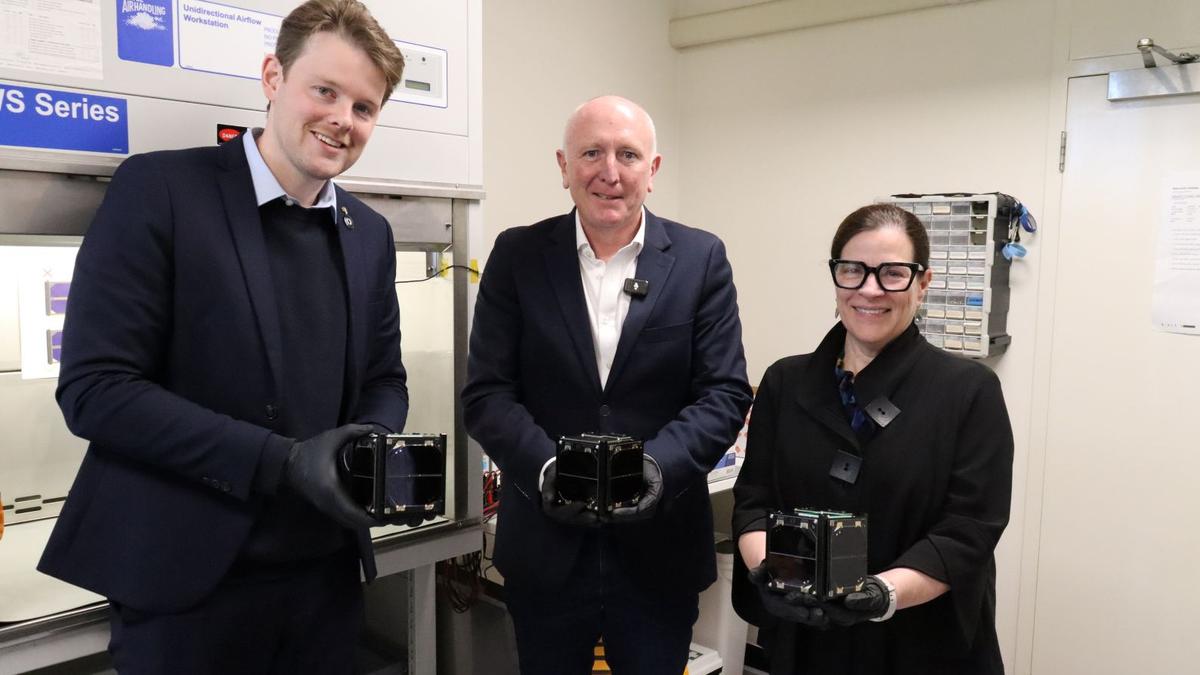
WA’s homegrown space fleet will be bolstered by a university-based program, which is set to launch three new satellites this year.
The Binar space program designs, develops, tests, builds and operates small satellites out of Curtin University’s Space Science and Technology Centre. It aims to advance understanding of the solar system, lower the barriers to operating in space, and help develop Australia into a space industry leader.
Four Binar satellites, known as CubeSats, have been launched since 2021 and a further three are expected to zoom into orbit later this year, backed by $2.5 million in State Government funding. The recently announced funds will be delivered to the university over the next four years.
Curtin University vice-chancellor Harlene Hayne said the State Government’s support was critical to continue advancing WA’s space research.
“This continued investment will help the Binar space program take its next giant leap and expand its reach to create even more opportunities for Western Australia,” Professor Hayne said.
“It will help inspire and equip students from primary school through to postgraduate levels with valuable STEM skills, while strengthening our research capability and growing partnerships with WA space companies that are helping to shape the future of the industry.”

All the Binar CubeSats are 11.5cm by 10cm by 10cm, weigh about 1.33kg and are made from aluminium. The internal circuit boards are made from copper and a type of fibreglass called FR4.
Each iteration of Binar builds on the legacy of the previous satellite.
Binar-1 was the first spacecraft bus entirely designed and built in WA. It spent more than a year in space before succumbing to atmospheric drag. The second space mission saw identical mini satellites Binar-2, 3 and 4 deployed to the International Space Station in 2024.
The third space mission will begin later this year, with Binar-5, 6 and 7 having been built and delivered in a record 18 months.
Binar-5’s main goal is to test a series of eight high school-designed and -built technologies and science experiments developed through the BinarX program.
Binar-6 will test new technologies developed by engineers and scientists at Curtin University, while Binar-7 will test a multispectral imaging system designed to monitor and assess the flammability of WA forests.
The program offers a rare opportunity to train high school students, undergraduates, graduates and postgraduates in satellite design, manufacture and operation.
Curtin PhD student Alex Conduit worked on the program as an undergraduate mechatronics engineering student and has continued with it as a postgraduate candidate.
“As a high school student interested in STEM, I would stare at the glow-in-the-dark stars on my bedroom ceiling and wonder how I might be able to help take humanity into space one day,” the 27-year-old said.
“Ever since working at the Binar space program as an undergraduate student to now in my PhD, I have to pinch myself that I’m lucky enough to work with such a brilliant and talented team building WA’s space industry right here.”
As well as carrying eight experiments designed by WA high school students, the third mission will test advanced technologies for future deep space missions and demonstrate new Earth observation and navigation systems.
Binar space program manager Fergus Downey said it was important to continue developing WA’s space industry.
“Thanks to the support of the State Government, we’re going to continue training the next generation of the space workforce right here in WA, expand our research capabilities to develop more advanced engineering systems for small satellites and open our doors to industry to diversify their businesses and expand the State’s space industry,” Dr Downey said.
“Previous missions have taught us that space is relentless, and we’ve learnt a lot of valuable lessons about how to test and prepare our satellites for orbit, as well as how to train the next generation of satellite engineers to design systems to work in these environments.
“Our upcoming missions will enable us to identify how we can support the WA industry to compete on the global stage and expand our research focus to bushfire prediction using satellite data.”
Science and Innovation Minister Stephen Dawson said he was hopeful continued investment in the local space industry would future-proof WA’s economy.
“Western Australia has the geography, expertise and ambition to be a key player in the space sector, and we’re making sure the right settings are in place to support long-term growth,” he said.