This spring, Cowtown was named the 10th largest city in the United States. The designation, touted as a victory for the city, also begs a question those in the local arts community have asked for years:
Should Fort Worth continue to rely on philanthropic families to primarily fund the arts, or does the city have a responsibility to contribute more to cultural affairs through a dedicated department?
Among its brethren in the top 10 largest cities in the U.S., Fort Worth is the only one without a dedicated arts department or office of cultural affairs.
By comparison, Philadelphia, which allocates the lowest amount among top 10 cities, budgeted $5.39 million for the arts this year. Dallas is allocating roughly $13.3 million to its arts office in 2027.
The city’s outlet for funding is Arts Fort Worth, a nonprofit that received nearly $1.59 million in fiscal year 2026 to oversee the city’s public art and grant programs. The organization previously managed the Fort Worth Community Arts Center before it closed to the public in January 2025.
Although Arts Fort Worth has been a central point of support for creative efforts in the city, the small nonprofit is not poised to do the work a department does, current executive director Wesley Gentle said.
A nonprofit, by nature, is focused on raising funds to support specific community activities while a government entity is designed to serve residents equitably, he explained.
“It’s not very often you find a nonprofit that can serve a constituency of a million people,” Gentle said.
What type of art offices do other top U.S. cities operate?
- New York City: Department of Cultural Affairs
- Los Angeles: Department of Cultural Affairs
- Chicago: Department of Cultural Affairs and Special Events
- Houston: Mayor’s Office of the Arts
- Phoenix: Office of Arts and Culture
- Philadelphia: Creative Philadelphia
- San Antonio: Department of Arts and Culture
- San Diego: Office of Cultural Affairs
- Dallas: Office of Arts and Culture
These offices typically distribute financial support to local organizations and individual artists, manage city-owned arts centers and advise elected officials on cultural policies.
Some elected officials in Fort Worth are open to the possibility of a city arts department. Others point to a need for more conversations with arts leaders to explore future needs of the creative community.
“I don’t think there’s a right or wrong answer, but it’s a decision that our elected officials ultimately need to make,” said former assistant city manager Fernando Costa, who supported the arts during his nearly three decades working for Fort Worth.
City manager Jay Chapa, who is responsible for the day-to-day management and administration of Fort Worth, declined an interview. Currently, only the council can create, discontinue or combine departments.
Why hasn’t Fort Worth had an arts department?
City officials and the arts community had a collaborative relationship when Flora Maria Garcia led Arts Fort Worth as its former executive director for seven years starting in 2000, she recalled.
At the start of her tenure, the city’s population was roughly 545,000. City staff and arts leaders met at the table frequently to plan initiatives and educate newer elected officials about the importance of the arts.
“The relationship was very good,” Garcia said. “I felt advocacy was a huge part of my job, and keeping the mayor and city council members educated and informed was very important.”
That close partnership, Garcia said, was built from the decades the city leaned on Arts Fort Worth following the nonprofit’s establishment in 1963.
Fort Worth, unlike the four other largest cities in Texas — Austin, Dallas, Houston and San Antonio — has never operated any official department or office dedicated to the arts.
Elected officials have historically never felt a need to establish a department for cultural affairs as there is a “general train of thought” that funding the arts is a function of philanthropy, Costa explained.
Arts Fort Worth, previously known as the Arts Council of Fort Worth, serves as an advocacy group intended to streamline fundraising activities in the city.
“Instead of individuals deciding which arts organization to give to, the idea was to let the Arts Council determine where the needs are and allocate the funds accordingly,” Costa said.
Although Garcia recalled a collaborative environment 20 years ago, the relationship has changed in recent years, said Wesley Kirk. The advocate leads Support Fort Worth Art, an organization that has called for the city to be more involved in cultural funding.
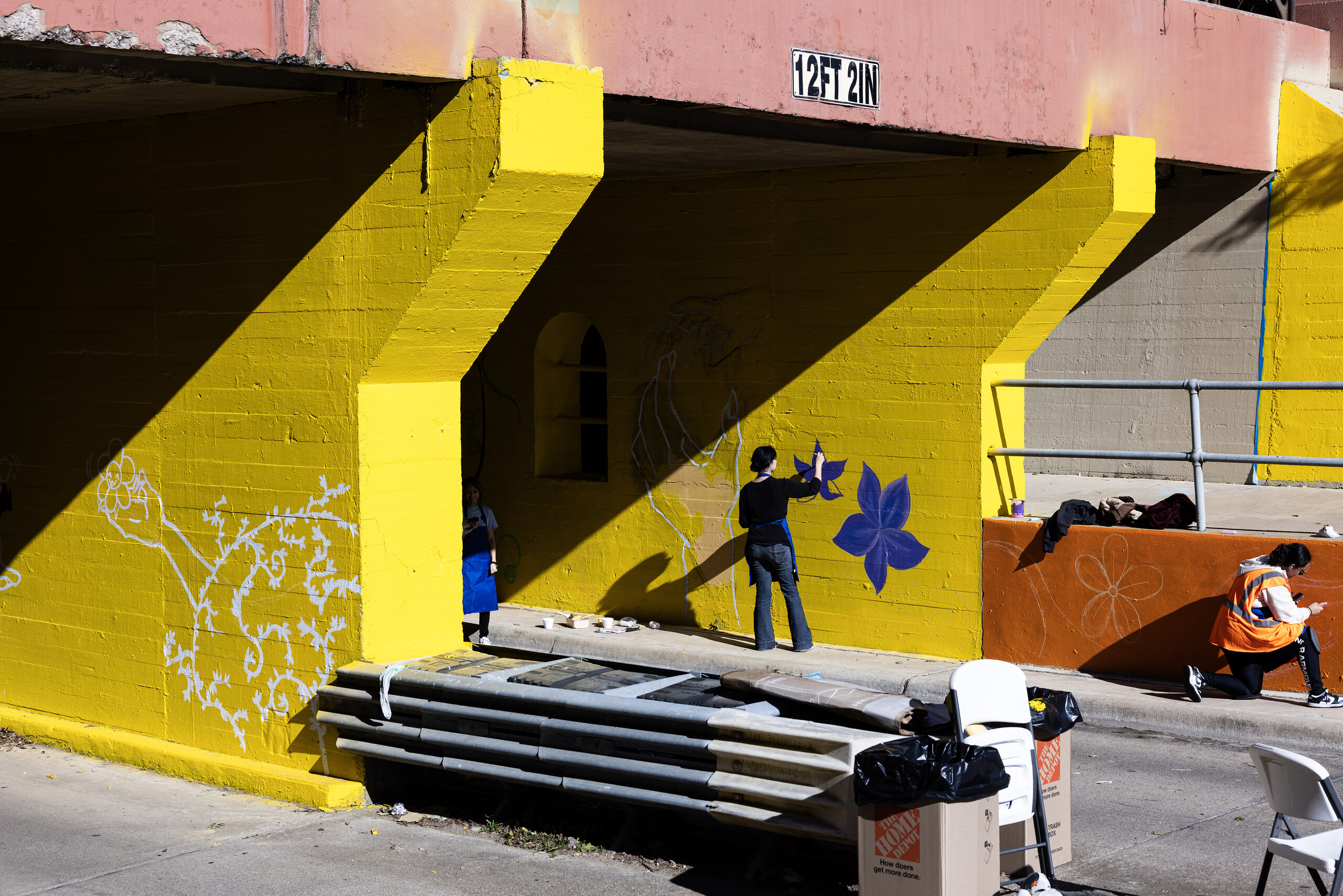
Kirk referenced an incident in 2021 when members of the arts community clashed with the city after local artist JD Moore was removed from painting a public mural under the North Henderson Street bridge.
The city said Moore failed to complete deadlines he allegedly agreed to, according to reporting by WFAA. City officials then planned to bring in Choke, another local artist, to complete the project. That artist turned down the offer, saying it was “a slap in the face” to Moore and the community.
Officials later reversed the decision, but that incident fueled arts advocates to call for a city department that stands up for artists, Kirk said.
Members of the Fort Worth Art Commission — an advisory board that oversees the city’s public arts plan — have expressed frustration about how the city has not increased the public program’s funding despite frequent advocacy and the city’s population doubling over the past two decades. The city allocated $1.63 million to Arts Fort Worth in fiscal year 2025. For 2027, the organization is set to receive nearly $1.59 million.
“There are a lot of crowded places in the world, but that alone does not make you a world-class city,” former commission chair James Talambas said in 2024, referencing the city’s booming growth. “It takes commitment to funding all types of art.”
An additional challenge to Fort Worth’s current structure is that most of the public arts dollars are tied to bond elections every four years, said Philip Newburn, current chair of the commission. Bond funds have restrictions on where public art projects can be located, he added.

Philanthropy vs. public dollars
Starting in the 1930s, prominent philanthropic families built and continue to support the city’s major arts organizations, now including Amon Carter Museum of American Art, Bass Performance Hall, Fort Worth Symphony Orchestra, Kimbell Art Museum and the National Cowgirl Museum & Hall of Fame.
Families like the Basses and Moncriefs have continued to hold the reins of financial support in recent decades as major donors and board members of arts institutions.
In 2024, Mercedes Bass committed to donate $5 million over five years to the Fort Worth Symphony Orchestra, which she has chaired since at least 2019. Robert and Anne T. Bass gave roughly $1.5 million to Texas Ballet Theater through their foundation in 2021. Ed and Sasha Bass own Sundance Square, which coordinates its own cultural programming and artist showcases. Kit Moncrief has been president of the National Cowgirl Museum for more than 20 years.
Major Fort Worth charitable organizations such as Sid W. Richardson, Amon G. Carter and North Texas Community foundations are among other big funders to the arts.
Some local leaders have wondered who the next generation of philanthropic donors will be to carry the torch for the city’s growing needs. Neils Agather, former executive director of The Burnett Foundation, previously pointed to “the wealthy people in this town” who care about the city. Dee J. Kelly Jr., partner at Kelly Hart & Hallman, said there is a new generation of foundations popping up.
“The Richardsons and Carters I expect to stay a little longer; the next generation I expect to step up. But, as the city is growing, it’s going to need more support,” Kelly said in 2024. “The hope is that private individuals step up.”

While private dollars have been important, Kirk said, city involvement builds a healthy cultural ecosystem that allows smaller organizations to have every rung on the ladder to success. He referenced the recent announcement that Fort Worth-founded glass art studio SiNaCa received $1 million from the city of Arlington for its relocation after struggling to land increased support from local major donors.
“Billionaires like their name on big, rich, fancy things,” Kirk said. “They don’t care as much about community art. So the city (of Fort Worth) not playing a key enough role, that to me is always the original sin.”
Costa pointed to a similar sentiment he’s heard from folks who “say the time has come” for city leaders to consider a different model in funding cultural affairs.
Fort Worth hasn’t steered away from contributing to specific art projects from time to time. Within the past two years, the city has committed $15 million to the upcoming National Juneteenth Museum and $6.5 million to the cowgirl museum’s expansion.
The city is in the midst of exploring how to transform a downtown property into a community arts incubator, with a public meeting expected in early November. The Fort Worth Public Library — which manages Arts Fort Worth’s city contract — has also identified wall space across eight branches that could support community exhibitions to fill gaps left by the arts center’s closure.
If the city were to consider establishing an arts department, Costa said, the plan would probably be proposed by city management with “adequate” dollars behind it based on available or new dedicated funding streams. Any new department has typically been proposed during city budget discussions each spring before going to council for final approval, he said.
Growing the city’s involvement in the arts could start with creating a position dedicated to cultural affairs, whether under the public library or a separate department, Newburn said.
Library director Midori Clark has been a prominent arts advocate within Fort Worth City Hall in the nearly three years she has led the department, Gentle said.
Clark declined to comment.
What do city officials think?
Asked about the city’s future role, Mayor Mattie Parker said initiatives like the Community Arts Incubator Working Group and Arts Fort Worth help officials explore “how we can most effectively invest” to ensure the arts remain a key part of Fort Worth’s future.
“We are fortunate in Fort Worth to have a long history of a thriving, diverse, and deeply engaged arts community, and as our city continues to grow and evolve, we have a responsibility to ensure this community continues to flourish,” Parker said in a statement.
Council member Michael Crain said he is open to exploring how a cultural affairs office could build on the city’s arts scene and the generosity of its philanthropic community, strengthen partnerships and expand access across neighborhoods.
“Any proposal should have clear goals, demonstrate meaningful community benefits, and make responsible use of taxpayer dollars,” he said via email. “Supporting the arts and maintaining strong core services — including public safety and infrastructure — are both important to our city’s quality of life.”
Council member Elizabeth Beck expressed concerns that Fort Worth is “behind the curve” regarding dedicated support for the arts. She previously asked city staff for an informal report about how other large cities function but couldn’t recall if or when she received the information.
Beck said she doesn’t know enough to conclude whether an arts department is the right path forward but believes the city needs a role dedicated to managing cultural events instead of passing responsibilities to the library department.
Mayor pro tem Carlos Flores said via text that public art thrives in the community when nurtured by public-private partnerships, noting the downtown arts incubator and the recent voter-approved bond that allocated $10.8 million toward art projects.
Council members Charles Lauersdorf, Deborah Peoples, Mia Hall, Macy Hill, Chris Nettles, Chris Jamieson and Jeanette Martinez did not respond to a request for comment.
‘Investing in culture’
If the city were to establish a cultural office, Gentle wouldn’t see it mark the end of Arts Fort Worth. The nonprofit could function alongside a city agency as public-private partners that push arts advocacy forward, he said.
He noted how the city of Tulsa’s Office of Public Art and Community Partnerships works with Arts Alliance Tulsa, a nonprofit that raises unrestricted funds to support local creative institutions.
Fort Worth is in a “very good” position to have it both ways, Kirk said.
“We absolutely need an office of arts and culture, but in order to maximize the benefits of that, we also need Arts Fort Worth so that each can do things that the other can’t,” he said. “Arts Fort Worth has built up so much community trust.”
Garcia disagreed with the idea of changing Fort Worth’s arts landscape. Creating a cultural office would be the wrong move, she said, as it wouldn’t be independent from political shifts and internal budget cuts. A centralized agency could lead to a duplication of efforts that clash with existing arts nonprofits, she added.
After her time in Fort Worth, Garcia went on to serve as CEO of Metro Atlanta Arts & Culture Coalition before leading the United Arts of Central Florida, both nonprofits that focus on financially supporting creative groups.
The city of Atlanta’s Mayor’s Office of Cultural Affairs and Metro Atlanta could not agree on anything and found themselves with conflicting initiatives, Garcia said. If arts advocates are concerned about a lack of adequate funding, she said, the solution could be for the city to increase its Arts Fort Worth budget beyond the $1.59 million.
“That’s frustrating and that’s the ongoing struggle that arts in all cities have is wanting more money,” she said.
No matter what city management determines is the right path forward, Gentle hopes elected officials continue conversations about ways to grow cultural investment.
“What I see from other places across the country, the private sector responds better when the public sector steps up,” he said. “There has to be a spirit of partnership when it comes to investing in art, investing in culture.”
One thing is clear to Costa: The arts are a vital component of any successful city, allowing it to attract economic prosperity.
“No business is going to move to Fort Worth because we have good sewers,” he said. “Businesses tend to consider quality of life when they make major decisions about their facilities and where employees are going to live. That quality is influenced by the arts.”
David Moreno is the arts and culture reporter for the Fort Worth Report. Contact him at david.moreno@fortworthreport.org. The Report’s arts and culture coverage is supported in part by the Meta Alice Keith Bratten Foundation and the Virginia Hobbs Charitable Trust.
Disclosure: Neils Agather is a member of the Fort Worth Report’s board of directors. At the Report, news decisions are made independently of our board members and financial supporters. Read more about our editorial independence policy here.
This <a target=”_blank” href=”https://fortworthreport.org/2026/10/20/fort-worth-only-top-10-us-city-without-arts-culture-department-should-that-change/”>article</a> first appeared on <a target=”_blank” href=”https://fortworthreport.org”>Fort Worth Report</a> and is republished here under a <a target=”_blank” href=”https://creativecommons.org/licenses/by-nd/4.0/”>Creative Commons Attribution-NoDerivatives 4.0 International License</a>.<img src=”https://i0.wp.com/fortworthreport.org/wp-content/uploads/2021/04/cropped-favicon.png?resize=150%2C150&ssl=1″ style=”width:1em;height:1em;margin-left:10px;”>
<img id=”republication-tracker-tool-source” src=”https://fortworthreport.org/?republication-pixel=true&post=839998&ga4=2820184429″ style=”width:1px;height:1px;”><script> PARSELY = { autotrack: false, onload: function() { PARSELY.beacon.trackPageView({ url: “https://fortworthreport.org/2026/10/20/fort-worth-only-top-10-us-city-without-arts-culture-department-should-that-change/”, urlref: window.location.href }); } } </script> <script id=”parsely-cfg” src=”//cdn.parsely.com/keys/fortworthreport.org/p.js”></script>