Dozens of gaming companies have applied to operate in Alberta ahead of the province’s market launch, which is set for mid-July.
Several of them are familiar names to people who bet on sports and casino games, including BetMGM, FanDuel, PointsBet, and Score Media and Gaming.
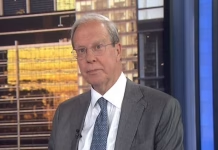
Dan Keene, the CEO of the Alberta iGaming Corporation, which is working closely with Alberta Gaming, Liquor and Cannabis (AGLC) to manage the new industry, said he’s excited by the enthusiasm surrounding Alberta’s launch. He said the agencies are currently sifting through the 35 applications to determine who ultimately will be allowed to operate in the province come July 13.
“It’s all dependent upon whether or not they’ll, once vetted by us, sign our operating agreement and also adhere to the AGLC policies,” he said.
“They have to go through an exhaustive onboarding program with us, but that’s part of making sure that we get it right, right from the onset.”
Alberta opened its market because the province felt it was missing out on revenue. Albertans would use offshore gambling platforms that the government couldn’t regulate or tax.
Now, the government can receive a portion of the revenue by making the market legal in Alberta and encouraging operators to get established in the province. Eighty per cent of gambling revenue will go to operators, while 20 per cent will go back to the province. Indigenous communities will receive two per cent, with one per cent allocated to social responsibility.
Comparisons with Ontario
Alberta is following Ontario, which opened its gambling market in 2022.
In the years since, the province has recouped billions in revenue. According to iGaming Ontario, a provincial body that has managed the market launch, in 2024-25, the province generated $2.9 billion in total gaming revenue, an increase of over 30 per cent from the previous year.

Since 2021, when federal legislation loosened up the rules around sports betting, Ontario has gone full throttle, creating what many have called a Wild West gambling environment. CBC’s Jamie Strashin explores how single-game betting has changed the game for some fans and why addiction experts are worried.
Carrie Shaw, a research co-ordinator with the Alberta Gambling Research Institute, said Ontario’s “problem gambling rates increased significantly” after its market opened. The institute recently published a study on the subject.
“However, in the rest of Canada, problem gambling rates decreased. So we know that this is about specifically their market opening … the best prediction is that we’ll see that same kind of scenario happen here in Alberta.”
The research also found that Ontario youth spent nearly three days per month gambling (compared to a day and a half per month for Alberta youth), and that Ontario youth have the highest problem gambling scores in the country.
Shaw and others feel that Alberta’s self-exclusion program will benefit people who may be problem gamblers.
“In Alberta, if you decide that you don’t want to gamble, you can use a self-exclusion program that will make sure that you cannot use any of the sports books and gaming apps that you’re registered on,” said Steve McAllister, the editor-in-chief of Gaming News Canada. “I know that’s something that was a source of frustration for operators in Ontario.”
McAllister also pointed out the differences in the sporting tastes of fans in Ontario versus Alberta, and how that could affect the types of gambling options we see here.
“Western Canada, you have more Canadian Football League fans than you would have in Ontario,” he said.
“I’ve had conversations with operators who are applying to do business in Alberta. They’re telling me that [they] understand that Alberta is a different marketplace … a hockey fan in Alberta is going to be different than a hockey fan in Ontario.”
Rules for advertising
In mid-April, Edmonton Oilers star Leon Draisaitl posted an ad on his Instagram account for safe, responsible gambling.
Under Alberta’s regulations, Draisaitl and other sports stars are limited in how they endorse gambling products.
“The use of active or retired athletes is only allowed for the exclusive purpose of advertising responsible gaming practices,” Keene said.
While Ontario initially allowed sports stars like Auston Matthews and Connor McDavid to appear in ads promoting gambling itself, it has since changed its legislation.
Keene also elaborated on advertising rules that target children.
“You can’t use cartoon figures or symbols or role models that might be appealing to minors. You can’t have advertising that is displayed in close proximity to locations that are visited by minors. “
Support for problem gamblers
Shaw feels that Alberta is lacking in support and resources for people vulnerable to gambling addiction, pointing to the province cutting funding to the Problem Gambling Resources Network last year. While she commended the province for its self-exclusion approach, she thinks more needs to be done.
“Gambling is kind of a unique beast. We don’t have a biological stopping mechanism when it comes to gambling, as we do with substances. If you drink alcohol, at some point you’re going to fall asleep. There’s going to be a biological mechanism that stops you from engaging any further, but with gambling, we don’t have that.”
What will constitute a successful market opening?
With the market launch just weeks away, Keene outlined his definition of success.
“The biggest thing is about Albertans’ satisfaction, and that relates to their satisfaction in responsible gaming, protection of their funds, protection of their data,” he said.
For McAllister, it’s also about where the gambling revenue ultimately goes.
“An environment where people aren’t rolling their eyes or are frustrated with the amount of advertising, and they don’t feel like they’re being hit over the head with gambling advertising,” he said.
“And the government is telling a good story where there’s a very healthy regulated environment, where there’s significant tax dollars coming in, and those tax dollars are being steered towards … mental health and education programs around gambling.”