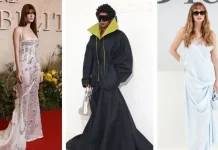
“Semiformal” is one of those terrible default dress codes, like “festive” and “dress to impress” and “dressy casual” (the “jumbo shrimp” of fashion).
It sounds good in theory but in practical terms causes more angst than anyone might have imagined.
It’s the middle ground of dress codes, the DMZ (demilitarised zone) of fashion. It may seem safe – no commitment required! – but it also leaves you stranded in the sartorial netherworld of neither here nor there.
Which means you can easily get it wrong.
Dana Asher Levine, a stylist who works with Shonda Rhimes, calls it “the most misunderstood dress code”.
Asking the hosts for clarity generally doesn’t help. They probably picked that dress code exactly because they didn’t want to be too dictatorial with their guests and will offer platitudes like “wear what makes you feel celebratory”.
For men, that vagueness, while annoying, is somewhat less of an issue.
Semiformal is mostly defined as a suit, not a tux, with or without a tie, and accessorised with a certain level of restraint (don’t get out the wild prints or character vests).
Read more: Why fashion is embracing the imperfect luxury of ruched toe loafers
But for women, the blurriness is a real quandary.
That’s why there are so many online guides to what “semiformal” means, including pages of TikTok videos with the #semiformal hashtag, many of them including the word “help”.
The Emily Post Institute has attempted a clarification: “A semiformal dress code is best described as being more formal than what you would wear to an office, but slightly less formal than what you would wear to a formal event.”
This, however, doesn’t mean much, because office dress codes now range from ultracasual to traditional, and people wear jeans to the Met Gala.
Even the most basic old guideline – no long gowns – is no longer relevant.
So what to do?
Levine, the stylist, thinks of semiformal as “less dressy than black tie and not as glitzy as cocktail attire”.
When asked for a translation, Derek Blasberg, the author of Fast + Louche, a collection of images from his stint as a chronicler of nightlife for Interview magazine, says: “Getting dressed for a party is stressful enough. Guests don’t want mystery. They want direction.”
Then he offers, “What your host is probably trying to say is, ‘Please make an effort.’”
That doesn’t mean rushing out to buy a new dress or suit, but it does mean taking a considered look at what is in your closet.
For Levine, that means paying attention to materials.
Simple shapes or a nice skirt and jacket are fine, as long as they are in dressier fabrics like velvet, taffeta and heavy crepe.
Read more: Fashion makes the case for wearing your fanciest jewellery every single day
“If you have a gown that you haven’t worn in a while,” she says, consider taking it to a tailor and having it hemmed.
Midi, tea length or to the knee – take your pick. The result will be more versatile and, she says, qualify as “semiformal.”
For Blasberg, the answer is thinking about a favourite piece and “turning it up a notch”, he says (he’s partial to a pocket square with a suit).
Pay special attention to shoes. Avoid loafers or daytime flats.
“Dress shoes are always the right choice for men – no white soles or giant logos,” he says. “And for women, wear the jewels.”
A simple black dress with a great necklace, a stack of bangles or even a scarf and a pair of heels can do the trick.
If in doubt, Blasberg advises, it’s better to be slightly overdressed than underdressed.
“Looking like you cared is never the wrong answer,” he says. – ©2026 The New York Times Company
This article originally appeared in The New York Times.