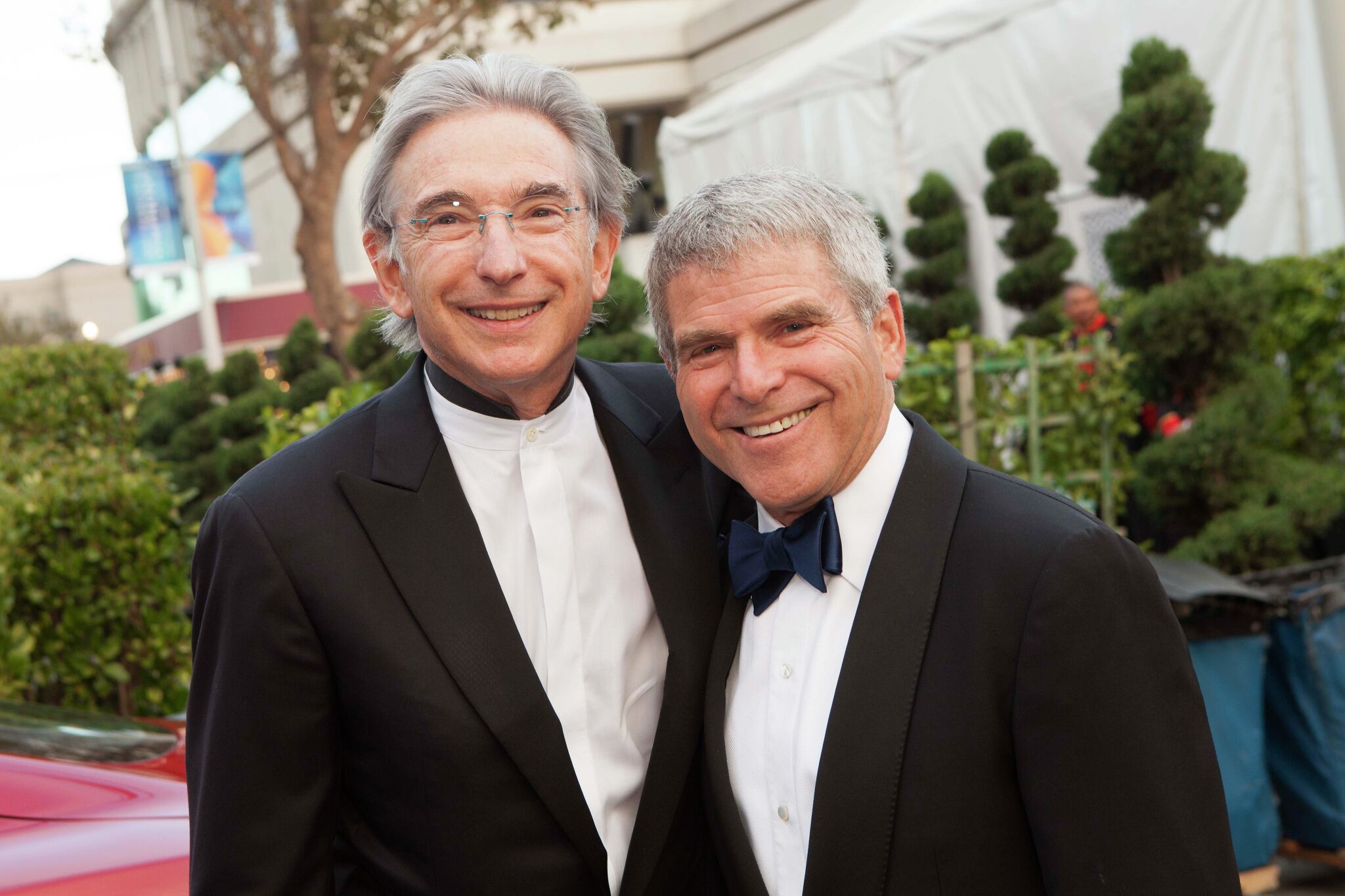

Michael Tilson Thomas and Joshua Robison at the San Francisco Symphony Opening Night Gala on Wednesday, Sept. 3, 2014.
Michael Tilson Thomas’ five-decade career as a conductor and composer saw him reach the pinnacle of classical music.
Given his artistry and 25 years of leadership at the San Francisco Symphony, it’s fitting those achievements take center stage in his biography. But Thomas, who died Wednesday, April 22, at age 81 after a years-long battle with glioblastoma, was also a quiet trailblazer for LGBTQ representation in the rarefied world of classical music.
From the time he partnered personally and professionally with Joshua Robison in 1976, they did not hide. While earlier in the 20th century, the relationship between British composer Benjamin Britten and tenor Peter Pears was an open secret in the classical music world for almost 40 years (with discretion owing to England’s anti-homosexuality laws), others — like Thomas’ mentor, conductor and composer Leonard Bernstein — were only later able to live more visibly gay lives.
Article continues below this ad
Thomas, who rarely spoke about his sexuality in the media, discussed his early years in a CBS Sunday Morning interview last year.
“I had come out, or I was coming out, and various people had, or did not have, issues with that,” Thomas told Lesley Stahl of being openly gay in his 20s. He generally encountered little resistance, he added, and his career clearly did not suffer.
“Most of the time — nearly all the time — it worked well,” he told Stahl, noting that he felt colleagues in classical music at the time “were very happy to see someone like me come along.”

Composer Michael Tilson Thomas and partner Joshua Mark Robison circa 1971.
In a 2019 Chronicle profile of Robison, Thomas reflected on their relationship — which they believed was among the first same-sex relationships in classical music to be publicly acknowledged — with characteristic understatement.
Article continues below this ad
“We were just … Michael and Joshua,” Thomas said. “It’s only now that I have more perspective on what that meant.”
Thomas and Robison were not activists in the usual sense, but by living authentically, Thomas opened the door for other classical musicians to come out of the closet, said Edwin Outwater, music director for the San Francisco Conservatory of Music.
“He’s certainly among the first, if not the first music director I can think of who was openly gay,” Outwater, who was Thomas’ resident conductor at the Symphony from 2001 to 2006 and a close friend, continued. “Even in my early career, you’d hear about issues with searches not wanting gay directors. There’s no question Michael made it easier for musicians to be out, and he was certainly happy to be gay.”
By 1994, when Thomas was under consideration to become music director of the San Francisco Symphony, he and Robison were widely known as partners. The two were childhood classmates at North Hollywood Junior High School (now Walter Reed Middle School), and Robison became an indispensable manager of the empire of concert dates, recordings and compositions that would become MTT Inc.

2019 Kennedy Center Honoree conductor Michael Tilson Thomas, left, and his husband, Joshua Robison, at the State Department for the Kennedy Center Honors State Department Dinner on Dec. 7, 2019, in Washington D.C.
“It was very rare that we were even considering a music director who was gay, much less one who was quasi-married,” Thomas Horn, vice president of the War Memorial Performing Arts Center, told the Chronicle in February, after Robison’s untimely death.
Article continues below this ad
Despite San Francisco’s reputation as an LGBTQ haven, Horn said their partnership “was not without controversy at the board level.”
“The turning point in Joshua being accepted was when Nancy Bechtle became president of the San Francisco Symphony Board,” he recalled. “She was firm Joshua was Michael’s partner and had to be treated as such.”
Bechtle and her husband Joaquim would later host their wedding in 2014.
While never an employee of the Symphony, Robison’s assistance in areas ranging from programming to fundraising became invaluable to the orchestra. He also played a key role at the New World Symphony in Miami Beach, which the couple founded in 1987. Together, the two were arguably one of the most important power couples in the world of classical music.

Michael Tilson Thomas, embraces Joshua Robison at his 70th Birthday Gala celebration at Louise M. Davies Symphony Hall in 2015.
Once Thomas was hired as music director for the Symphony, he used the position to celebrate gay composers. For instance, he commissioned works that explored LGBTQ themes, such as David Del Tredici’s 2001 song cycle “Gay Life,” which chronicled the sexual revolution and the AIDS crisis.
Article continues below this ad
Thomas’ own composition “Whitman Songs,” setting poetry by the gay American writer Walt Whitman to music, premiered at Davies Symphony Hall in 1999 and included a version of the famously homoerotic work “We Two Boys Together Clinging.”
He also mentored young musicians, some of whom, like Outwater, are gay.
“Visibility and representation like that is important for the gay community, broader LGBTQ+ community, arts community, and frankly, all of us everywhere,” San Francisco Gay Men’s Chorus Artistic Director Jake Stensberg said in a statement. “We could all stand to be a little more like MTT.”
Robert Mollicone, music director of the LGBTQ ensemble the Bay Area Rainbow Symphony, worked with Thomas on the Britten opera “Peter Grimes,” as well as a concert of “West Side Story” and on Aaron Copland’s Symphony No. 3. He said that Thomas’ “legacy of passionate leadership and music-making while never apologizing for himself, particularly in the heteronormative environment in which he came up, is an inspiration to all of us at BARS.”
In 2017, Thomas conducted the first San Francisco Symphony Pride concert. The performance was created in reaction to anti-LGBTQ legislation passed in North Carolina where the Symphony was due to perform. After canceling the planned appearance in Chapel Hill, six-time Tony Award-winning American actress and singer Audra McDonald headlined the celebration of queer artists and composers as a benefit for Bay Area LGBTQ organizations.
Article continues below this ad

Davies Symphony Hall decorated for the 2017 Symphony Pride Concert.
The following year, Thomas approved Outwater’s debut of “Holiday Gaiety” in the Symphony’s programming. Conducted by Outwater and hosted and produced by Peaches Christ, it was among the first times drag performers were featured at a major symphony. The inaugural show featured “RuPaul’s Drag Race” winner Bob the Drag Queen, and it has since become an annual tradition.
“As the artistic boss of the house, he could have said no,” said Outwater. “When we did the show for the first time, he did a walk-on stage appearance. Not only did the audience know who he was and love him, but for him to support me and Peaches that way, it meant the world to both of us.”
For Outwater, Thomas’ impact was how he “lived by example.” By not bowing to pressure to hide his sexuality early on, he was able to live his life without compromise and build a career on his own terms.
“He was part of the gay community, and whenever the opportunity came up for him to support things he would,” said Outwater. “But he was always just quietly who he was.”