
Listen to this article
Estimated 4 minutes
The audio version of this article is generated by AI-based technology. Mispronunciations can occur. We are working with our partners to continually review and improve the results.
Saskatchewan’s Opposition NDP says the provincial government’s decision to sell its ownership stake in Information Services Corporation (ISC) opens the door to massive fee hikes for Saskatchewan people and businesses, and there’s nothing stopping the new owners from selling to a foreign company.
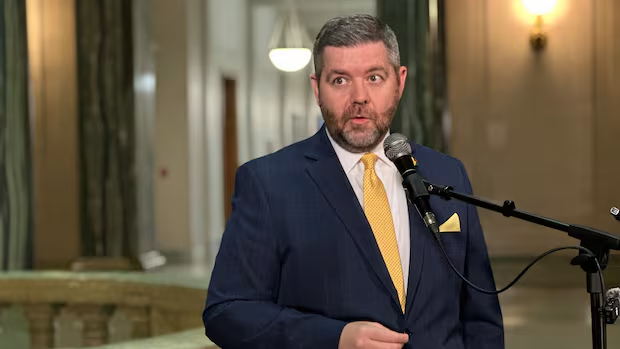
“This is a company who is going to be interested in what’s best for their investors, and that is increasing profits,” said Aleana Young, the NDP’s critic for the Crown Investments Corporation.
The province announced on Tuesday that the former Crown corporation, which is responsible for various government registries including business filings and land titles, will be sold to a subsidiary of Plenary Americas, an infrastructure investment arm of the Caisse de dépôt et placement du Québec.
Every piece of farmland and every property with a home or business in Saskatchewan is registered with ISC.
Young described the sale as selling profitable farmland to pay off a “monthly credit card bill.” She said ISC has made record profits year after year.
“They’re giving away long-term profits for a one-time cheque. They are handing a steady stream of revenue to the private sector.”
That’s the reason Plenary Americas is buying it, she said.
A government news release said Plenary Americas will acquire 100 per cent of the Class A limited voting shares of ISC, including those held by the Crown Investments Corporation, for $51 per share.
The provincial government said it expects to receive approximately $277 million, not including fees and closing costs, and will use the proceeds to fund health-care infrastructure.
It has said ISC will continue to be the exclusive manager and operator of the Saskatchewan Land Registry, the Saskatchewan Personal Property Registry, the Land Surveys Directory and the Saskatchewan Corporate Registry.
The government also said the Master Services Agreement, which regulates and controls land titles fees, would continue to apply after the sale.
‘Replaced a flow of revenue with an asset’: prof
Jason Childs, an economics professor at the University of Regina, said while ISC is worth more now than it would have been several years ago, he is hesitant to call health-care spending an economic investment.
“There is not going to be a meaningful economic return in terms of being able to provide health care in the future,” Childs told CBC News on Wednesday.
The province will get future value from health-care spending, but it won’t generate revenue over time, he said.
“So you’ve replaced a flow of revenue with an asset.”
The province didn’t necessarily need the money since it’s in good shape credit-wise, and more revenue is expected flow in from the sale of natural resources like oil and uranium, Childs noted.
It’s possible the province thought the offer for ISC was higher than it valued the asset, “and you’re going to take the money and run,” he said.
Childs noted the province’s “golden shares” have been retained and ISC’s headquarters are required to remain in Saskatchewan.
“The sale may be part of having that corporation provide services beyond Saskatchewan,” he said.
As for future ISC fee hikes, privatization could either lower costs or raise them, Child said.
The transfer and registration costs associated with real estate transactions are not a major driver of expenses for those transactions — the price of the real estate itself is much more important, he said.
“So it’s kind of a waiting game to see, we don’t know if this [sale] is going to be a good thing or a bad thing.”