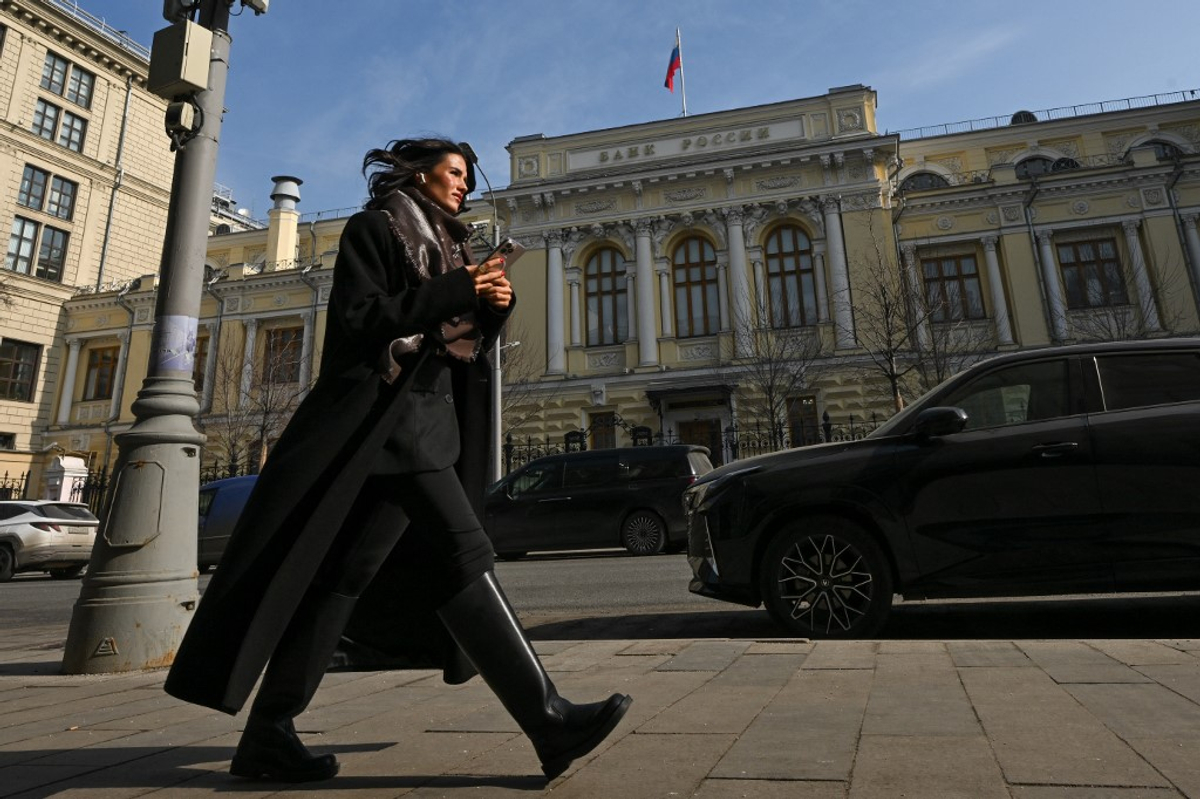
Russia’s economy is weaker than it appears and could be heading toward “long-term decline or shock,” according to Sweden’s military intelligence chief.
In an interview with The Financial Times, Thomas Nilsson, head of Sweden’s Military Intelligence and Security Service, said Moscow is struggling to sustain its war-driven economy despite a temporary boost from rising oil prices linked to conflicts in the Middle East.
JOIN US ON TELEGRAM
Follow our coverage of the war on the @Kyivpost_official.
“The Russian economy can only enter one of two scenarios: long-term decline or shock,” Nilsson said.
Russia would need prices for its key Urals crude to remain above $100 a barrel for at least a year to close its budget deficit, and for significantly longer to address broader economic problems, he said.
“It’s not a sustainable growth model to produce material for the war that is then destroyed on the battlefield,” Nilsson added.
Strains inside the war economy
Russia’s defense sector – a key driver of recent growth – is now showing signs of strain, according to Swedish intelligence. Funding is being redirected toward unmanned systems and long-range weapons as the war evolves.
But outside the drone sector, much of Russia’s military-industrial complex is unprofitable, affected by corruption and embezzlement, and reliant on loans from state-run banks, Nilsson said.
He also warned that the real state of the economy is likely worse than official figures suggest.
Other Topics of Interest
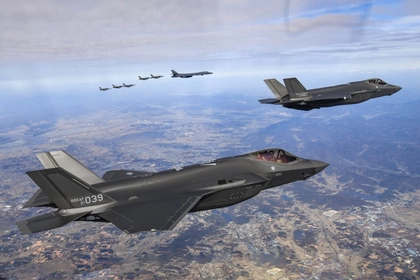
Norwegian F-35s Intercept Russian Il-38 Surveillance Plane
The Norwegian military described it as a “routine” mission when two F-35 fighters were sent to intercept a Russian maritime patrol aircraft approaching the country’s airspace.
“If you have created a system like Putin has, he might not know how bad the economic situation really is. But even with the false info he gets, you ultimately can’t run from all of this,” Nilsson said.
Sweden’s intelligence assessment indicates that Russia is manipulating economic data to present a stronger picture to Ukraine’s Western allies. Inflation, Nilsson said, is likely closer to the central bank’s 15% key interest rate than the official 5.86%.
Stockholm also agrees with Germany’s intelligence agency, the Bundesnachrichtendienst (BND), that Russia is understating its budget deficit by $30 billion, and has identified financial indicators that could point to a future banking crisis, he added.
Official data already signals trouble
Even Russia’s own data reflects mounting pressure.
Russian President Vladimir Putin acknowledged last week that the economy is underperforming, noting that GDP contracted by 1.8% in January and February, including declines in key sectors such as industry and construction.
A day later, Central Bank Governor Elvira Nabiullina warned that both imports and exports have been affected.
“External conditions are now getting worse on an almost constant basis – for both exports and imports,” she said.
Higher oil prices – which Putin said could bring in up to $150 million in additional daily revenue – have provided temporary relief, but he cautioned the boost would be short-lived.
Nilsson said Russia could face further financial strain if oil prices stabilize, particularly if geopolitical tensions in the Middle East ease.
“Living on borrowed time”
While international forecasts broadly align with Russia’s central bank projection that inflation will slow to around 5% by the end of the year, Sweden’s assessment is far more pessimistic.
“Russia is ‘living on borrowed time,’” Nilsson said.
Sweden is urging European countries to push forward with additional sanctions and increase support for Ukraine to exploit Russia’s economic vulnerabilities.