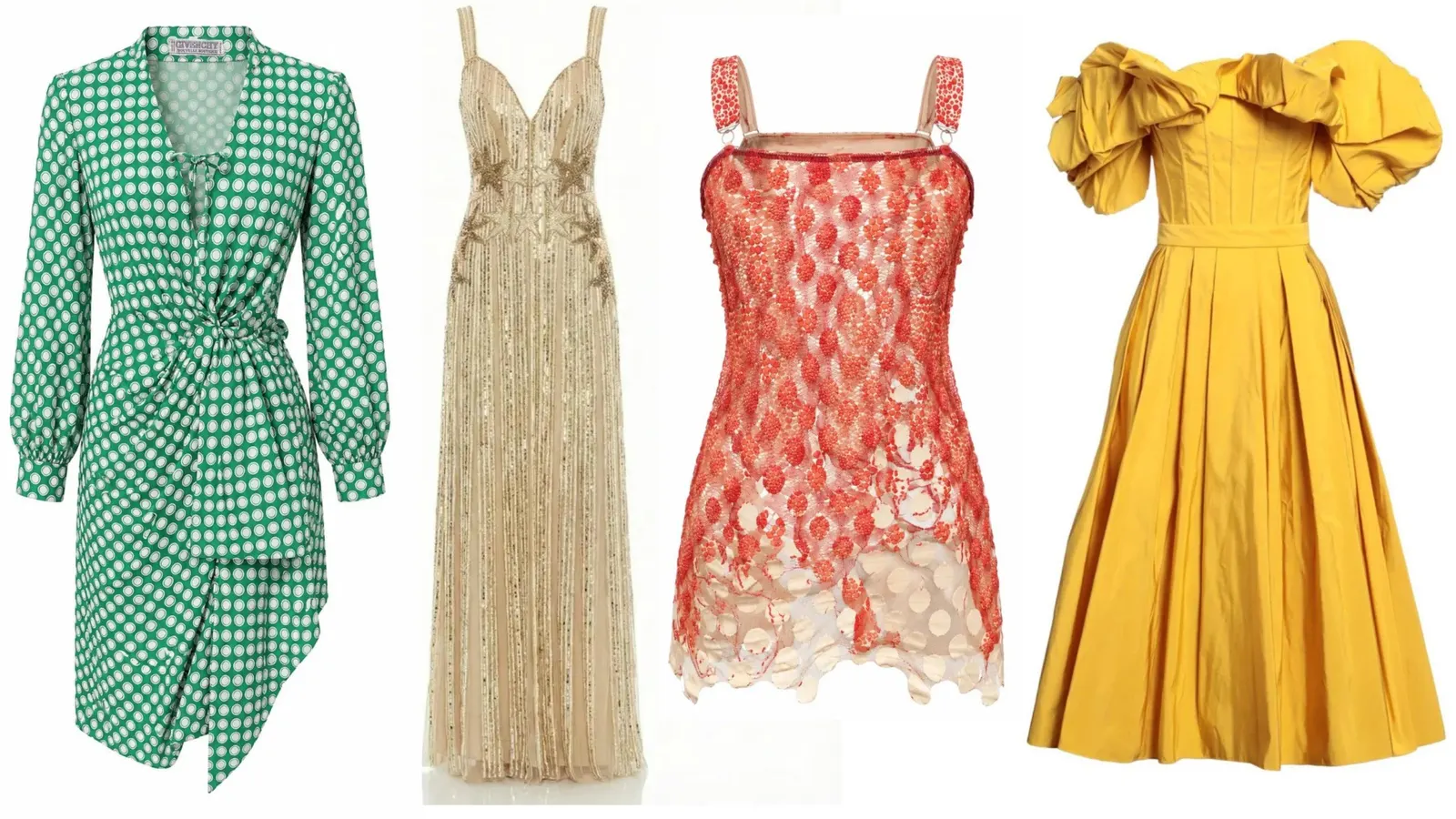
A Givenchy wrap dress, Lanvin evening gown, John Paul Gautier top, and an Alex McQueen dress, all listed on the Louvelle platform.
Courtesy of Tanya Tamer
Many companies have tried to make a whole thing out of renting or selling high-end and vintage fashion, but Louvelle, founded and built by Tanya Tamer, has created something truly innovative and interesting. Louvelle is centered around people.
An invite-only platform, Tamer’s brand is a one which actively works to build community and to connect collectors, fashion lovers, stylists and others who want to expand their access to high-end fashion without committing to the purchase of a garment they might only ever wear once.
After spending a few afternoons digging through the app, I met with the founder to ask her all my nosiest questions about Louvelle, the hows and whys and where she plans to take it next. When we sat down over Zoom I asked her first about the company’s name and how it was connected to the origin story of the transformative fashion experience she has created for serious fashion lovers everywhere.
“Louvelle is the combination of two words in French,” Tamer told me, “which means to rent or lend, and then nouvelle, which means new. The concept is that you’re renting or lending things that are in great condition, that are in demand.”
Bringing Lenders And Renters Together
I knew from the research I’d done that Louvelle members were generally separated into two groups, lenders and renters, those who offer what they own and those who borrow a piece for one of the many life events which require nothing less than a fabulous look.
A black leather Alexander McQueen Top/Vest from renter @berniemcgroderr.
Courtesy of Tanya Tamer
“We separate the lenders into three buckets,” Tamer explained. “One is the collector, which I touched on earlier. The second is stylists. And then the third is everyday lovers of fashion who are shopping. From a collector’s standpoint, these are women who have warehouses full of insane vintage pieces that they’re not looking to sell. They’re looking to hand down to their granddaughters or daughters, but they want to be able to monetize these pieces that are just collecting dust in their closet. For stylists, they also have warehouses full of items and that means storage costs as well. It’s a really interesting proposition, to warehouse their items with us and also monetize their pieces, and basically just get checks in the mail every month. Then, the everyday shopper, we’re seeing a lot of really great financial literacy and investment. They’re really seeing their closet as an investment. So before buying a piece, think about how it would rent on the platform. Getting smarter about how they shop and really using Louvelle as a financial incentive for them.”
I asked if there was a similar system in place, or perhaps a business philosophy, which dictated the designers, brands and pieces of apparel that are approved for listing on the Louvelle app.
Alexander McQueen Ruched Faille Bustier Midi Dress listed on Louvelle by @thedailyrunway.
Courtesy of Tanya Tamer
“The way we think about the items that we want on Luvelle we break into three pieces,” Tamer said. “We have archival vintage, timeless pieces that hold relevance over time, and then the most coveted pieces of the current season. Within those buckets, you have traditional high fashion luxury houses, or contemporary brands, to more up-and-coming in-demand designers. So obviously we have Chanel, Prada, Miu Miu, all the luxury houses, and then we have our contemporary brands, but then we have a lot of upcoming brands.”
Were there specific needs that the founder, who came out of the finance world, was hearing from her members? What did these lenders and renters want or need that only Louvelle could provide?
“It’s different for the lender and the renter,” Tamer told me thoughtfully. “From a renter’s perspective, what we’ve seen a ton of lately is the need for wedding outfits, whether it’s the bride, or the bridal party or someone is just attending a wedding and wants a really stunning gown. It’s actually very exciting. In a couple of weeks we are launching this bridal partnership focusing on vintage bridal pieces. Like, stunning vintage bridal pieces; vintage Dior, vintage Valentino, vintage Galliano, et cetera. We’re really focusing on finding the right resale partners to work with us on that.”
A Maison Margiela 10 Patterned Shirt Jacket listed on Louvelle by @larasingsvintage.
Courtesy of Tanya Tamer
“The way we think about the items that we want on Luvelle we break into three pieces,” Tamer said. “We have archival vintage, timeless pieces that hold relevance over time, and then the most coveted pieces of the current season. Within those buckets, you have traditional high fashion luxury houses, or contemporary brands, to more up-and-coming in-demand designers. So obviously we have Chanel, Prada, Miu Miu, all the luxury houses, and then we have our contemporary brands, but then we have a lot of upcoming brands.”
Were there specific needs that the founder, who came out of the finance world, was hearing from her members? What did these lenders and renters want or need that only Louvelle could provide?
“We’re also rolling out a bridal program for the bride and the bridal party,” the founder continued, “to make it easier to look beautiful without having to break the bank. That’s been a really big request from the renter’s side, it’s been really interesting to understand the incentives behind why they are uploading their items.”
A Schiaparelli Rhinestone Chains Bracelet listed on Louvelle by @reedwarren.
Courtesy of Tanya Tamer
Community Focused So Everyone Wins
One of the things I immediately noticed about this brand, something I very much liked and did not see much of from other fashion rental services, was the trust I could see from all sides. Louvelle makes a point of vetting everything at every stage, specifically to make certain that any party involved in any transaction can do so with trust and faith. There is a feeling of friendship, or maybe comradery, imbued into the entire enterprise.
“Luvelle is a curated community of people who are really intentional about how they engage with fashion,” Ramer explained to me. “When I started this, I really thought about the pillars of Luvelle and community was one of the biggest ones. Adjacent to that is trust because, if the goal is to be able to rent and lend and circulate high-end luxury pieces, you have to have a trustworthy community. That’s the only way, on both sides of the marketplace, that you’ll be able to have a successful kind of platform. Lenders need to feel like they can trust whoever is borrowing their items. And renters have to trust that what the lenders are uploading and posting is accurate as well.”
I wanted to know how the founder chose what brands and labels to include or feature, what the metrics were for adding a new designer’s work, how Louvelle’s clientele communicated their most fashionable wants and needs.
Moschino “Fashion Kills” Cigarette Box Bag listed on Louvelle by @maegancampbell.
Courtesy of Tanya Tamer
“We have an approved designer list,” Tamer explained, “and we’re always editing it, adding to it. Users can also request certain designers and send us the items that they want put up. Then we have our internal wardrobe consultancy team, that I like to kind of compare to a multi-brand retail buyer. That’s how we approve any new or curated designers. A lot of the time there are up and coming designers where the quality and the timelessness are mixed. Sometimes we’ll approve just certain pieces from that designer and those are housed under curated designers on our platform. Same thing for vintage. A lot of vintage doesn’t have a label on it, and so we’ll put it under curated vintage.”
“Our north star, and what we talk about every day is trying to redefine how women relate to their wardrobes,” the founder explained. “That’s really what we’re constantly thinking about. Because the process, from buying a piece to wearing it to having it in your closet, to either passing it down or potentially selling it, there’s a lot that goes on in between. And we really want to be interacting with that entire process. I think a year from now, we have a lot of really exciting offerings that we are rolling out. One is including resale into our platform. That’s been something that we’ve seen happen very organically on the platform. A lot of people organically renting something and then deciding they want to keep it forever. We’re seeing a lot of that.”
Innovations That Make Vintage Easier
Shopping for vintage fashion has challenges unique, and they have long complicated the online sales or rental of historic clothing. Sizing across brands, especially in women’s wear, has never been consistent, not in any decade, and this one factor can make finding the right vintage piece unnecessarily difficult. Then there’s condition, how well preserved a piece might be, how well made it was, what it is made of. I told the Louvelle founder how curious I was about how her company handled the potential issues which are so specific to vintage apparel.
A Junya Watanabe Black Faux Patent Leather Strappy Cape listed on Louvelle by @larasingsvintage.
Courtesy of Tanya Tamer
“Condition standards are really, really important to us,” Tamerold me. “The floor is minimal signs of wear, but we also understand nuance. So, for example, slight wear on a vintage Dior by Galliano piece, that could be part of the story of the piece, while a micro trend piece from two seasons ago might not hold lasting desirability. When they’re fads, we tend to pass on them. We follow a premise of making sure that the items on the veil are very curated. We are a marketplace, so we have to be very intentional about the designers and the pieces that we allow on the platform.”
And the sizing issue? The fact that the numbers on labels might not really mean anything? How did Louvelle deal with that?
“It was definitely something that we thought about from the very beginning,” Tamer said, “because even if it does have a size, it’s usually not 2026 sized. We encourage the lenders to put up both the tagged size as well as the size that it would fit. And then we also have a fitting scale, if it says like, ‘fits from small to size to fits large’. And if you want to ask the lender a question, you can communicate directly with them and ask them questions- whether it’s your height for the gown, or if the bust fits correctly. We try to make sure that there’s a lot of direct transparency between the renter and the lender. A lot of times the renter will ask for specific measurements, and a lender will give it to them. We also have a lot of vintage pieces in our warehouse and we work with a lot of collectors who tend to have a lot of vintage.”
Paco Rabanne 1969 Nano Shoulder Gold Bag listed on Louvelle by @alexiarosasm
Courtesy of Tanya Tamer
Authentic Community Makes A Difference
Before our conversation ended, I wanted to know with certainty what the lady I was speaking with wanted my readers to know. What was the most important thing about her company? What was the underlying message, the throughline which inspired this work? Because this is a lady committed to improving the renting and reselling of exceptional clothing, and she is absolutely determined to ensure that it really is, and remains, a community.
“There’s a ton of resale marketplaces,” Louvelle founder Tanya Tamer said to me. “The condition and the quality of pieces are all over the place out there. We’re trying to cut that out, really create a curated platform where every piece that you see, you understand why it’s on Luvelle, and know that there’s a reason why it’s there. Because it is this curated community, we’ve been focused on how we can protect it, how we can keep it curated while being very intentional about our growth. Because we don’t have to limit growth, we just have to be intentional about how we grow.”
“When people put up amazing vintage pieces, other people want to put up their amazing vintage pieces as well, so we’re kind of seeing this network effect, I want to share my closet, I want to share my style and I’m willing to put up my best items because other people on the platform are doing the same thing. From a lender’s perspective, it’s the ability to monetize your closet and see it as an asset that’s working for you rather than a liability. And from a borrower’s perspective, it’s access to high-end luxury without the clutter in your wardrobe or financial commitment. It’s the infrastructure and the community that makes it seamless for both sides.”
MORE FROM FORBES