When I think of the best moments I’ve had at YU, I think of two places. The first is the run-down building in the Heights that houses the Schottenstein Theater. Although it is gross and falling apart, with a creaky elevator and rooms full of old garbage and treasures, 560 West 185th Street is home for those who can get past the exterior and find meaning within. The second is 245 Lexington room 407, a windowless classroom that is somehow stifling hot in the dead of winter.
The commonality between these two places is music.
Over my past three years at YU, I’ve been privileged to be a part of two musical communities that have each enhanced my college experience and given me parts of YU that I love.
The first is the Music Community, previously the Music Club. I joined the club’s group chat during my first week at YU, and later that year I was sorted into a student band to play and perform with a group of peers. I owe a debt of gratitude to the Music Club’s founding presidents, Miriam Bluth (SCW ‘24) and especially Danny Kutin (YC ‘25), for starting the current iteration of the club and providing me and other student musicians with a space to practice and a stage on which to perform.
Two years later, I became president of the Music Community. I’ve played in three student-run bands as well as the Yeshiva College Jazz Ensemble class, and both the Schottenstein Theater and our practice room a few floors above it has become home to me. Being president has been incredibly rewarding; it’s a lot of work, but seeing everything come together at our events is indescribable in the best way. Watching each group feel the thrill of performing and bask in applause from their peers has been the most rewarding part of the job. Running the club has truly been a highlight of my college experience; it has added so much joy and energy and exhilaration to my life, even throughout the late nights and stressful moments. I am incredibly grateful that Danny entrusted me with his club, and I hope I’ve done a good job keeping it running.
It’s often said that music is a universal language, and that’s what I’ve felt in the Schottenstein Theater. There, music has the power to unite a room of 150 people. In contrast, music nine miles south, in 245 room 407, is akin to another language, one in which the five of four is one and parallel fifths are the worst and an augmented second is the same as a minor third and spelling always counts.
While I entered Stern searching for the Music Club, I became a music major almost accidentally. At the end of my second semester, I decided to minor in music; I was able to skip a prerequisite class that I’d missed, and I joined my grade’s music cohort the next fall. I haven’t looked back. After taking all of the required courses for the minor and not wanting it to be over, I shifted to be a music major — one of only two in the school — and I love it.
The Music Department is special not only because of what we study, but also because of the professors from whom we’re privileged to learn. Our course of study is one that leaves us well-rounded music students rather than specialists in any area, and this is reflected in our professors: We have a composer, a theorist and a performer, and we’ve been incredibly lucky to get to learn from and form meaningful connections with each of them.
Professor Marcia Young teaches choral ensemble and chamber ensemble, taking individual singers or musicians and truly making us into a group. In choral ensemble, we learn to sing from the back of our heads, to shape our mouths properly and to be hyper-conscious of our vowel sounds. Some of my favorite memories from choral include walking out of room 407 still singing canons or going to visit the offices of the deans and academic advising to sing for them at the end of the semester.
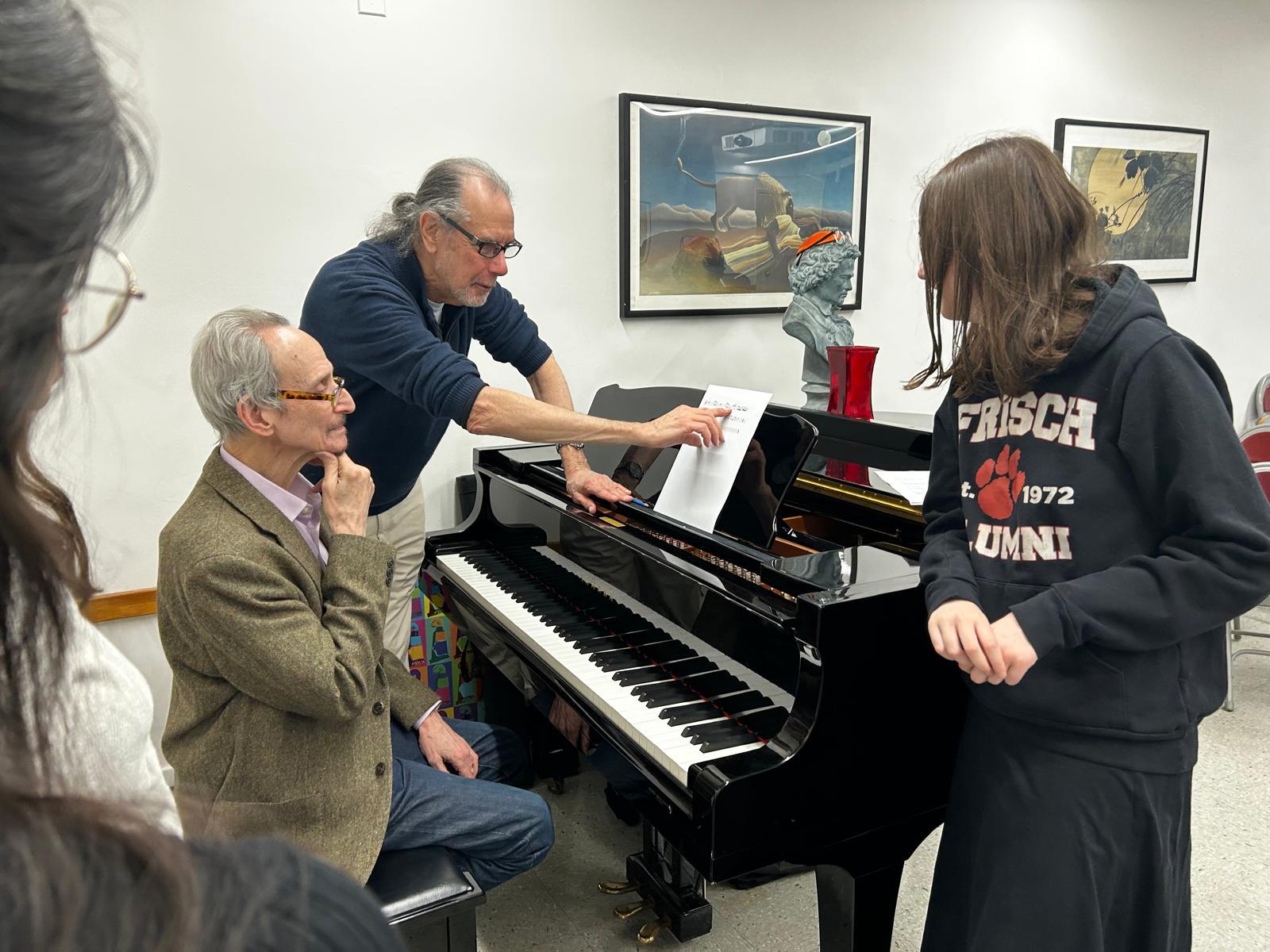
Professor Stanley Dorn, our resident music theorist, constantly amazes me with the breadth and depth of his musical knowledge. It seems as though he can answer any music question, pulling in quotes and references as he does so and introducing us to key theorists, pieces and musical techniques. In our two-student Theory 3 class, Professor Dorn challenges Tamara Yeshurun (SCW ‘26) and I with difficult concepts but always acknowledges the progress we make. His musical genius constantly reminds me that there is so much I don’t know — and yet he never makes us feel that we’re behind.
I’ve technically taken enough classes (six) to graduate with a minor in Professor David Glaser. While a Sense of Music student who likes the word “flowy” might find Professor Glaser intimidating and harsh, it’s clear to music majors and minors that he is the opposite. Professor Glaser is patient and caring, always willing to review concepts as many times as necessary to help students. My fellow music students and I have so many funny quotes and memories from learning with him. With Professor Glaser, I’ve been able to simultaneously learn and have fun, and I am so thankful for the way he has enhanced my Tuesday and Thursday schedules as well as my entire Stern experience.
And of course, my fellow music students are part of what makes my experience so meaningful. Music major Tamara Yeshurun (SCW ‘26) and music minors Eliana Saibel (SCW ‘27), Leora Schramm (SCW ‘27), Chaya Trapedo (SCW ‘26) (and a shout-out to Hayley Goldberg (SCW ‘26) and Aliza Gans (SCW ’27)) and I have spent countless hours gathered around the piano in our room 407 keyboard corner. We’ve spent just as much time looking at each other’s homework as at our own, and I’ve gained so much from being in class with them. I’m so honored to have been a part of their music journeys, and I’m thrilled that they’ve all been a part of mine. Getting to call your classmates friends is a beautiful thing, and it is a gift of being part of such a small department. Each day when I leave my music classes feeling grateful to be a music major, it’s because of my classmates just as much as because of my teachers.
I’m graduating this year, and I don’t know where my music journey will lead next. I’ll no longer be able to play in a Music Club band, I’ll no longer be responsible for running events and I’ll no longer spend my days gathered around a piano analyzing music and spending time with friends. I hope to be able to continue to have new music experiences, but even if not, I’ll take comfort in my memories of music at YU.
As I leave, I hope that the next group of musical students will pick up where I left off. I’m sometimes afraid that they won’t; it can seem like the arts are viewed as increasingly unimportant. The number of music students is dwindling. But I believe that these creative communities, both in the classroom and out, are crucial to our institution, and I hope that I am just one in a long line of music majors and Music Club presidents.
Photo Caption: The author analyzing a music composition assignment with professors Glaser and Dorn
Photo Credit: Leora Schramm
Source link