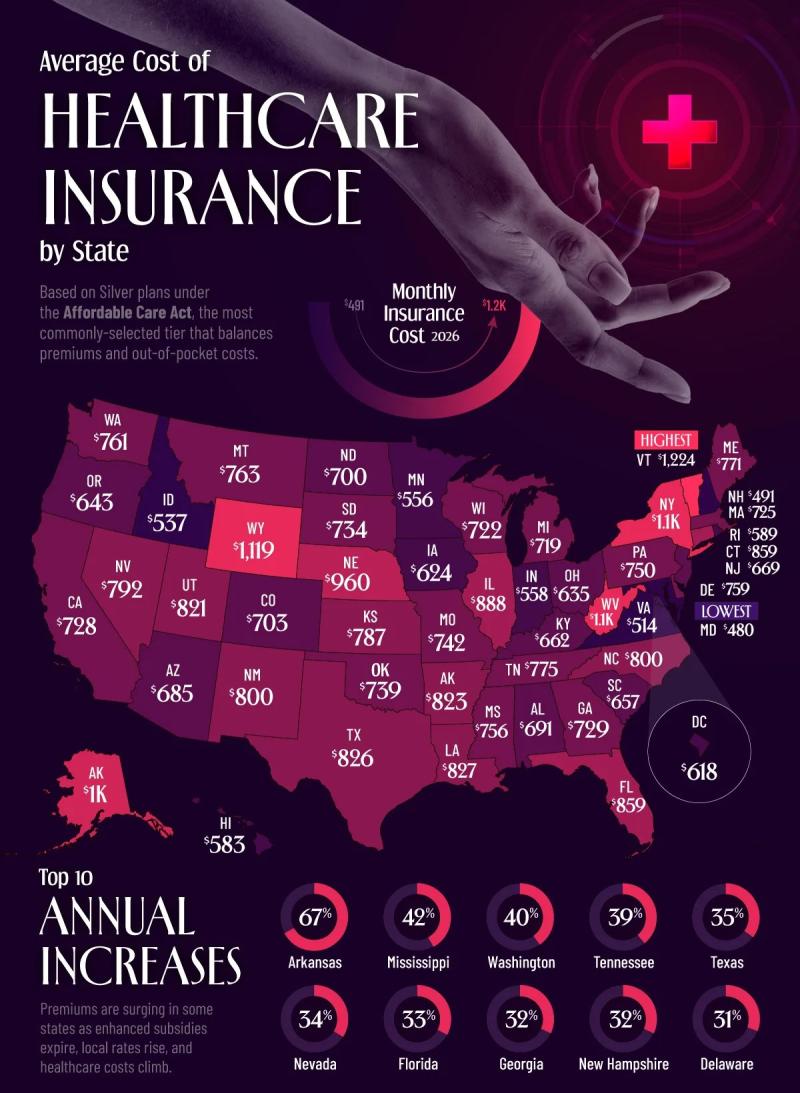
Credits: visualcapitalist.com
Market Overview
💡 North America health insurance market reached US$ 1621.35 billion in 2023 and is projected to reach US$ 2408.49 billion by 2031, growing with a CAGR of 5.2% from 2024 to 2031.
Health insurance costs across the United States increased sharply in 2026, highlighting growing affordability challenges for individuals purchasing coverage through the ACA marketplace.
The analysis focuses on average monthly premiums for Silver-tier plans, which are the most commonly selected due to their balance of cost and coverage.
The national average monthly premium rose to approximately USD 750, representing a substantial jump compared to the previous year.
This increase reflects a combination of policy changes, rising medical expenses, and insurer pricing adjustments.
➢ Get a Exclusive Sample PDF Of This Report (Get Higher Priority for Corporate Email ID):- https://www.datamintelligence.com/download-sample/north-america-health-insurance-market?rk
➢ Premium Disparities Across States
✦ Health insurance premiums vary widely by state, showing more than a twofold difference between the most and least expensive markets.
✦ States with smaller populations or limited insurer participation tend to experience higher premiums due to reduced competition.
✦ Geographic factors, healthcare infrastructure costs, and local regulations play a major role in shaping premium levels.
➢ States With the Highest Insurance Costs
✦ Vermont recorded the highest premiums nationwide, with average monthly costs exceeding USD 1,200.
✦ Other high-cost states include Wyoming, West Virginia, New York, and Alaska, all reporting premiums above USD 1,000 per month.
✦ These states often face challenges such as aging populations, higher per-capita healthcare spending, and fewer insurers, which push premiums upward.
✦ Rural healthcare delivery costs and limited provider networks further contribute to elevated pricing.
➢ Get Customization in the report as per your requirements: https://www.datamintelligence.com/customize/north-america-health-insurance-market?rk
➢ States With the Lowest Insurance Costs
✦ Maryland emerged as the most affordable state, with average premiums below USD 500 per month.
✦ New Hampshire, Virginia, Idaho, and Minnesota also reported relatively low premium levels.
✦ These states benefit from broader insurer participation, effective state-level policy frameworks, and more competitive insurance markets.
✦ Larger risk pools and proactive regulatory oversight help stabilize premium growth.
➢ Year-over-Year Premium Changes
✦ Several states experienced double-digit year-over-year premium increases, signaling heightened pressure on consumers.
✦ Arkansas recorded one of the steepest increases, reflecting rapid market adjustments and cost realignments.
✦ In contrast, Alaska stood out as a rare case where premiums declined slightly, supported by market stabilization measures.
✦ These variations underline how state-specific market dynamics influence annual pricing outcomes.
➢ Regional Trends
✦ Premiums are generally higher in the Northeast and Mountain West, where healthcare delivery and labor costs are elevated.
✦ Mid-Atlantic states demonstrate comparatively better affordability due to strong competition and balanced risk pools.
✦ Southern and Midwestern states show mixed outcomes, with some experiencing rapid premium growth due to insurer exits or rising claims.
➢ Key Drivers Behind Rising Premiums
✦ The expiration of enhanced premium subsidies significantly impacted affordability, particularly for middle-income households.
✦ Rising hospital charges, prescription drug prices, and healthcare workforce costs added to insurer expense burdens.
✦ Insurers adjusted premiums to account for higher utilization rates and uncertainty in enrollment trends.
✦ Inflationary pressures across the broader economy also contributed to increased healthcare operating costs.
➢ Buy Now & Unlock 360° Market Intelligence: https://www.datamintelligence.com/buy-now-page?report=north-america-health-insurance-market?rk
➢ Impact on Consumers
✦ Higher premiums increase the financial burden on uninsured and self-employed individuals who rely on marketplace plans.
✦ Some consumers may downgrade coverage, increase deductibles, or delay care due to cost concerns.
✦ Premium volatility may also affect enrollment stability, especially in states with limited affordability protections.
➢ Policy & Market Implications
✦ The 2026 premium landscape highlights the importance of policy continuity and subsidy support in maintaining coverage affordability.
✦ States with competitive insurer environments demonstrate better resilience against sharp price increases.
✦ Policymakers and insurers may need to focus on cost containment, preventive care, and market stabilization strategies.
➢ Key Takeaways
✦ Health insurance premiums in 2026 rose significantly across the U.S., with wide disparities between states.
✦ Smaller, less competitive markets face the highest costs, while states with strong insurer participation remain more affordable.
✦ The data underscores the growing need for sustainable healthcare policies and competitive insurance ecosystems to manage long-term premium growth.
➠ Overall, the 2026 health insurance cost landscape highlights the importance of stable policy support and competitive insurance markets. States with strong insurer participation and proactive regulatory oversight have been more successful in controlling premium growth. The data emphasizes the need for long-term strategies focused on cost containment, preventive care, and market resilience to improve affordability going forward.
Contact Us –
Company Name: DataM Intelligence
Contact Person: Sai Kiran
Email: Sai.k@datamintelligence.com
Phone: +1 877 441 4866
Website: https://www.datamintelligence.com
About Us –
DataM Intelligence is a Market Research and Consulting firm that provides end-to-end business solutions to organizations from Research to Consulting. We, at DataM Intelligence, leverage our top trademark trends, insights and developments to emancipate swift and astute solutions to clients like you. We encompass a multitude of syndicate reports and customized reports with a robust methodology.
Our research database features countless statistics and in-depth analyses across a wide range of 6300+ reports in 40+ domains creating business solutions for more than 200+ companies across 50+ countries; catering to the key business research needs that influence the growth trajectory of our vast clientele.
This release was published on openPR.