
Outside of the rock club, the green room, the recording studio, stripped of the telecaster, the drum kit, the microphone, torn from record sleeves and music videos and magazine profiles—how do you spot a musician? Their clothes? Leather jacket, slick sunglasses, tall boots, mohawk or shaggy mod cut? It’s 2026; we should be so lucky. Aside from a sliver of a guitar case and an empty sheet-music stand, there is nothing in “Portraits of People Who Make Music,” photographer and designer Alexa Viscius’ solo show at Epiphany Center for the Arts, that reveals the truth of the show’s title. Untitled, this could just as easily be a collection of photos of friends, taken with more sensitivity and a more expensive camera than you might be used to a friend having. If, however, you happen to have paid any attention to independent music over the last ten years (especially in Chicago), the show will look much more like the front page of Pitchfork or the “recommended artists” section on your streaming platform of choice.

And some of these photos have, if memory serves me, appeared in just those places: press releases, streaming profiles, the occasional album cover. Viscius, who lives in Chicago and shoots portraits both in the field and out of her Wicker Park studio, has trained her lens on a significant sliver of contemporary alternative music’s best-known and best-loved characters, and, in doing so, had a heavy hand in what alternative music looks like today. “People Who Make Music” offers just a smattering of the full roster, but a weighty one: Chicago-via-Madison indie rockers Slow Pulp; the lead duo of Chicago royalty Whitney; local wunderkinds Horsegirl; the songwriter of the moment, Cameron Winter; plus a handful of other acts, local and not, totaling ten.
Viscius’ photos, however, test the limits of all this context. Many of the photos are placeless, unadorned by details that might reveal an indie rocker’s home in the local scene or proximity to the spotlight; more strikingly, the photos are almost all silent. A concert photo, in which a musician’s musicianship is self-evident, can be deafening. At the very least, it begs for a bit of auditory imagination from the viewer, an almost synesthetic summoning of kick drums and straining vocals. Viscius gives us no such clues. We are confronted with faces and bodies and asked to take these people who make music as people who don’t always make music.

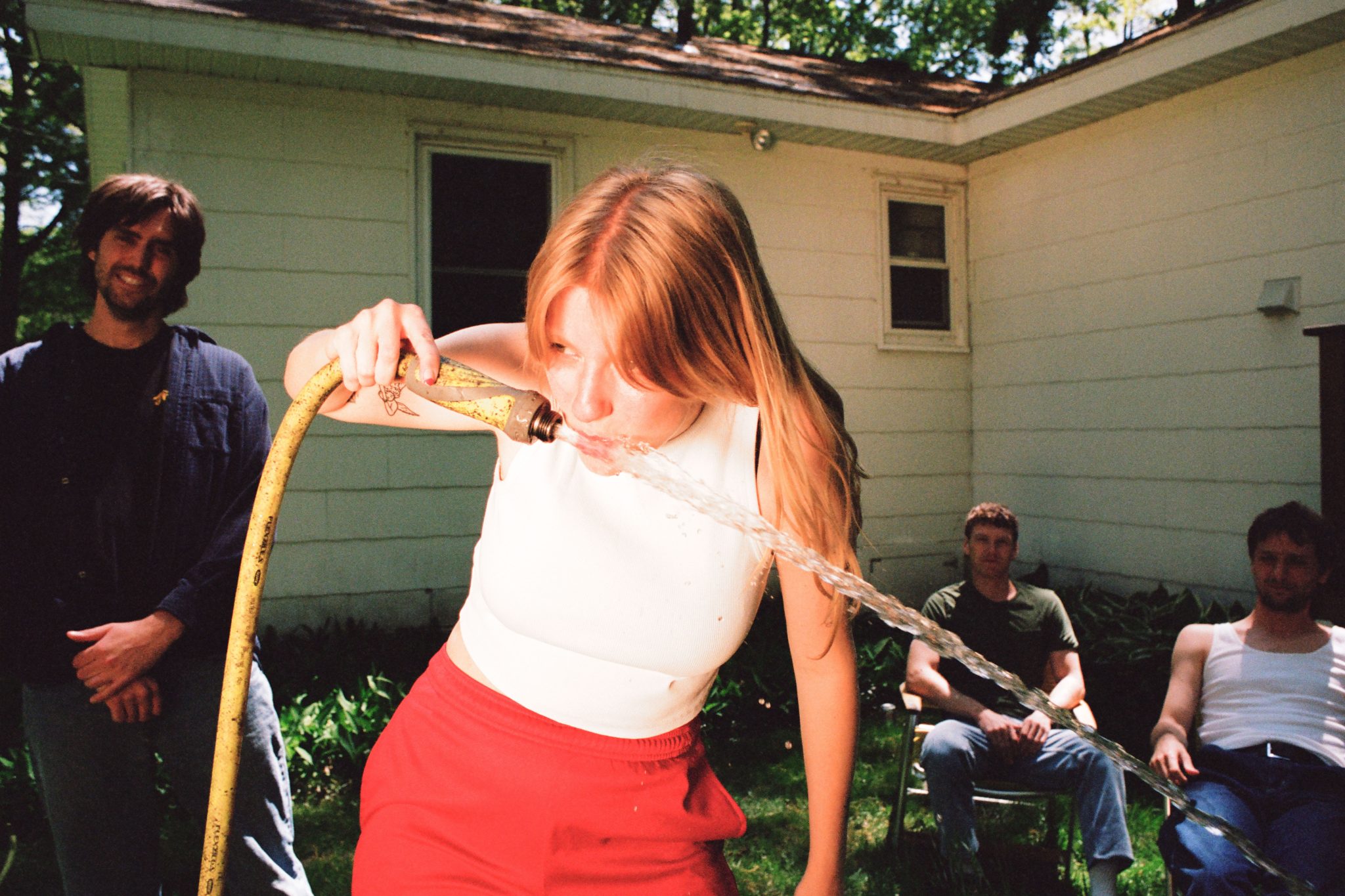
In the cleverly composed shot of Slow Pulp, Viscius toys with her opposition to the concert photo. Singer-guitarist Emily Massey is flanked by her bandmates as she sips from a garden hose in some nondescript backyard; this isn’t a photo from a gig, but we see the band members inhabiting their respective positions on stage, Massey leaning toward the hose like a microphone as, by chance or not, the light shines a touch brighter on her. In the show’s other band portrait, Horsegirl is frozen mid-skip on a grassy hill, a shot that distills the delight of making music with your best friends, but may betray the band’s sharpened art-rock bona fides. The show’s feature image, of singer-songwriter and Geese frontman Cameron Winter, swings from the collective identity of a band portrait to the isolation of the solo performer. In a shadowy room beneath Rockefeller Chapel, moments before taking the stage on one of two sold-out nights, Winter stares past the lens, pensive or vacant or brooding. Viscius’ photos are characterized by their intimacy; she has access to the unguarded moments in the artist’s life and her project is to communicate that closeness. The portrait of Winter is certainly defined by this access, but the subject remains opaque. A sterile overhead light is all the light available in this image, and it can illuminate only what Winter himself offers. The lens, Viscius tells us, is even more focalized than the spotlight—it can be just as blinding, and just as revealing.
“Alexa Viscius: Portraits of People Who Make Music” is on view at Epiphany Center for the Arts, 201 South Ashland, through April 25.