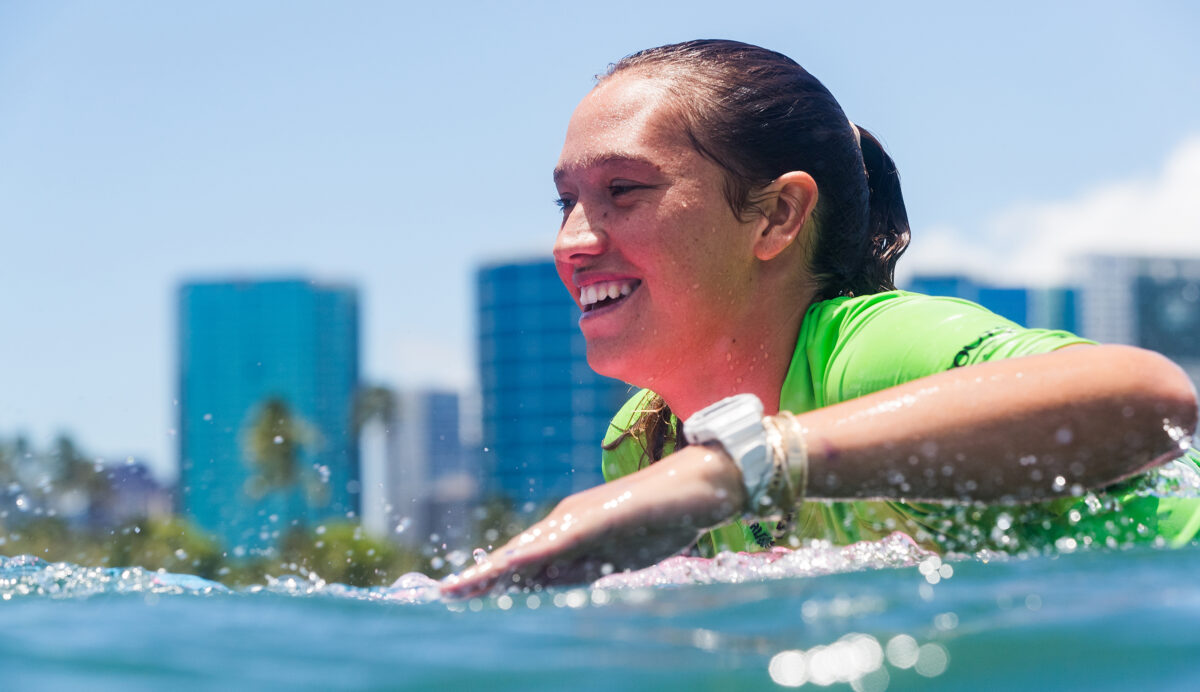
Could you get a better ambassador for Hawaiian culture? Photo: WSL

Hawaii is undeniably the epicenter of surfing. Home to the famous Seven Mile Miracle, Oahu hosts countless contests each year, with some of the world’s best surfers coming from the islands. Although nearly 10 million people visit Hawaii annually, few are familiar with the rich culture and history of the Hawaiian people.
Hawaiian is a Polynesian language that originated from Marquesan and Tahitian settlers between 300 and 800 CE. In the 1820s, Calvinist missionaries created a 13-letter written form of the language alongside the Hawaiians to translate the Bible. In 1893, following the overthrow of the Hawaiian Kingdom, the language was banned, and English became the primary language. Nearly a century later, in 1978, Hawaiian was once again recognized as the official state language.
A key player in the re-legalization of the Hawaiian language was Adelaide “Frenchy” DeSoto. A respected and celebrated community leader and activist who passed away in 2011, she gave her passion for preserving the Hawaiian language and culture to her children and grandchildren. To celebrate and honor the language, we caught up with Frenchy’s great-granddaughter and pro surfer, Puamakamae (Pua) DeSoto. Here, the native Hawaiian shares what it was like to grow up on Oahu, her work to preserve and share her culture, and steps visitors can take to respect her home.
What was it like growing up on Oahu?
Oahu is very special. You get both the touristy parts and culturally active places. Even in places like Waikiki, there’s so much history and culture. There are a lot of buildings and people, but there’s also the Iolani Palace, which is where our queens and kings lived and did amazing things to lead our people. I was so blessed to be raised in Kaimuki, and I learned how to surf in Waikiki. When I was 12, I moved out to Makaha, which is a little bit more country – there are less people and buildings. It’s so special, and I love just being with my family and being around the ocean.
Did your parents do a lot to teach you about your heritage and culture?
My parents were two of the biggest people who have taught me about my culture and my heritage. My mother’s side were fishermen and fisherwomen and my dad’s side were surfers. So, there was a huge emphasis on being in the ocean and doing our cultural practices in the ocean as our kapuna did.
My mom got two degrees in Hawaiian language and became a professor of Hawaiian language and Hawaiian culture. She is the one who taught me Hawaiian and she is the person who continued to guide our family through the culture and history. My dad’s grandmother re-legalized Hawaiian language after it was illegal, so she has a very important role in his life and later in mine. He always emphasized teaching us what my grandma fought for and how we have a privilege but also a responsibility today to continue her legacy and celebrate that legacy.
Did you attend a Hawaiian immersion school?
Yes, I started attending Hawaiian immersion school when I was three years old, and I wouldn’t change it for the world. It’s such a privilege and an honor to know my language and to have it as my first language. Being put in that at such a young age helped me see the world through the lens of speaking Hawaiian instead of seeing the world and thinking English. I don’t look at something and think that’s food, I look at it and think that’s mea’ai. I’m able to really connect it to the Hawaiian words, the Hawaiian history.
Why is it important for you to work to keep the Hawaiian language alive?
Language is everything to a culture. Language is how you tell your stories. It’s so important to have our language because we have the privilege of understanding our history and the stories our kapuna experienced or wrote through language. The way that I keep it alive is by speaking it and by honoring it.
In every interview, I introduce myself in the Hawaiian language. In every post-heat interview, I do the whole interview in Hawaiian and sometimes translate it a little bit. It’s such a privilege to know it and know that my grandma and so many other activists fought for us to have it back. I’m definitely very proud of it and continue to speak it, fight for it, and be an example that I want to see in more native Hawaiians.
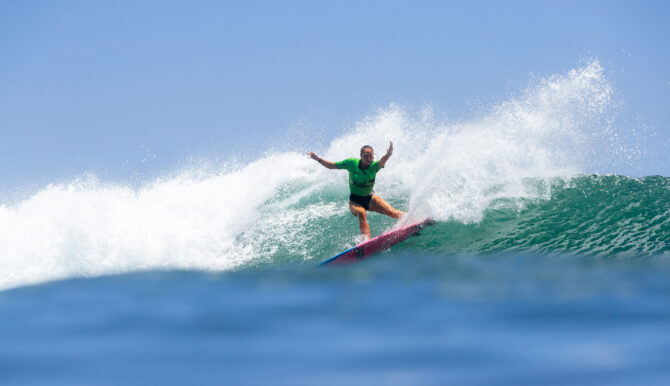
Pua, “wave sliding” during a Qualifying Series event this year at Ala Moana. Photo: WSL
What are some ways you personally work to keep Hawaiian culture alive?
My great-grandma was a huge pillar in revitalizing the Hawaiian language and culture and bringing back traditions like hula. And so, I have a responsibility today to continue and carry that. I do it by talking about our culture and our history. So many people don’t know the true history of Hawaii, so even just by talking and expressing, I can see people excited to learn about it.
As a surfer, I have a lot of friends who come to Hawaii to visit and surf Pipeline and all the North Shore waves. I make it very important that I educate them on the culture. And honestly, many of them ask, and I really enjoy the privilege to share with people outside of Hawaii the history of surfing, Hawaiian culture, the language, the illegal overthrow, and all that. It’s important to me because I’m a native Hawaiian and I want the world to understand the history.
What are some things that people who call Hawaii home can do to help preserve the culture?
Learn the language, even people who call Hawaii home and may not be native Hawaiians. We all have a place in Hawaii to preserve our culture, to continue to speak Hawaiian, and be proud of it. So many people who are not Hawaiian represent our culture in an amazing way. It’s important for us to continue to show up, speak our language, and be the example and the aloha and ha’aha’a that we want to see in the world.
How important is surfing for Hawaiians?
Surfing is a native Hawaiian cultural practice that has been practiced for thousands of years. We have so many stories of our ali’i and how surfing was their enjoyment and step away from life. Some people even used surfing to win over districts of land. Surfing is so important to Hawaii, and it’s a way that we Hawaiians are able to express ourselves. I think it’s so important to continue that.
Do you like when non-natives try to speak the language or call places by their Hawaiian names, or do you find that disrespectful?
Absolutely not. Everywhere should be called by its Hawaiian name, and every place should be known for its historical name. There are so many waves in Hawaii that the name today is actually not the name before. For example, the wave at Sunset Beach is called Paumalu. I think we need to celebrate and honor the historical names.
I know so many non-native Hawaiians who speak our language fluently and strive to perpetuate our language even if it’s not their cultural language or ethnicity. I think it’s so special for them to honor and celebrate our culture and our language. I think it’s respectful to learn someone’s language.
What are some steps visitors can take to be respectful and learn more about the place they are visiting?
No matter where you visit, you should do your research and educate yourself on the oppression of the native people. Tourists who visit Hawaii have an obligation to respect the land and the people. Some people have the best experiences in Hawaii, and some say everyone is so mean. I think the energy that you come to Hawaii in is the energy that you’ll get back from the aina and the people. If you come with respect, aloha, and care, and if you’ve educated yourself, I’ve noticed people come with a different sense of humility than when they don’t know the history and just want a vacation in paradise. Visitors should honor native Hawaiians but also give back: Find the boutiques, the small businesses, and support local.
What are some Hawaiian words you’d like to share?
One of my favorite words is aloha. Aloha means so many things. Alo is the face and ha is the breath. In Hawaiian culture, it’s called a hani – it’s a kiss where we touch each other’s nose and we exchange our breath. So, aloha is actually much deeper than love and kindness: It’s respect, it’s a connection, and it’s a reciprocal relationship of giving your breath and your mana, but you’re also receiving that from the other person.
Another word is he’e nalu and that is surfing. He’e is to ride or to slide and nalu is wave, so it’s wave sliding. In our culture and back in the day, we had wooden surfboards, and that’s how we would wave slide. If you look at photos, it literally looks like they’re wave sliding. Today, you have airs and barrels and so many other things, but back then, it was wave sliding.
Another word I love is po’i. Po’i is the breaking of the wave. I think that part of it is so special because they’re not all the same – every wave is unique, every wave breaks in its own way. It’s just like people and how we are and who we are.
And then we have kuleana. Kuleana is one of my favorite words. In Hawaiian, kuleana means responsibility. The way I was taught it from my mom, dad, and grandparents, kuleana is a privilege. You’re privileged to have responsibility: to have a family to look after and to have the culture to carry and teach.