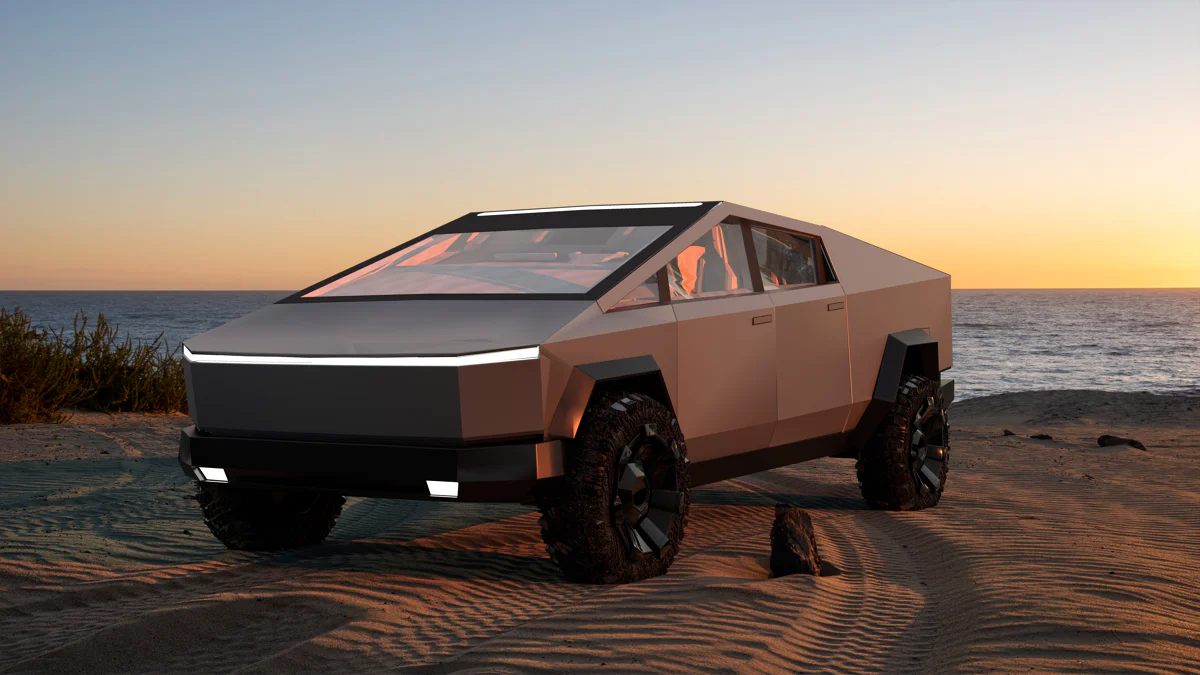
Tesla will stop building the Cybertruck, its unsuccessful electric pickup behemoth, at its factory in Austin, Texas, starting in the middle of next year. Tesla CEO Elon Musk announced the move in a post on his social media platform X. Tesla plans to use the factory’s freed-up capacity to build more two-seat Cybercab robotaxis.
Flop
The decision to stop production of the stainless-steel electric vehicle in Texas comes just three years after the first model went on sale. Musk had much higher hopes for the vehicle: in 2023, the Tesla chief predicted the automaker would build around 250,000 Cybertrucks a year starting in 2025. Instead of a runaway success with record sales, Tesla has sold only tens of thousands over the past three years.
Tesla doesn’t release specific Cybertruck sales figures. Instead, the company groups it with the Model S, Model X, and Semi under “Other Models.” But the figures speak for themselves: Tesla delivered just 8,295 “other models” in the third quarter of 2026, according to the data. Since production of the Model S and Model X has been suspended since April, U.S. outlet Electrek estimates that 7,000 to 8,000 of those vehicles could be Cybertrucks. That would amount to roughly 30,000 Cybertrucks a year — far below the current production capacity of more than 125,000 vehicles.
Estimates from Cox Automotive for the U.S. market are even worse: The research firm puts Cybertruck sales at 3,519 in the first quarter of 2026 and 3,744 in the second quarter, down from 14,416 in the third quarter of 2024. Cox says another 4,323 Cybertrucks were sold in the third quarter of 2026. The firm estimates total sales of just 70,000 units since 2023.
“Only logical”
The Austin factory is considered the only production site that builds the Cybertruck and has the equipment needed to make the vehicles. Musk hasn’t said whether Cybertruck production will move to another location. But doing so would be a major undertaking, especially for a vehicle that has never sold well.
More about the Cybertruck
Given the weak sales, ending production is the logical move, said Andy Palmer, the former head of sports car maker Aston Martin, to Reuters. “It doesn’t make sense to keep it going when it’s not meeting its targets,” he said. “It will no doubt only be a rounding error on Tesla’s balance sheet, but the statistics speak for themselves.”
Built for the U.S.
Another problem for the Cybertruck was that its design meant it could be sold in only a few markets. It wasn’t designed for the European market, Elon Musk said in 2024. He said at the time that the Cybertruck had been adapted to North American requirements. Meeting international requirements would have brought additional restrictions — “and that would have made the product worse, to be honest”.
The Cybertruck cannot receive standard approval for Germany in its U.S. configuration because it doesn’t have EU type approval under Regulation (EU) 2018/858. Potential sticking points include its rigid, angular stainless steel body under UN Regulation No. 26 on external projections, as well as pedestrian protection requirements under UN Regulation No. 127 and Regulation (EU) 2019/2144. The Cybertruck also lacks the speed limiter required for vehicles weighing more than 3.5 metric tons.
Meanwhile, a Swiss company is trying to make the Cybertruck suitable for Europe. It plans to modify the vehicle so it can be approved in Switzerland and market the Cybertruck as an independent importer starting in 2027. It’s unclear whether the plans will go ahead after the announced end of production.
More about Tesla
(afl)