Christopher Nolan’s The Odyssey is one of the biggest movie releases of the year and scammers wasted no time taking advantage of it. Within hours of the film’s release, we found scams targeting people looking for pirated copies. Some used fake browser warnings on piracy sites, while others disguised malware as movie downloads.
Some used fake browser error messages designed to funnel people through malvertising networks. Others offered what appeared to be movie downloads that were actually Windows executables disguised as video files.
Neither scam has anything to do with the movie itself. They’re simply taking advantage of people searching for a popular new release.
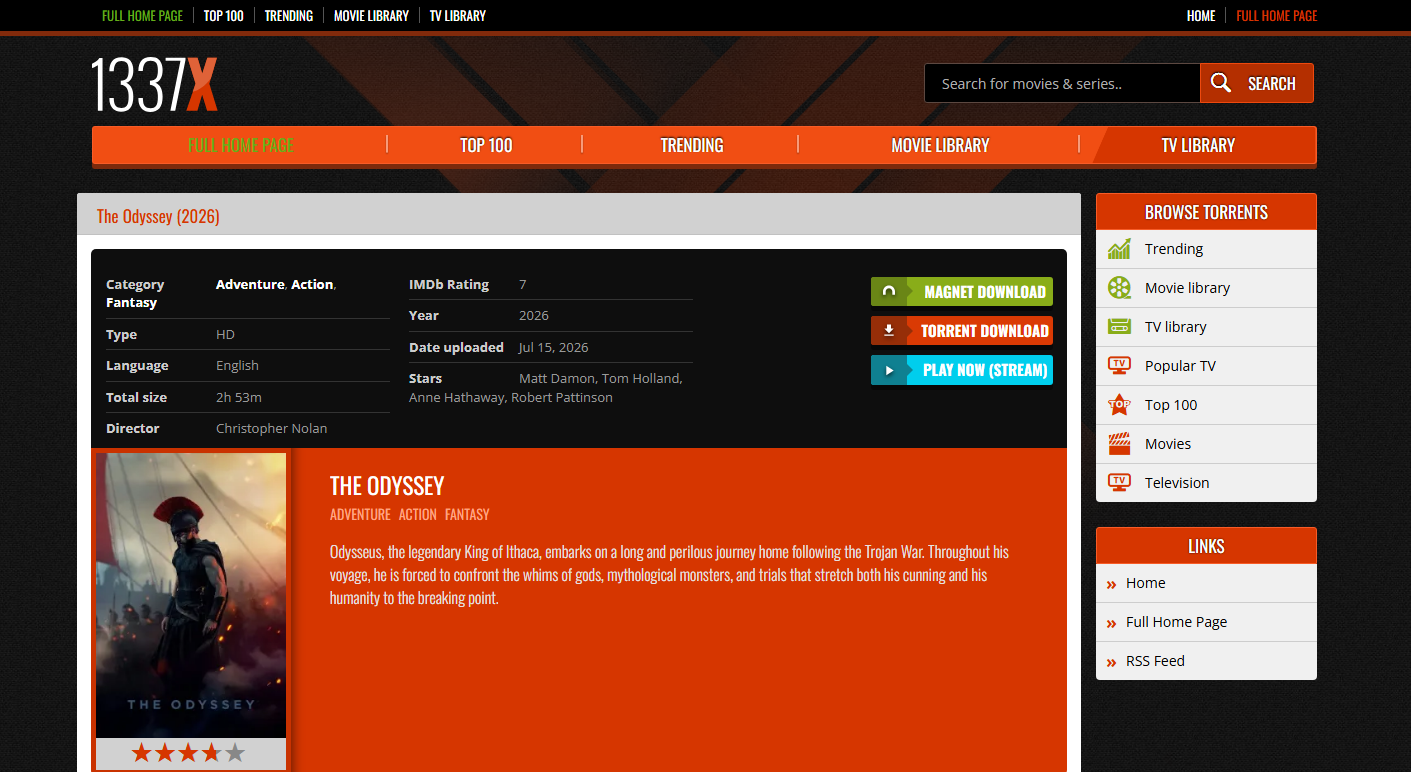
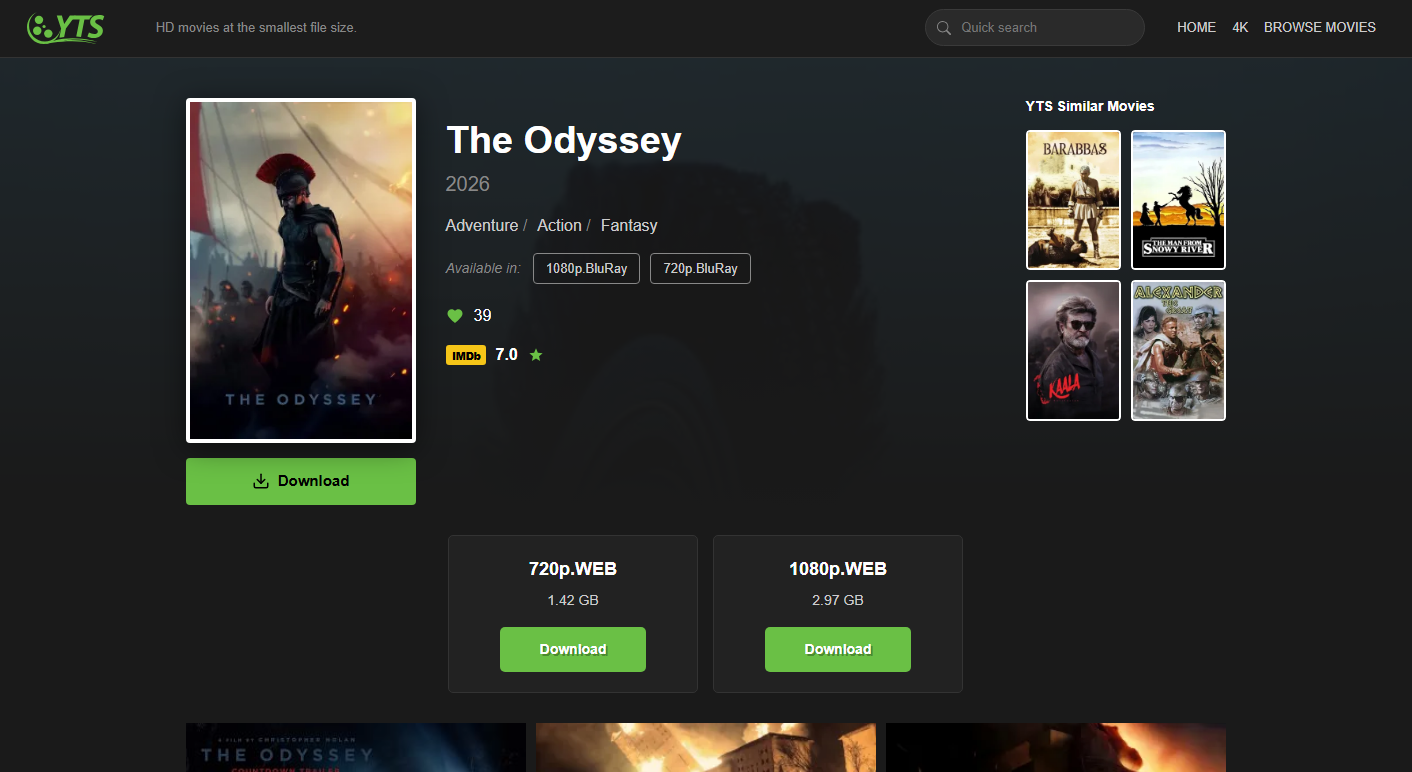
The Odyssey piracy scams we found
We observed two main tactics.
One used fake pop-ups claiming your browser was missing a required “component.” Clicking Fix It Now didn’t solve any problem. It simply routed visitors into a malvertising network. Exactly where those redirects ended depended on whatever campaign the network was serving at the time.
The second involved a file advertised as The Odyssey 2026 1080p WEBRip-LAMA. Once downloaded, however, it turned out to be an .exe file. That’s a Windows application, not a video.
Movies don’t need to run as programs. If a supposed movie download ends in .exe, it isn’t a movie.
The fake “Browser Issue Detected” warning
On cloned piracy sites listing The Odyssey torrents, we encountered a fake browser pop-up claiming Browser Issue Detected. It warned that a “missing component” was preventing full access. It presented a prominent Fix It Now button, with a much smaller Close and Continue Browsing option underneath.
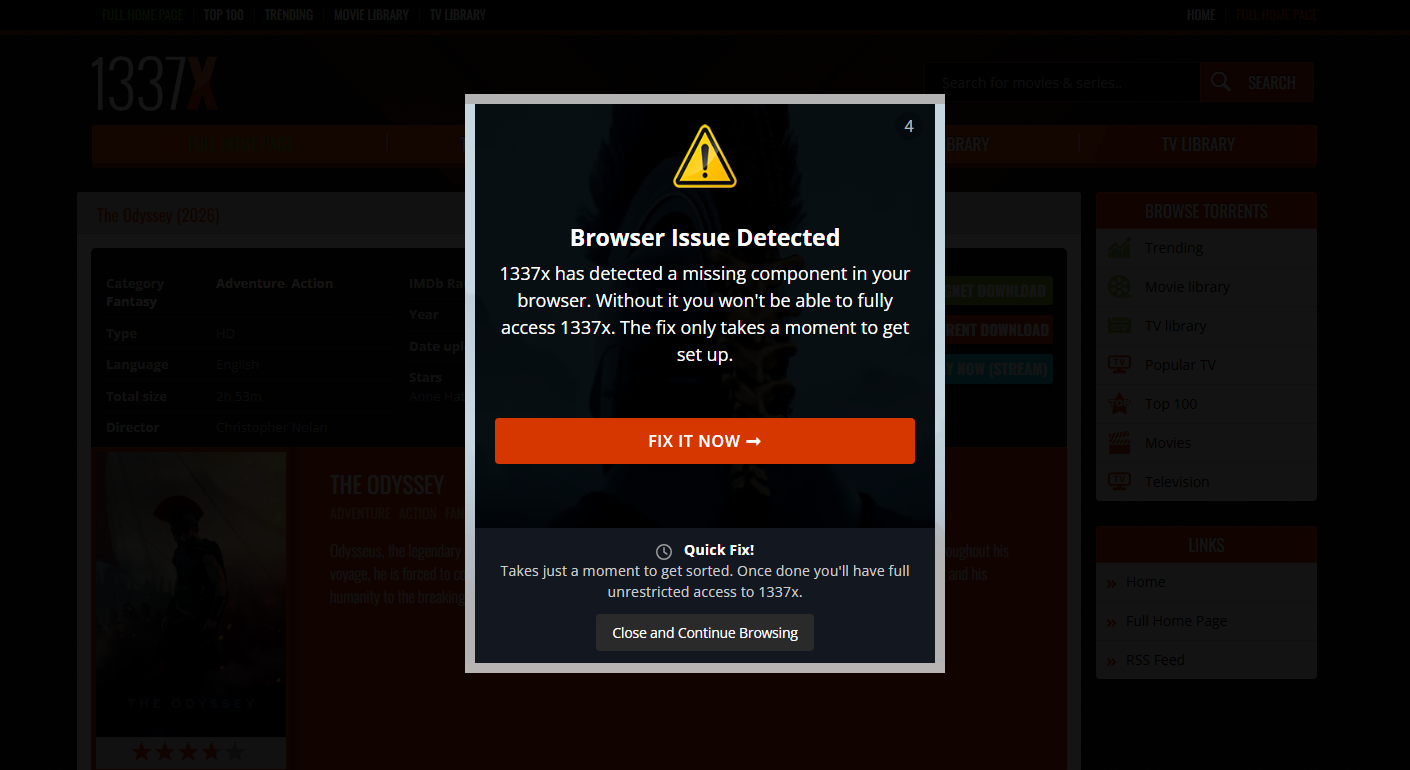
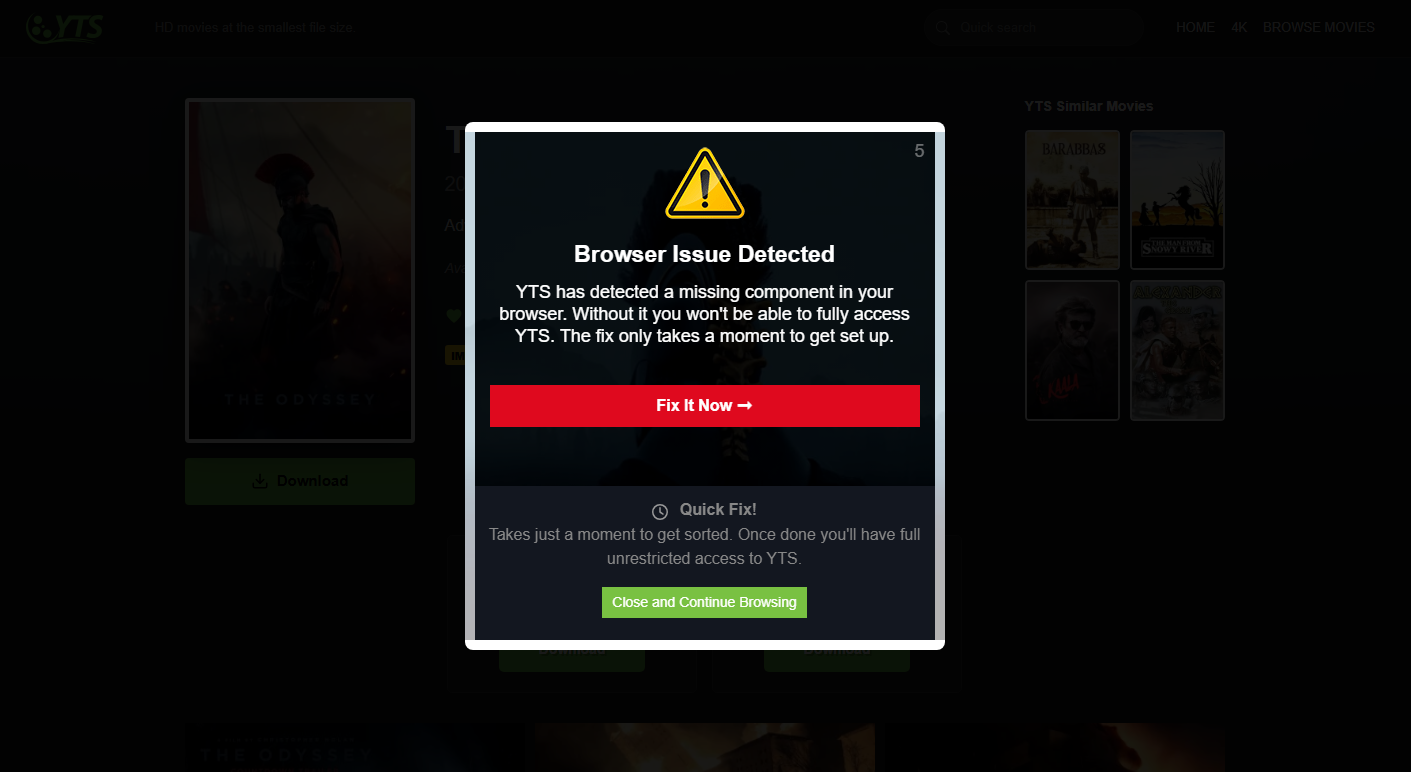
There was no missing browser component. The entire pop-up was part of the webpage itself, designed to look like a genuine browser warning.
What made this particularly interesting was how consistently it appeared. We found the same overlay—identical wording, identical layout, with only the branding colors changed—across multiple cloned torrent sites.
These were not the genuine torrent trackers, but convincing copies designed to impersonate well-known piracy sites that reproduced real listing layouts, artwork, and cast information for The Odyssey, then displayed the fake browser warning on top. Taken together, the cloned websites and identical pop-ups strongly suggest a coordinated campaign built to capture searches for a major new release, rather than legitimate torrent sites that had been compromised.
Clicking Fix It Now typically sends visitors through one or more advertising redirects. Depending on which campaign is active at that moment, users may eventually land on:
- A fake browser extension
- Scareware urging them to call a fake technical support number
- Another redirect attempting to deliver malware
The final destination can vary from one visit to the next because the underlying ad network changes what it serves over time.
A movie that was actually a program
The second scam targeted people who actually tried to download the movie. We also found a listing named The Odyssey 2026 1080p WEBRip-LAMA.exe, advertised as a 1080p WEBRip release with 597 seeders and 520 leechers.
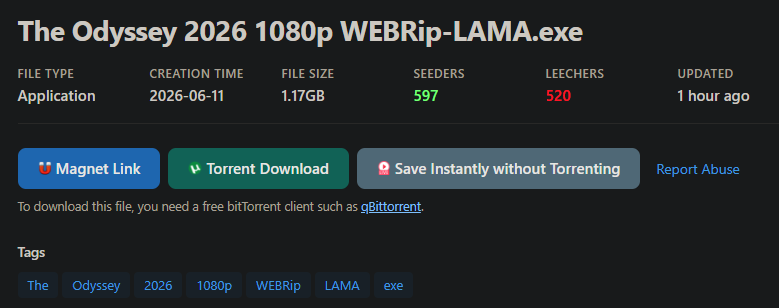
Windows immediately identified the download as an Application, confirming what the file extension had already revealed.
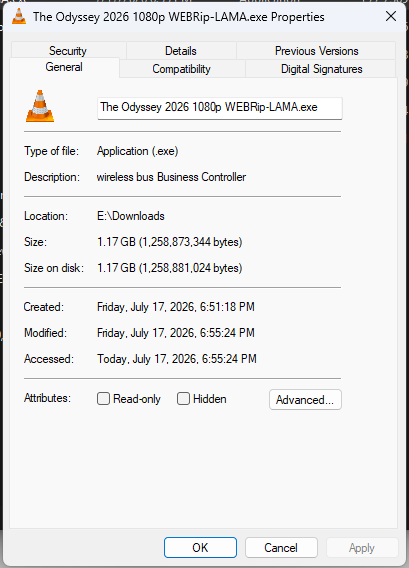
Legitimate movie downloads use video containers such as .mkv, .mp4, or .avi. These files are opened by a media player, they do not execute code.
Several other details stood out.
The file description read “wireless bus Business Controller,” which has nothing to do with video playback and was likely leftover metadata from whatever software was originally used to build the executable.
The file also displayed VLC Media Player’s familiar orange traffic cone icon, despite being an application rather than a video file. That’s a classic social engineering trick. VLC is one of the world’s most widely used media players, so many people instinctively associate its icon with a harmless video. In a downloads folder, the file looks like something you can safely double-click when, in reality, doing so executes an unknown program with your own user permissions.
Files packaged this way (with misleading extensions, spoofed icons, and inconsistent metadata) are a well-established malware delivery technique.

Picked up something you shouldn’t have?
What runs after the user launches the file depends on the campaign. It could be:
- A Trojan that opens a backdoor into the system
- An infostealer that steals saved passwords and browser sessions
- A loader that downloads additional malware
- In some cases, ransomware
It’s also worth remembering that large numbers of seeders don’t prove a file is safe. They only indicate that many people are sharing it, and plenty of people unknowingly distribute malicious files.
Why these scams work
Neither scam relied on exploiting a software vulnerability.
Instead, both relied on convincing someone to take the next step: clicking a fake browser warning or running what they believed was a movie.
That’s much harder for security software to prevent completely, because browsers can’t reliably distinguish between a genuine browser message and one rendered entirely in a webpage’s HTML. Likewise, antivirus software can’t flag every executable simply because it uses a misleading icon or contains unusual metadata, as many legitimate applications do too.
Security software still plays an important role. It can block known malicious websites, detect malware after it’s identified, and stop many malicious downloads or redirects before they complete.
But recognizing that a “movie” ending in .exe is never really a movie remains one of the simplest and most effective security checks users can make themselves.
What to do if you may have been affected
- If you clicked Fix It Now and something unexpected downloaded or opened afterward, run a full Malwarebytes scan.
- If you ran a supposed movie that turned out to be an
.exe, disconnect the computer from the network, perform a full malware scan, and avoid using the device for banking, email, or other sensitive accounts until you’re confident it’s clean. - Check your browser for extensions you don’t remember installing and remove anything unfamiliar.
- If you executed an unknown program, change passwords for important accounts from a separate, trusted device.
- Treat any pirated “movie” that isn’t a standard video format as suspicious. There is no legitimate reason for a movie download to be a Windows application.
Closing thoughts
Piracy-adjacent malvertising and fake-movie droppers persist because they don’t need to be sophisticated. They only need a title popular enough to guarantee search traffic. A $250 million IMAX epic with a year of ticket pre-sales behind it is about as close to guaranteed traffic as the piracy economy gets, which is why these scams surfaced within hours of release day rather than weeks later.
If you’re downloading a film and it asks you to install something, fix your browser, or run an .exe, you’re almost certainly not getting a movie. You’re downloading software that could infect your computer.
Stop threats before they can do any harm.
Malwarebytes Browser Guard blocks phishing pages and malicious sites automatically. Free, one click to install. Add it to your browser →