Trump attends supreme court birthright citizenship arguments, first sitting president to do so
We’re starting to get pictures from outside the US supreme court ahead of oral arguments in Trump v Barbara, which will decide if the administration’s attempts to restrict birthright citizenship are unconstitutional.
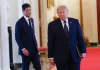
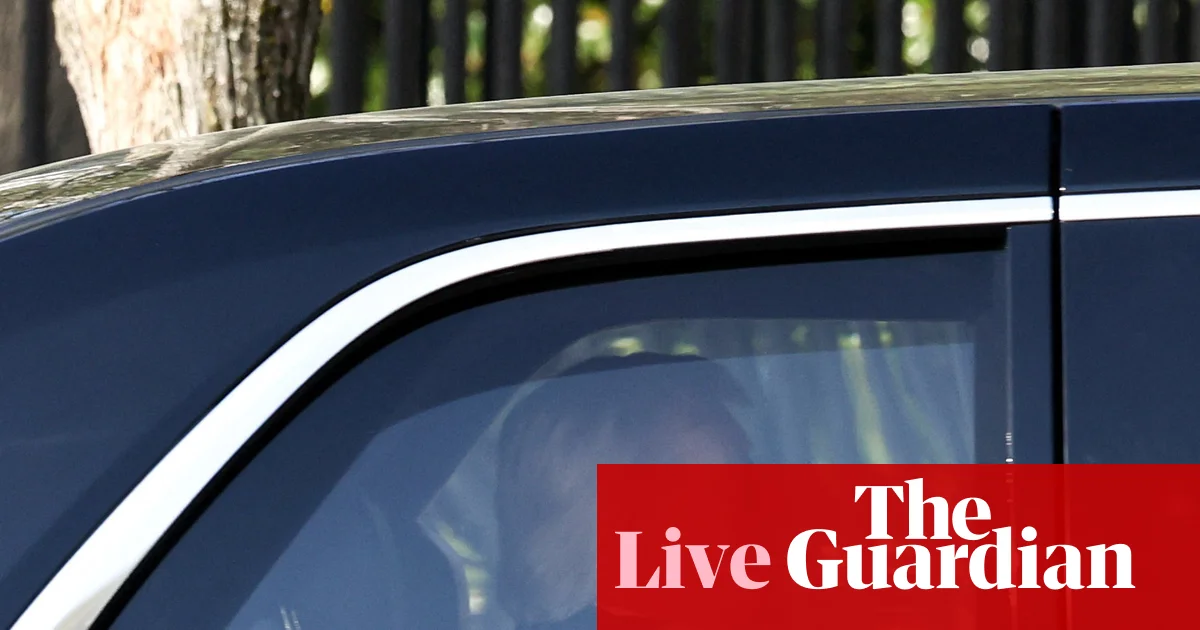
Donald Trump has just arrived, and plans to listen to arguments at the court – the first time a sitting president has attended arguments.


Key events
There are some so-called “exceptions” to the birthright citizenship rule for children born in the US. These are outlined in Wong Kim Ark.
-
Children born to foreign diplomats or ministers
-
Children born on foreign public ships in US waters
-
Children born to foreign enemies within the US during a hostile occupation
-
Children of members of the Indian tribes, who owe direct allegiance to their tribe
In a back and forth with justice Sonia Sotomayor, Wang returns to the government’s argument about “allegiance”, and how it pertains to the citizenship of children born in the US to foreign nationals.
“The government’s rule, which really is looking at whether someone has a divided allegiance because they’re a citizen of another country, would exclude the children of all foreign nationals,” Wang said.
“I would say that the relevance of allegiance is the relevance, under the English common law rule that’s embodied in the fourteenth amendment – all persons born in the territory the sovereign owe natural allegiance.”
Trump leaves court after administration arguments end
Reporters at the court note that Donald Trump left the supreme court after D John Sauer’s arguments and is now back at the White House.
Joseph Gedeon
Bishop William Barber, the social activist and first speaker to take the stage at Wednesday’s rally outside the supreme court, framed the birthright citizenship case in explicitly spiritual terms, calling Trump’s executive order an “unholy attack on babies and children” that cuts across the teachings of many faiths.
“This is 158 years of settled law,” he told the Guardian, warning that overturning it would strip millions of children of healthcare, protection from deportation, and the basic promise of justice. “There will be nothing supreme about ending birthright citizenship.”
He also refused to accept the label of conservative for the court’s majority. “I don’t call them conservative, they’re extremists,” he said.
Barber warned that a ruling against birthright citizenship would have only one logical conclusion: “We have to go on top of that building and erase equal protection under the law.”
Justices move to question legal chief for challengers
The justices have finished questions for the solicitor general. We’re now hearing from the lawyer representing the challengers – Cecillia Wang, national legal director of the ACLU.
“This Court held that the fourteenth amendment embodies the English common law rule – virtually everyone born on US soil is subject to its jurisdiction and is a citizen,” Wang said in her opening argument, while adding that the majority opinion in Wong Kim Ark said that domicile is “irrelevant” under common law.
“The fourteenth amendment’s fixed bright line rule has contributed to the growth and thriving of our nation,” Wang added. “It comes from text and history. It is workable and it prevents manipulation. The executive order fails on all those counts, swaths of American laws would be rendered senseless.”
Throughout today’s arguments, justices have pushed back against the administration’s position about a parent’s “allegiance” to the United States. The fourteenth amendment doesn’t mention whether a parent’s so-called “allegiance” should be a determining factor for their child to be considered an American citizen.
Sauer explains that allegiance “is not a question of subjective loyalty” but rather a “reciprocal relationship” between a person and the US. “If you’re talking about an alien, if they’re just temporarily passing through. No, they don’t have allegiance,” the solicitor general said.
Joseph Gedeon
Robin Galeraith, who travelled from Maryland to join Tuesday’s demonstration outside the supreme court, was heartened by the size of the crowd gathered to defend birthright citizenship but cautious about what the day’s ruling might bring.
“It’s very nice to see so many people defending the constitution and defending what makes our country great – we are an immigrant nation, and that is why we thrive for so long,” she said.
She dismissed Trump’s appearance at the court as the behavior of someone acting out of fear rather than strength.
Robin stopped short of full confidence in the outcome, voicing concern that the court’s conservative majority had been unduly shaped by wealthy interests. It’s a worry, she said, that cuts to the heart of what kind of nation America is meant to be.
“Unfortunately, our supreme court has kind of been bought and paid for by the super rich,” She said. “And so that’s really concerning, because our nation is not supposed to be a nation of just only rich.”
If you’re listening along to the oral arguments at the supreme court today, you’ll have heard a particular case mentioned frequently – US v Wong Kim Ark.
This is the landmark decision on birthright citizenship, which made clear that a child born to parents of Chinese descent who had permanent “domicile” in the US would be a US citizen at the time of birth under the fourteenth amendment.
The Trump administration is arguing that “domicile”, meaning a permanent residence, is a critical part of the interpretation, despite the word not appearing in the citizenship clause itself.
Justice Elena Kagan said that the rationale of the Wong Kim Ark decision was clear.
“Everybody got citizenship by birth, except for a few discrete categories,” she said. “What the fourteenth amendment did was accept that tradition and not attempt to place any limitations on it. And so that was the clear rationale, a clear rationale that is diametrically different from [the administration’s] rationale.”
Kagan ultimately said that the administration’s “revisionist theory” requires the court to change what “people have thought the rule was for more than a century”.
Trump lawyer concedes ‘no one knows’ if claimed birth tourism is significant problem
When it comes to the matter of birth tourism, which Sauer argues is a key side-effect of unrestricted birthright citizenship, the solicitor general contends that “no one knows for sure” how significant a problem it is. He cites a number of media reports about estimates, and a report by congressional Republicans in 2022 which says that changes to state department policies over the last decade have made birth tourism more accessible.
Protesters rally outside the court
Joseph Gedeon
Outside the supreme court, Carol Rose, executive director of the ACLU of Massachusetts, joined a loud and excitable crowd Wednesday as the case against Trump’s executive order targeting birthright citizenship – filed by the ACLU chapters of Massachusetts, Maine, and New Hampshire alongside the national ACLU – is argued before justices.
The impact of the case even drove Trump to hear today’s arguments at the court –a first for a sitting president.
“Trump wants to make the story be about him, but that’s not what the story is today – the story today is about the constitution and the Bill of Rights,” Rose said.
She added that besides Trump’s in-person appearance at the court, the mood among demonstrators was one of joy and optimism.
Rose said when thinking of the core identity of the US, a nation built by immigrants, there was little doubt about how she expects the day to end.
Kagan and Gorsuch question Trump lawyer’s argument on what constitutes being ‘domiciled’
One key point here, the administration is arguing that since noncitizens who are in the country temporarily aren’t “domiciled” they aren’t pledging “allegiance” to the US, and that subsequently invalidates their children’s claims to citizenship.
However, justice Elena Kagan questioned the solicitor general and asked where this principle comes from, since the language of “domicile” isn’t part of the citizenship clause.
“The text of the clause, I think, does not support you,” Kagan told Sauer. “I think you’re sort of looking for some more technical, esoteric meaning.”
Conservative justice Neil Gorsuch chimed in, following up on Kagan’s line of questioning, and probed Sauer about what qualifies as domicile in 2026, as opposed to 1868, when the fourteenth amendment was ratified.
Sauer pushed back and said that domicile is a “high level concept has been pretty consistent over centuries – which is lawful presence with the intent to remain permanently”.
Oral arguments begin in case challenging Trump’s attempts to restrict birthright citizenship
Oral arguments have begun, and solicitor general D John Sauer is arguing on behalf of the Trump administration. In his opening argument, Sauer notes that the citizenship clause – which the challengers say Trump’s executive order violates –“does not extend citizenship to the children of temporary visa holders or illegal aliens”.
He adds that unsrestricted birthright citizenship “demeans the priceless and profound gift of American citizenship”, and suggests that it operates as “a powerful pull factor for illegal immigration and rewards illegal aliens who not only violate the immigration laws, but also jump in front of those who follow the rules”.
Sauer also argues that the established precedent of birthright citizenship has “spawned a sprawling industry of birth tourism” and created “a whole generation of American citizens abroad with no meaningful ties” to the US.