By
·
July 21, 2026
Family bands have a checkered history. On one side, you’ve got the Carter Family, The Shaggs, and The Partridge Family. (OK, they weren’t real, but they were based on a real family band, The Cowsills.) You’ve also got Bee Gees, Beach Boys, Danielson Famile, Old Skull, and even Father Yod.
But then there’s Big Blood.
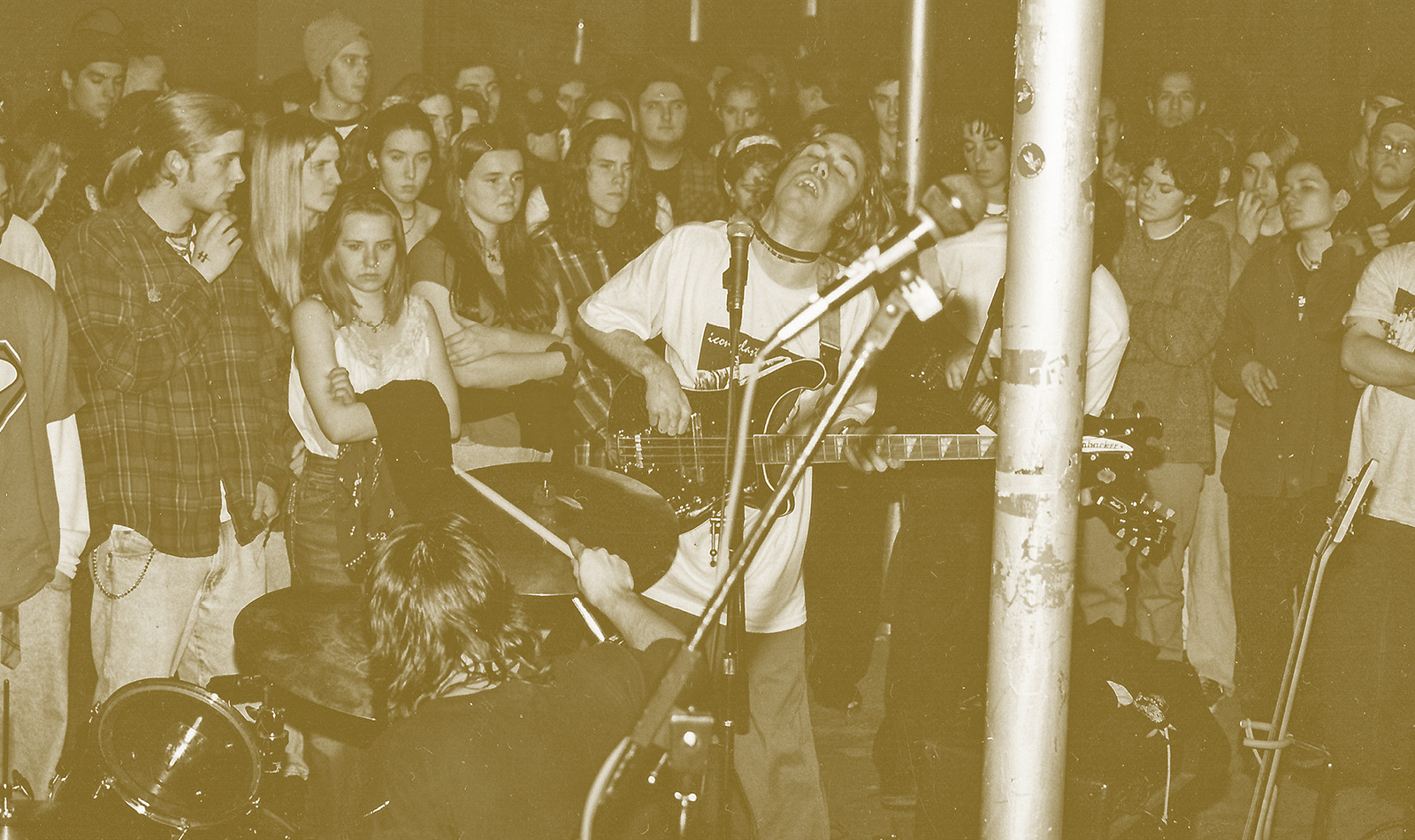
Based in Portland, Maine, Big Blood is the partnership of veteran musicians and lifelong DIY devotees Colleen Kinsella and Caleb Mulkerin. Over a decade into their creative entanglement, they welcomed a third member into their family. These folks have been pursuing their vision of homegrown art for so long that it is fused into their bones and courses through their veins. The story of Big Blood begins over 30 years ago, when emo and post-hardcore were thriving, and a band called Cerberus Shoal distinguished themselves from the pack with a unique sound.
Cerberus Shoal
…And Farewell To Hightide
Formed in Boston in 1994, Cerberus Shoal took their name from a poetry book authored 100 years earlier by students at Brown University. While the band would go on to feature 14 different members over the course of their existence, original members Caleb Mulkerin, Chriss Sutherland, and Tom Rogers remained constant. On the band’s 1995 debut, they were already pushing emo’s rapidly codifying forms outward; “Daddy As Seen From Bar Harbor” is essentially a love letter to Slint’s Spiderland. While the meandering guitar lines, jazzy drumwork, and spoken vocals are performed in lockstep with the quiet-loud dynamics, the vibe is as psychedelic in intent as it is self-consciously “emo.” For the following year’s …And Farewell To Hightide, the band moved away from post-hardcore and towards post-rock. “Broken Springs Spring Forth From Broken Clocks” builds patiently but forcefully, like Tortoise cutting loose into a full sprint; and while it doesn’t get much more emo than the spoken poetry of “Falling To Pieces Part Two,” the slowly swelling ambient jazz that swallows the words was a new wrinkle in the emo aesthetic. 1997’s Elements of Structure/Permanence featured two extended compositions that soundtracked a pair of experimental films. By this point, Cerberus Shoal was leagues away from being an emo band; in fact, they were a new kind of art rock in a classic mold, having more in common with ‘70s prog and fusion groups such as Van der Graaf Generator and Weather Report than even bands on the outer rim of experimental rock. And they would only get stranger.
Homb
Released in 1999, Homb could have found a place on the ECM roster, and the label would have been hailed for its vision. Instead, Homb came out on Temporary Residence Ltd., then only a few years into their now-storied run. (In 2022, the label undertook an extensive vinyl reissue campaign of the greater part of the Cerberus Shoal discography, including remastered audio and digital-only bonus tracks.) Absorbing members of the band Tarpigh into their lineup, on Homb, Cerberus Shoal kept going further out. “Harvest” is a foreboding fog of a track driven by a heartbeat rhythm followed by the post-rock fusion-jazz of “Omphalos.“ The “Myrrh” trilogy takes up the second half of the album; with wordless vocals, violin, and hand drums, it sounds like it could fit on a new age tape by Laraaji or a lost krautrock classic from Deuter.
2001’s Garden Fly, Drip Eye EP was another change in direction—“Garden Fl” is all sharp angles and demented vocals, while “Drip Eye” uses xylophone and complicated time signatures, recalling the off-kilter prog of Henry Cow. Most significantly during this period, Colleen Kinsella, who had done the art for all of Cerberus Shoal’s records up to that point, joined the band, her distinctive vocals lending a nightmarish edge to “Garden Fly.” 2002’s double CD Mr. Boy Dog collected several years of recordings by the now-six-piece band. It’s a kaleidoscopic peek into the apothecary, like a post-punk version of an esoteric hippie band as they cycle through angular rock, jazz, folk, drone, which all comes together on the evocative final track “An Egypt That Does Not Exist.”
Chaiming The Knobblessone
2003’s Chaiming The Knobblessone is the culmination of Cerberus Shoal’s exploration of their boundless inner realm. After nearly a decade of playing together, they had developed their own musical language, so there’s a sort of post-apocalyptic campfire feel to the raucous but desolate combination of accordion, piano, flamenco guitar, music boxes, toy pianos, and disembodied voices that is periodically interrupted by jerking, thrusting rock music. The songs are long, multi-part suites, a new kind of prog-folk whose only real antecedents are austere European groups such as Art Bears. By this point, Kinsella was a full-time member, and her quavering vocals anchor the music to something recognizably song-based. However, she has such a unique voice—it almost sounds as if she has a spring-reverb tank built into her throat—that they are rendered uncanny and enchanting. But it’s not all weird vocal cadences and musical virtuosity. The band indulges in a skit called “A Paranoid Home Companion,” a dialogue between a human and an artificial intelligence that seems more ominous than ever in a modern context. “Story #12 From The Invisible Mountain Archive” is another odd play-like performance, as if Cerberus Shoal was scoring a Surrealist puppet show or a radio serial circa 1928.
By the end of their run in the mid-2000s, Cerberus Shoal was twisting folk idioms into new shapes, having mostly left the rock elements behind. Billing themselves as a “theatrical experimental folk collective,” their final release, An Ongoing Ding, shows Kinsella taking a more prominent role, foreshadowing what was to come in Big Blood.
Big Blood
For Mulkerin and Kinsella, Big Blood wasn’t a rebirth so much as a continuation of what they had spent a decade refining with Cerberus Shoal. As their new project was getting started following the arrival of their daughter, Quinnisa Rose Kinsella-Mulkerin, the pair also recorded with Fire On Fire, a group which featured Cerberus Shoal’s Chriss Sutherland and Tom Kovacevic. At first glance, Fire On Fire seemed to be what was called “New Weird America” at the time, but in actuality, Fire On Fire is probably the closest these folks came to a version of traditional music. Across 2008’s The Orchard, released on Michael Gira’s Young God Records, Fire On Fire use instruments such as banjo, harmonium, oud, and upright bass, their vocals massed together to realize these songs of old-world intimacy and despair. With their familial vibe and focus on acoustic instruments, Fire On Fire grounds the otherworldly bent of Cerberus Shoal and the domestic psychedelia of Big Blood.
From their home in Maine on the coast of the Atlantic, Mulkerin and Kinsella have constructed a cottage industry of handmade, messily human artworks. There are more than 30 releases on Big Blood’s Bandcamp page for their imprint donttrusttheruin. Below are some highlights:
The Grove
On this 2008 album of winsome folk ballads and haunted sea shanties, the ghosts of the old, weird America come back around for another nip at the moonshine jug. The closing “Low Gravity Blues” brings a pulsing beat, delayed harmonica, and tendrils of guitar feedback—Big Blood’s folk and rock sides combined into a sturdy structure that points the way forward. The very last seconds of the song feature a baby laughing—were these the first yawps of the next generation?
Big Blood & The Bleedin’ Hearts
Released the same year as The Grove, The Bleedin’ Hearts are former bandmates from Cerberus Shoal and Fire On Fire. The sense of continuity is apparent on the album opener “Bah-Num,” which sounds like a small child playing with language and trying to get a handle on the spoken word. “Oh Country (Skin & Bones)” reaches beyond the physical towards the everlasting, while “The Birds & The Herds” adds acid-fried guitar to the plucking banjo and a chorus of “We’ve waited so long.”
Dead Songs
One of three albums Big Blood released in 2010, Dead Songs distinguishes itself with trashy blues-rockers like “Lay Your Head On The Rails II” and “Daughter,” which indulges in stomp-clap the way you wish every handlebar-mustache-sporting cocktail bartender had done back in the day—utilizing simple tools to communicate, to cut through the noise of modern life. Kinsella sings “The Archivist & The Archeologist” all by herself; the long, winding song addresses themes of memory and experience as if Kinsella is trying to urgently tell future generations about the thread that binds us all together. This sense of tenderness and empathy exuded by Big Blood is part of their DNA, the essential component of their creative practice.
Radio Valkyrie 1905–1917
Put out by Feeding Tube, this 2013 double LP is one of Big Blood’s most significant statements, marking the point when the band started delving into more outré material that wasn’t so reliant on the folk motifs that they had already mastered. Of the record, Feeding Tube A&R man and famed music critic Byron Coley wrote, “the scent of smoke hangs as heavy over this record as any we’ve heard,” while Bandcamp user Grain Sparrow left a comment calling Radio Valkyrie “a labyrinth of ice and mist.” All of these natural phenomena come to a head on “Everything Is Improving,” which laments climate change under a blanket of fuzz and sludge. “Cast Iron Hand” drones noisily like Cale-era Velvet Underground, while “Sanati” finds Big Blood covering Egyptian singer Leila Mourad, and on “Secret Garden” they channel Spacemen 3 like old pros.
The Daughters Union
This 2017 fan favorite shows Big Blood relying increasingly on rhythmic elements, such as on “Reproduce & Get Dirty,” where Kinsella’s vocals have a clarity previously hidden behind tape hiss, but the fuzz bass-anchored groove is positively demonic; when the slide guitar comes in, you can picture this song rocking the foundations of whatever DIY club was hosting Big Blood that night. And you can imagine that venue would light up when the band ripped into their fantastic covers of classics by The Troggs (“Our Love Will Still Be There”) and Silver Apples (“I Have Known Love”). But even in such esteemed company, the original “All Is Clear” stands out with its combination of harmony and groove, like a meeting of Laurel Canyon and Motown. Featuring prominent bass guitar and a slightly more hi-fi sheen, The Daughters Union showed that Big Blood was firmly in their disco era, and the next album was going to deliver the funk, in their own inimitable way.
Operate Spaceship Earth Properly
By 2018, Quinnisa was in the band full-time, playing guitar and singing, with Kinsella switching to drums while continuing to fulfill lead vocalist duties. Along with the expanded line-up, Big Blood’s sound grew denser and thicker, spilling over with electronic beats, samples, and grimy textures. “Jagged Orbit” is a nasty slice of lo-tech IDM, “Takver” sounds like Deep Purple jamming with Joanna Newsom, “Pink Eye” is feedback-riddled post-punk motorik, and “No Human Color” quotes Prince without flinching. Hugely inspired by Octavia Butler, Operate Spaceship Earth Properly is a Big Blood banger. An even deeper exploration of this krautrock-influenced electronic style can be found on a collaboration with Thunder Crotch.
Do You Wanna Have A Skeleton Dream?
Now that Big Blood had ventured far afield from their foundational folk motifs, the sky was the limit, and with this 2020 album, they moved from kraut-influenced mutant disco to a sound straight out of an unmade David Lynch film. Delving deep into girl-group sounds, Do You Wanna Have A Skeleton Dream? is like a Ronettes album made with an Ouija board, a spring reverb tank, and a poodle skirt woven with memories. Not only are the girl group dynamics in full effect on Do You Wanna Have A Skeleton Dream? but the family dynamic is at its most potent, with Quinnisa, who plays drums, guitar, and trombone, and sings lead on several songs, practically stealing the show. “Sweet Talker” is a sassy diss track; “Real World” addresses social issues with palpable resonance and glows with the warmth of vintage soul; while “Insecure Kids” is one of the best songs about being young and dealing with the constant presence of the panopticon we call the internet. Quinnisa’s voice and viewpoint is wise beyond her years, but she still sounds like a teenager, full of life and curiosity. Sometimes nature and nurture work in harmony.
Electric Voyeur / Moonlight, Again
The most recent Big Blood release is a double album opus on Psychic Sounds that combines the Electric Voyeur album with the Moonlight, Again EP. This album finds Big Blood scaled back to the core duo of Mulkerin and Kinsella, but they make up for Quinnisa’s absence in a novel and challenging way: They decided to build all the instruments played on the album. The band explains: “All instruments were made in our home from scratch and took about 10 years to learn how to make and play. The parameters were simple enough in theory: ‘Can we make an album of only primitive electronics and vocals?’ On top of that, we tried only to consult books and fellow builders for construction…it is no easy task turning your back on the internets [sic], and for sure there were many times cheating was necessary.”
The result is one of Big Blood’s most fascinating recordings as the psychedelic drone, folk, and blues amalgam of their earlier years integrated with the intensely rhythmic direction the band had taken more recently. Electric Voyeur is American primitive body music, made by inventive and industrious autodidacts, a Harry Smith fever dream realized by a DIY community with roots in off-grid juke joints, guerrilla art galleries, and hardcore punk house shows. The use of reverb on Electric Voyeur is a masterclass in execution. “For Real”—the only track that uses a pre-built synthesizer—is pure ear candy, sounding like a dream collab of Arthur Russell and Silver Apples. “Electric Voyeur II” is weird, slinky proto-new wave like a lost Cabaret Voltaire track, while “Floating From Xanthi II (Giant Fir)” should score a traveling-back-in-time scene directed by Alejandro Jodorowsky, operatic and perverse in equal measure. Other tracks like “Night Stalk” and “No Rain Tonight” are terrifyingly effective examples of American Gothic synth-punk, like Chrome about to be burned at the stake. Moonlight, Again is more of the same shine, with songs like the shivery, Pram-like “Where Would You Go?” and the DIY Giorgio Moroder of “Eyes of Blue.” A new kind of electronic music, then, hand-built from raw materials with a silver current running through it.