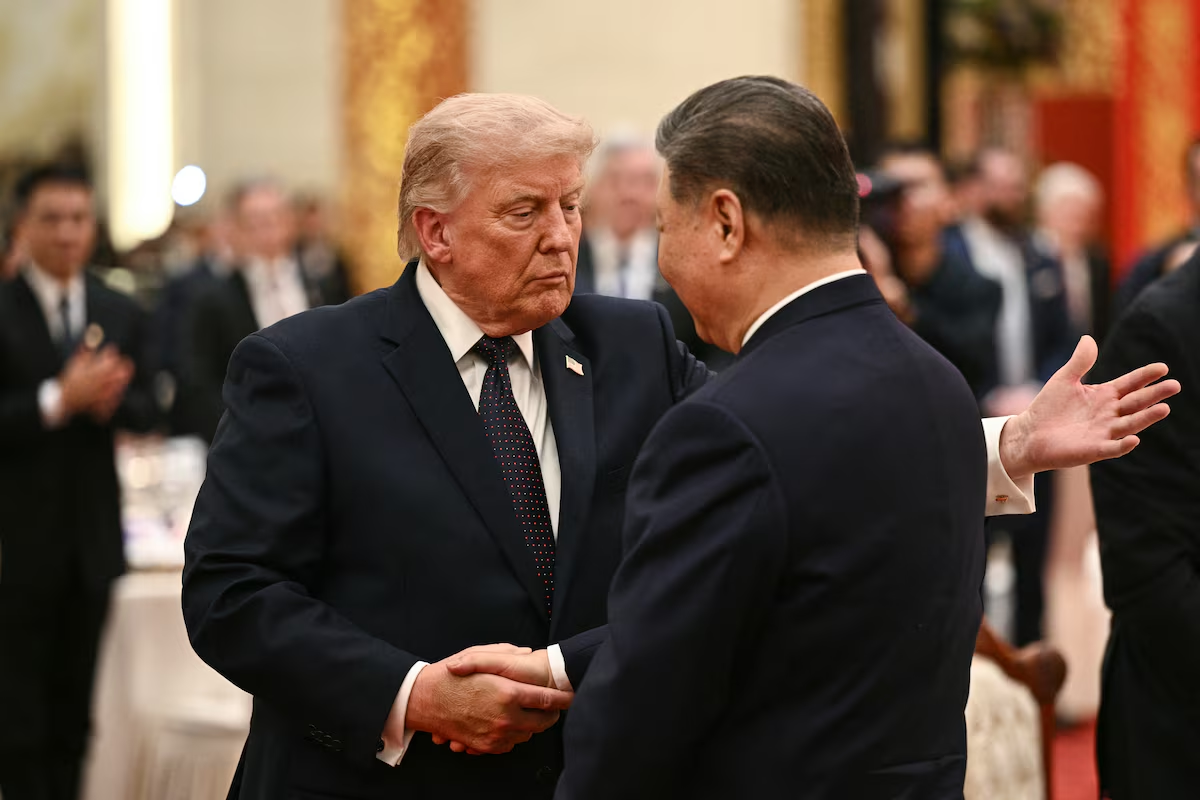
Chinese President Xi Jinping and U.S. President Donald Trump shake hands as they attend a state banquet in Beijing on Thursday. The two leaders meet this week for a closely watched summit.BRENDAN SMIALOWSKI/AFP/Getty Images
John Rapley is a contributing columnist for The Globe and Mail. He is an author and academic whose books include Why Empires Fall and Twilight of the Money Gods.
The world economy has a big problem, at the heart of which lie the U.S. and China. The Beijing summit provided Chinese leader Xi Jinping and U.S. President Donald Trump an opportunity to rectify this problem. Sadly, they bypassed it.
The problem is a massive imbalance in global trade, which is producing financial imbalances and political tensions. In short, China is running too big a trade surplus with the world, at more than US$1-trillion a year. Meanwhile, the U.S. is running too big a trade deficit, roughly mirroring China’s surplus.
Both are bad for the world economy. China’s trade surplus results from the country’s overinvestment in manufacturing and relatively low domestic consumption. The result is an excess supply of goods that are then sold abroad at knock-down prices. This has driven manufacturers around the world to the wall, resulting in industrial decline and rising unemployment. Quite simply, China’s current economic model makes it a bad neighbour.
Analysis: Trump touts Iran success in China, but it’s Xi who came out on top
But the U.S. is no better. The country can keep buying more than it sells to the world because the dollar remains the leading global reserve currency. In effect, the U.S. can credit the American bank accounts of foreign governments with printed money, which then ends up being used mainly to buy U.S. assets – traditionally government bonds, but increasingly U.S. stocks as well. That, in turn, has helped fuel a market rally that has sucked in capital from all over the world, fuelling a bubble in the U.S.
So, while each economy benefits in the short term – the U.S. gets to live beyond its means and experience stock market growth while China gets to capture ever more of the global market for manufactured goods – it’s hurting the rest of the world. As a global problem, this really calls for a global solution – a multilateral trade regime that forces China to consume more and the U.S. to stop running up its national debt, restoring balance to the world economy.
Unfortunately, neither Mr. Trump nor Mr. Xi show much interest in doing things that way. Although Mr. Xi pays lip service to the multilateral order, he remains wedded to the model of building a manufacturing powerhouse that captures the world market. The trade deals China negotiates, such as its recent zero-tariff deal with Africa, tend to reinforce this pattern of importing primary goods in return for Chinese production.
People ride a public bus on Thursday as American and Chinese flags are seen hanging in front of Tiananmen Gate for Mr. Trump’s visit.Kevin Frayer/Getty Images
Meanwhile, Mr. Trump approaches trade bilaterally, slapping tariffs on countries in proportion to their trade surplus with the U.S. while turning on American allies, treating everyone as a potential foe. Thus, China came in for steep tariffs in his Liberation Day onslaught last year, but after China retaliated by limiting rare earth exports to the U.S., Mr. Trump had to back down and strike a truce that nonetheless left some tariffs in place.
Although these had the effect of reducing China’s trade surplus with the U.S., they did nothing to reduce its overall surplus, nor the U.S.’s overall deficit – in no small part because Chinese producers shifted some operations to other countries and then sold into the U.S. from there. But one unintended result of Mr. Trump’s failed trade war is that it has reduced his leverage over his rival. China has shown it can adjust to his barriers, which in any event raise prices for American firms and consumers.
Jimmy Lai case is a ‘tough one’ for Xi, Trump says
Thus, weaker and now flailing in the Middle East, Mr. Trump travelled to Beijing this week with Mr. Xi holding, if not all the cards, a stronger hand. That was clear the moment the readouts of the meeting were released and the Chinese one forcefully mentioned Taiwan while the American one stayed uncharacteristically silent. And it’s a measure of how badly Mr. Trump’s Iran war has gone that, unable to find a way to reopen the Strait of Hormuz, he was hoping that Mr. Xi might use his leverage over the Iranian regime to hasten the war’s end.
Both the U.S. and China share an interest in bringing the war to a rapid conclusion. It’s becoming a political disaster for Mr. Trump and his Republican party, who face midterm elections with worsening poll numbers. For its part, China imports oil from Iran and would suffer disproportionately if the world economy slid into recession, since its export-dependent economy would lose sales.
Nevertheless, China can probably afford to outlast the U.S., which really needs the war to end yesterday. Mr. Xi is almost certainly pressing Tehran to make a deal, but he won’t force it to do so on U.S. terms.
As a result, what we got was a summit devoid of ambition – long on fulsome praise but short on substance. As Mr. Trump boarded Air Force One for his return flight to Washington, all he could announce were some vague pledges of increased trade and support for an open Strait of Hormuz.
And the problem in the world economy festers.