Last month, Dairy Farmers of America announced plans to close its long-running processing plant in St. Albans. The surprise announcement was just the latest in a series of recent plant closures.
A Hood-owned plant in Barre closed in the spring, followed by the closure of the Perrigo infant formula plant in Georgia last month. And the German company that purchased Franklin Foods in Enosburg Falls in 2017 said in June that they will shut down the plant in August.
This week Vermont Edition explored what this recent spate of dairy plant closures tells us about the dairy industry as a whole.
Dairy consolidation is part of a national trend
“There’s a lot of pressure points right now on the dairy industry, both on the processing side and on the on the on the farm side,” Vermont Secretary of Agriculture, Food and Markets Anson Tebbetts told Vermont Edition. Tebbetts said a lot of that pressure comes down to issues that also impact Vermonters who aren’t involved in dairy, such as affordability and the increasing costs of energy, labor and education.
Although it’s a national trend, consolidation has hit New England particularly hard
“It’s the accumulation of a decades-long trend of consolidation in dairy writ large, both at the farm level and processing level, and there’s a case to be made that the Northeast has been affected particularly acutely compared to other regions of the country,” says Claire Kelloway, food systems program manager for Open Markets.
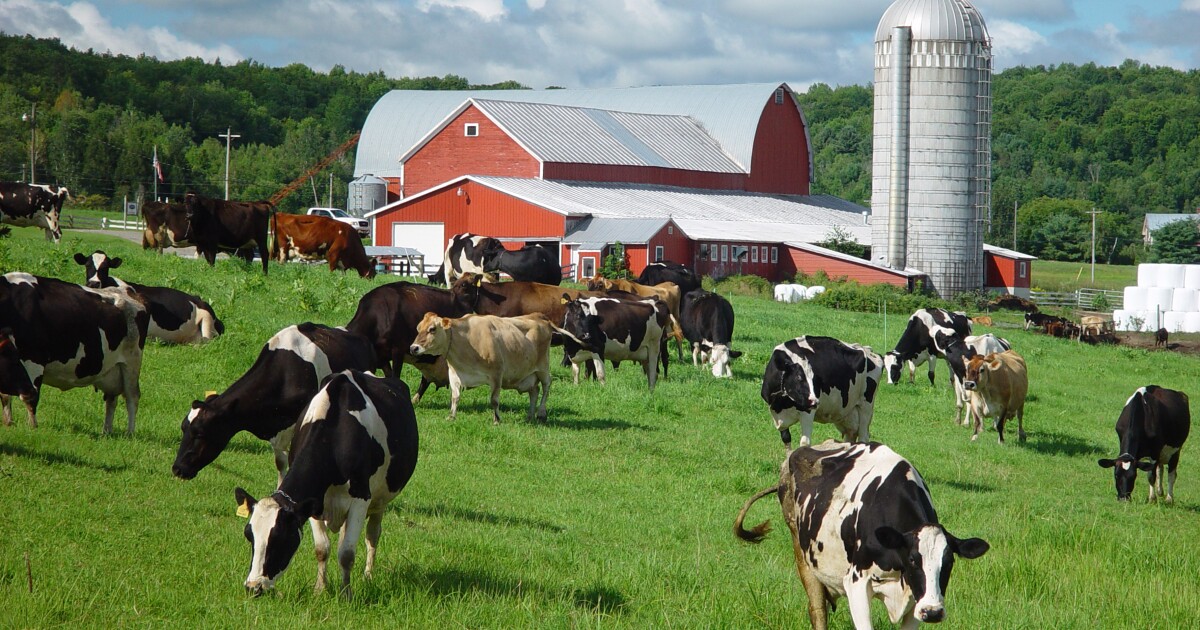
“There’s kind of a big shift of milk production from what we think of as traditional dairy states, like the Northeast and upper Midwest, to the western United States, where farms are much larger, sometimes 10 times larger or more than the average Vermont farm,” she added.
Vermont is looking to other states for ideas
The Vermont Milk Commission is looking at dairy processing incentives in neighboring states for ideas on how to support the local industry.
“A lot of our farmers point to New York, where they have some incentives for tax credits that if you invest in your operation, or if you invest in your farm — or maybe a processor — you get a tax credit and a refundable tax credit,” Tebbetts said.
Kevin Kouri, the chair of the Vermont Dairy Producers Alliance and director of nutrition and sales at Phoenix Feeds & Nutrition, also pointed to Maine’s milk tax system. “They petition the state every couple of years, come to the Legislature and cost of production studies are done,” he said.
The issue is likely to come up before the Vermont Legislature next year.
Congress is also considering solutions
U.S. Sens. Peter Welch and Bernie Sanders recently introduced the Milk from Family Dairies Act, which would establish a dairy market stabilization program to ensure dairy farmers get a fair price for their milk based on their cost of production.
It’s not all bad news
John Ovitt, who has worked at Franklin Foods for more than 37 years, is purchasing the Enosburg Falls plant and plans to reopen it in the fall.
“The workforce is going to go down, but I’ve been able to save a number of jobs and we’re going to run leaner and meaner,” Ovitt said.
That’s largely out of necessity, as Ovitt’s purchase agreement prohibits the plant from continuing to produce cream cheese for the next 10 years. The plant will continue to produce its two legacy products — baker’s cheese and Tofutti — but will also look to new opportunities, including truck washing.
“I’ve done a lot of work on this. There seems to be a demand for the tanker trucks, and we all know they’re going to be here because the milk is still here for the need, especially with the co-op downturn,” he said.