This article was first published in the On the Hill newsletter. Sign up to receive the newsletter in your inbox on Friday mornings here.
It feels like we were just on recess. Well, because we were.
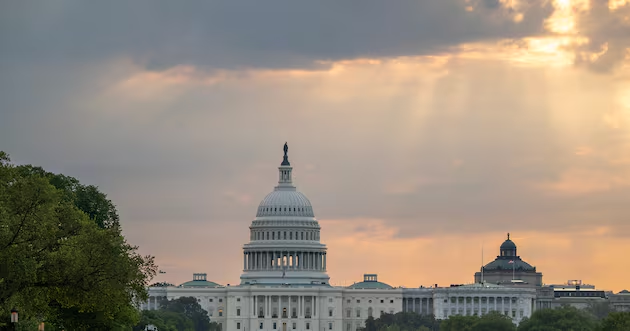
To jog your memory on the congressional calendar, the House and Senate were out all of August for their annual summer recess. The Senate came back on Sept. 14 for a quick three-week sprint in a last-ditch attempt to get some major legislation across the finish line to use as campaign fodder back home.
That didn’t really work out the way Republican leaders wanted. But that doesn’t make it any easier on Democrats.
In their short stint back, GOP leaders teed up a number of bills they thought would give their most vulnerable incumbents seeking reelection some good news to bring back to voters. They mostly dealt with affordability, the top issue heading into this election cycle — and very little progress was made.
It all started with the downfall of the CLARITY Act, a bipartisan effort to establish the first comprehensive federal framework for regulating cryptocurrency markets. This bill had been years in the making and it looked on track to advance during the September session.
But then talks quickly fell apart after Wyoming Sen. Cynthia Lummis, dubbed the “Crypto Queen” by her colleagues on Capitol Hill, released what negotiators thought would be the final framework. But Democrats said the language surrounding ethics requirements was still not strong enough — and the proposal hit a wall.
It ended up failing in a procedural vote, so it couldn’t advance to debate. That was a major blow to bipartisan negotiators, with each side blaming the other for things falling apart.
Then in the final week of session, Republican leaders decided they were going to put two major issues on the floor — basically daring Democrats to say no.
One bill had to do with cracking down on the high costs of data centers and the other had to do with implementing a stock trading ban for lawmakers. Both are bipartisan ideas in nature, so on its face, one could expect they’d pass with flying colors.
But that’s not what happened. Democrats rejected both those efforts, arguing neither proposal went far enough to actually solve the problem at hand.
“At a time when Americans are calling out for real guardrails on AI, Senate Republicans are trying to secure an ineffectual participation trophy before they skip town,” Senate Minority Leader Chuck Schumer, D-N.Y., said in a floor speech this week.
Those failed votes are bad news for Republicans who are trying to defend their already-slim majorities in Congress. That’s why they blame Democrats for sinking the legislation for political reasons rather than supporting bipartisan proposals.
But Democrats reject that version of the story. They say that Republicans were trying to push through “messaging” legislation, particularly pointing to the data center bill as being voluntary for companies to comply. That made the framework “toothless,” Schumer said.
That won’t make it easier for Democrats on the campaign trail. Yes, they can argue that because Republicans control Congress, the lack of productivity lies on their shoulders. But they may have a hard time explaining why they shot down proposals that could’ve paved the way to stronger governing.
“Good luck explaining to your constituents why you oppose a stock trading ban,” Sen. Josh Hawley, R-Mo., said this week.

The Senate did manage to get one big project across the finish line during their September session: The Protect College Sports Act.
But will that help out on the campaign trail? There are some skeptics who say no. Sure, it creates a federal framework for college sports in a way that lawmakers say will ensure fairness, but the bill still has a long way to go before it becomes law.
Also, some Republicans say it’s an issue that voters are not most concerned about.
“We’ve been spending all week on trying to make the football coaches happy,” said Sen. John Kennedy of Louisiana. “I’m voting for the bill, but I can assure that moms and dads out there across America, when they lie down to sleep at night … they’re not worried about the football coaches.”
Still, there is a beacon of hope. Shortly before leaving town for the October recess, a group of bipartisan senators unveiled the long-awaited proposal for permitting reform, an issue that actually would address some affordability concerns.
There’s still a lot to be worked out on that bill. It’s only the first draft of the framework, which took years to negotiate, and who knows what will happen when they return in November.
Depending on who wins in November, the power dynamic of Washington could be totally different. If Democrats take control of either chamber, they may not be as interested to help with these bills until they have a greater say.
We’ll chalk it up to a question mark for now. But moral of the story is: Lawmakers may have just survived a tense three-week session up here — but both parties will need to figure out how to message the failed votes while they try to convince voters they are the ones who should be running the show.
Stories Driving the Week
- Pocket cuts: The nonpartisan Government Accountability Office concluded that the administration’s unilateral spending cuts went beyond its constitutional authority. Trump issued the cuts through a process called pocket rescissions, a rarely used and legally questionable procedure that allows the president to cancel government funding without congressional approval.
- Under oath: Former special counsel Jack Smith appeared before the committee on Tuesday morning as he faced questions from both Republicans and Democrats about the two inquiries, one investigating Trump’s role in the Jan. 6, 2021, riot at the U.S. Capitol and another investigating alleged unlawful retention of classified documents at his Mar-a-Lago resort.
- Stock block: The Stop Insider Trading Act failed this week, falling short of the 60 votes needed to begin debate. All Democrats rejected the proposal over complaints it doesn’t go far enough, noting that while it would limit lawmakers from buying and selling stocks, it would allow members to keep the stocks they’ve previously purchased.
Senate confirms new Labor secretary
The Senate confirmed Keith Sonderling as the new secretary of the Labor Department, marking the final vote before the midterm elections.
Sonderling was confirmed in a 47-41 party-line vote late Wednesday evening. His confirmation comes after Sonderling has been serving as the acting secretary since April when former Labor Secretary Lori Chavez-Deremer resigned.
Chavez-Deremer faced investigations at the time of her resignation over accusations of misconduct.
Democrats opposed Sonderling’s confirmation over concerns of the Trump administration’s management of the Labor Department, such as taking over some grant programs previously overseen by the Education Department — which the administration wants to dismantle entirely.
“I fear any vote to confirm you is for more of the same: to strip overtime protections for our workers, to undercut our unions and to let giant corporations get away with robbery, literally,” Sen. Patty Murray, D-Wash., said during Sonderling’s confirmation hearing.
There were questions about whether Sonderling would be confirmed before the October recess. But the vote came together late Wednesday evening after the Senate approved a number of other proposals through fast-track unanimous consent requests.
President Donald Trump will now formally swear Sonderling into the position, but the transition should be smooth as he has been overseeing the department for nearly six months.
Quick Hits
From the Hill: Mike Lee helps craft bipartisan deal tackling energy projects, data center costs. … Utah Sen. Curtis fast-tracks wildfire prevention bill through Senate. … Sen. Mike Lee explains why he blocked bill banning demolition of presidential memorials.
From the White House: Trump announces South Korea will help fund Alaska pipeline. … Trump meets with AI executives, says they signed ‘morally binding’ document. … U.S. military ends 12-year anti-Islamic State campaign in Iraq.
From the courts: BYU graduate sues Candace Owens, says she tied him to Kirk killing. … Utah to get $2M in auto loan settlement, attorney general announces.