By Chevi Rabbit, Local Journalism Initiative Reporter
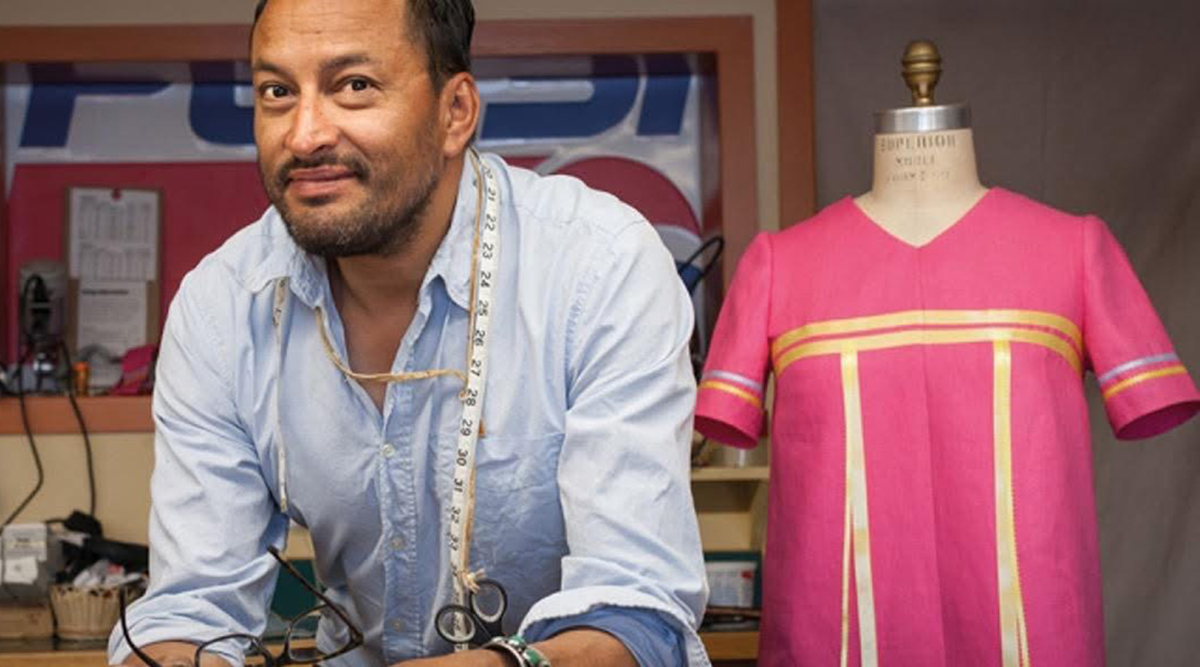
(ANNews) – For D’Arcy J. Moses, fashion has never simply been about clothing.
It became a path back to identity, a form of ceremony, and ultimately a way to rebuild a life shaped by separation, loss, and resilience.
Born Dene and impacted by the Sixties Scoop, Moses was taken from his family as an infant and raised by a non-Indigenous family on a farm outside Camrose, Alberta.
“I’m a ’60s Scooper,” he says. “I was adopted out as an infant. The church took me away from my mother, and I was raised by non-Native people on a farm in Alberta.”
Growing up disconnected from his culture, he found himself drawn to another world – one found in the glossy pages of fashion magazines. “My mother used to have Harper’s Bazaar and Vogue magazines, and I was enamoured by them,” he recalls. “High fashion – haute couture – that’s what first really sparked my interest.”
Those magazines offered a glimpse of possibility. By his mid-teens, Moses understood that creativity would define his future. “I knew from a young age that I was creative, but I didn’t realize until my mid-teens that I wanted to get into clothing design.”
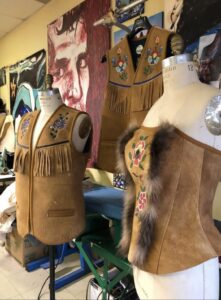
Current fashion designs by D’Arcy Moses.
Years later, after moving to Vancouver and Toronto, that childhood fascination began to take shape professionally. Along the way, Indigenous Elders recognized his talent and introduced him to the art of regalia making. “In my early twenties I was in Vancouver. I had some Elders take me under their wings and introduce me to regalia making.”
While refining his craft, Moses worked relentlessly to support himself. “I worked two or three jobs at a time – waiting tables, working in a sawmill, a lumber mill of all things. And in the evenings and weekends, I would just create.”
That persistence eventually paid off. “I had a few lucky breaks,” he says. “One of them was the Toronto Festival of Fashion, and the next day one of my garments ended up on the cover of The Globe and Mail, which was really big news at the time.”
As his reputation grew, so did his reach. Moses entered a rare space occupied by few Indigenous designers of his generation, signing licensing agreements with major manufacturers and selling his work through prestigious retailers. “I was fortunate because I signed license agreements with large companies that produced my garments,” he says. “I was selling at Holt Renfrew, and through Saks Fifth Avenue and Neiman Marcus in the United States.”
Yet one of the most significant moments of his life had nothing to do with fashion.
D’Arcy J. Moses is an Indigenous Dene originally from the Pehdzeh Ki First Nation, a small community located in the Mackenzie Mountains beside the Mackenzie River in Canada’s Northwest Territories.
Years after being taken from his family during the Sixties Scoop, a chance television appearance helped reconnect him with his relatives. “My relatives saw me on TV and said, ‘That is the missing D’Arcy,’” he recalls. “They contacted CBC North and CBC Toronto, and that’s how we were eventually reunited.”
For someone whose culture had been taken from him as a child, the reunion represented a homecoming decades in the making.
That sense of cultural reclamation would later become central to his work.
Moses has also spent years sharing his knowledge with emerging Indigenous artists and designers. “I have worked with the Banff Centre for Arts and Creativity for several years,” he says, viewing mentorship and cultural expression as an important part of his work.
For Moses, clothing is much more than commerce or artistic expression. It is deeply connected to identity and community. He recalls asking an Elder in Wrigley years ago why so much time and care went into creating beautifully crafted jackets, beadwork, and regalia. “She told me that amongst Aboriginal people, it shows your standing in the community,” he says. “It’s an expression of social stability and health and well-being.”
That teaching has stayed with him throughout his career and continues to shape the way he approaches design. “Dressing can be so ceremonial, and it carries meaning in different ways,” he says. “Amongst First Nation people, dressing is a form of personal identity and of social health and well-being.”
Over the decades, Moses has watched the fashion world evolve dramatically. “It’s not so much about breaking into fashion – it’s about visibility and building a following.”
Where designers once depended on department stores and galleries, social media has opened entirely new pathways. “Back in my days, I’d have to sell to a gallery or a store. A denim jacket might wholesale for $60 and retail for $120. The whole game has changed. With the internet, we don’t need that middleman anymore.”
He now sees Indigenous artists embracing those opportunities. “I see more and more Indigenous artisans – designers, musicians, poets, sculptors, painters – on Instagram and Facebook.”
Moses himself is rebuilding his digital presence. “I have some content on YouTube, and I’m working on a brand-new website. I’m going to start doing direct-to-consumer sales again.”
But just as he was preparing for a new chapter, disaster struck. Two and a half years ago, a wildfire swept through Enterprise, Alberta, destroying his home and studio while he was nearly a thousand kilometres away teaching a workshop. “This was a big challenge,” he says. “That fire burned down the entire community in 45 minutes.”
The devastation was absolute. “I lost everything – literally everything. My business, years and years of my work, clothing I had shown over the years, fabric, about $250,000 worth of industrial equipment, and all my personal belongings.”
Adding to the hardship, he had no insurance. “As an artist, I didn’t have any fire insurance.”
Recovery came through determination and community support. Working as a band manager for his First Nation, Moses dedicated each paycheque toward rebuilding his life and studio. “They gave me a house to start over in,” he says. “I just started buying one piece of industrial sewing equipment at a time, and embroidery machines.”
Today, he is looking ahead. He plans to return to the powwow trail, reconnecting with communities that have long inspired his work. “This year I really want to do the powwow trail again. I did it before and I absolutely loved it. You’re getting back into community, getting re-involved, and finding inspiration again.”
Experience has also given him clarity as an entrepreneur. “I know who my customer is now. I know what sells. I meet people at festivals every year in Yellowknife and other trade events. It’s a lot of work, but it’s a lot of fun.”
Looking back, Moses sees his journey as proof that culture and creativity can survive even the deepest forms of displacement. “All of my work is a demonstration of how proud I am to be First Nation. I love being First Nation.”
He hopes the path he carved has helped create opportunities for younger Indigenous designers and artists. “You see young people now so proud of who we are as Indigenous people. They express it through clothing, music, hip hop, visual art – it’s incredible.”
“I hope I’ve helped lay the foundation for other Indigenous designers. We have a lot to say.”
For young artists wondering whether their dreams are possible, his advice remains simple. “If you love what you do and you’re dedicated, anything is possible.”
Then, reflecting on a life that began with cultural loss but grew into one of artistic achievement and reconnection, he offers one final message:
“I started as a 16-year-old Scooper on a farm in Alberta with nothing of my culture, and I’ve been fortunate that fashion has taken me all over the world. So, believe in what you’re doing, work hard, and love your culture and yourself.”