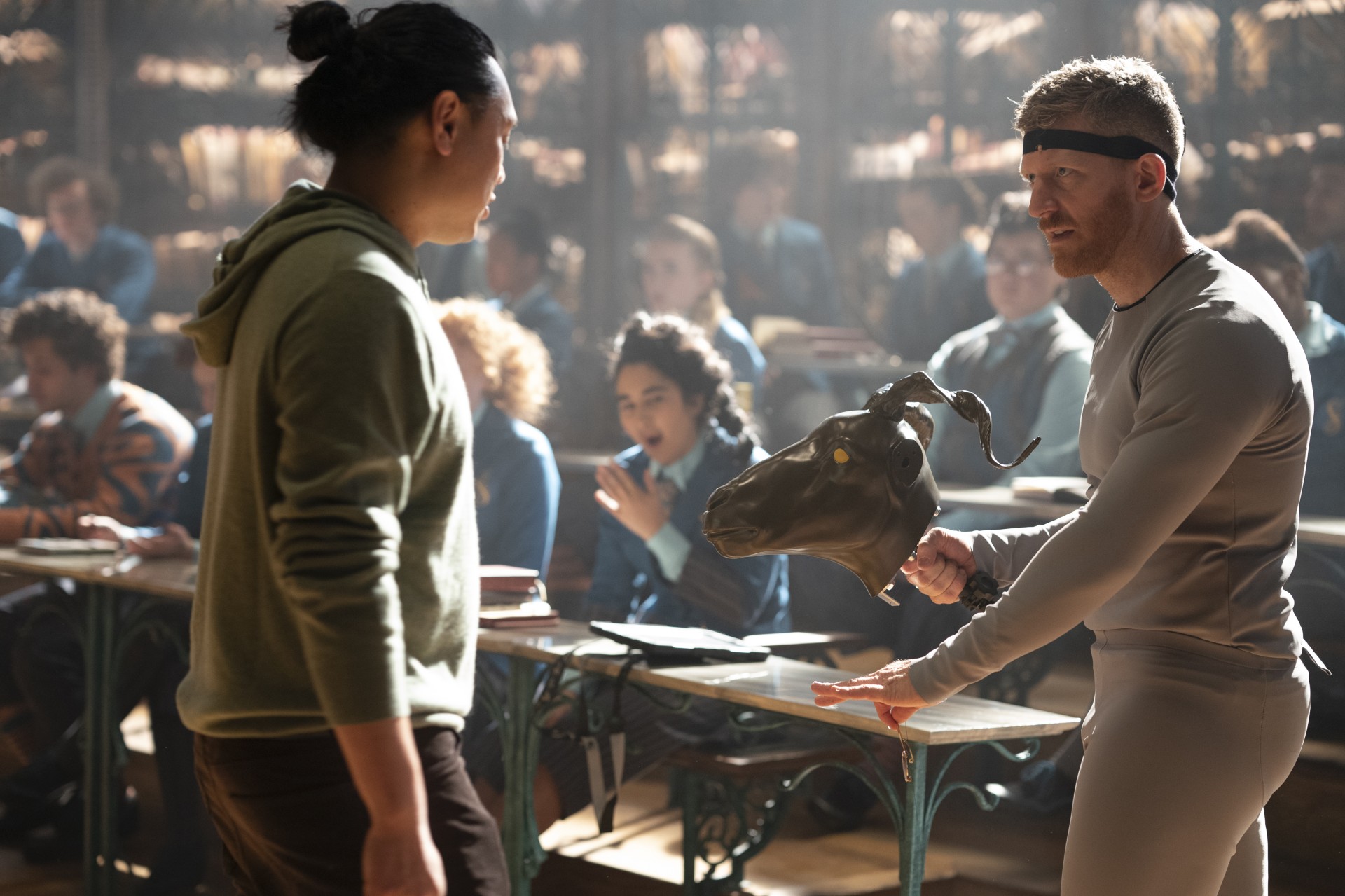
Robin Guiver, assistant professor in the Department of Theatre and Dance Performance at Ithaca College, had his work showcased in the recent two-part movie, “Wicked.” He was the lead movement artist in the films, embodying the animal characters, specifically Chistery, the flying monkey.
Guiver has spent most of his life in London, involved in theater and movie productions, until he decided to come to Ithaca in October 2023. For over a decade, he has been a lead movement artist in projects and teaching others how to do puppetry, he joined the IC faculty in July to work on teaching these skills full time in an academic atmosphere.
“Wicked” is just one of the extensive projects that Guiver has been a part of in his career. His puppeteer movements have been featured in many other big films, including “Snow White” (2025), “The Little Mermaid” (2023), “Fantastic Beasts: The Crimes of Grindelwald” (2018) and “Jurassic World: Fallen Kingdom” (2018).
Staff Writer Abbi Puckett spoke with Guiver about his work on the “Wicked” sets and other productions and how his experience in the field is helping him grow as an educator.
This interview has been edited for length and clarity.
Abbi Puckett: What sparked your love for theater?
Robin Guiver: I grew up in London, which has an enormous theatrical heritage over hundreds of years. I was part of the youth theater when I was young. We did youth theater projects that were really about conflict resolution. … I remain very passionate about the possibility for the arts, for theater, for cinema and storytelling devices to really impact people’s empathy. … So I think just being exposed to amazing work early on really had a huge impact on me. And I loved the live performance, especially the human connection that you get with live performance; it’s unique.
AP: As far as “Wicked” goes with Chistery, in the last film, he had one line, so you had to show a lot of emotion and [communicate] through body movement. What does that look like? And is that difficult?
RG: As human beings, we are experts at understanding communication, even if we don’t study it academically. [The movement team is] looking at how to take those human understandings of physical behavior and body language, and put that into this animal body instead. We did a lot of studying of real animals. But with these animal interactions, we want to just create a movement vocabulary so we can interact and improvise with the actors, rather than giving them the same thing every time.
AP: As you’ve worked on so many projects before, “Wicked” being a very recent and very big one, what’s the biggest lesson you learned from just this project?
RG: [I] love to see how the real, authentic relationships are communicated on camera. So when you see Elphaba and Glinda on screen, we really believe that their relationship, the care they have for each other, their frustration, the empathy, and I think that is such a direct result of the real relationship that Ariana [Grande] and Cynthia [Erivo] were able to develop on set as well. Seeing them in real life together is equally moving, because their relationship is so authentic and open and genuine and the camera was really able to pick that up, and they were really able to invest that in their work.
AP: Looking at some other projects, I noticed that you worked on “The Little Mermaid.” I can imagine it’s kind of difficult bringing these once 2D characters onto the big screen. Was that difficult to navigate?
RG: Because [the characters are] not human-shaped, we’re so much bigger than them physically. We got puppets designed that could move in interesting ways, that could move in 3D spaces, underwater, or could be puppeted and performed on set, so that everyone could understand what was happening very clearly. So the actors like Halle [Bailey] would be able to see them and interact with them and understand that as well. But then the animators come in and do all of their beautiful work afterwards. [Director] Rob Marshall had a very clear vision. … It was an interesting casting process as well, because we knew we wanted to have puppeteers who were going to mimic the voices and the accents of the characters [and] whose heritage and background match them as well.
AP: While you teach theater students and [communications] students, how has that really helped make it kind of a full circle moment bringing in your experience?
RG: What I feel very excited about is having a lot of first hand experience, which is extremely current. The industry changes so fast. … I think that perspective is very useful, because it means that there’s a lot I can share in terms of kind of real anecdotes and real experience of what I’ve seen in the film industry. It means also that I feel like I can talk with quite a lot of authority, certainly at the moment, about what’s happening in the film industry right now and what happens on set, and what it’s like.
AP: What’s the best piece of advice you would like to give your theater students now, that you wish you had when you were a theater student in college?
RG: There’s a huge trend in the arts at the moment for genuine authenticity. Social media means that we feel like we know these celebrities, we get a real glimpse into their personal lives, into what they’re like off camera as well. And that’s what’s fueling this desire for people who appear like real, well-rounded human beings with flaws, with negative traits as well as positive traits. So really acknowledging who you are and accepting yourself for who you are and diving into that wholeheartedly, I think, is easier said than done, and it’s a lifetime of work, but start it now, is what I’d say.