We have thousands of human-written stories, discussions, interviews and reviews from today through the past 20+ years. Find them here:


“This is a festival for friends, and by friends.”
Pianist and Executive Director Angela Yoffe emphasized this idea repeatedly last week at the North Shore Chamber Music Festival, which wrapped up Saturday night at the Village Church of Northbrook, Ill., near Chicago.

Vadim Gluzman and Angela Yoffe, founders of the North Shore Chamber Music Festival, and cellist Mark Kosower. Photo by Jose Viera.
It’s a simple sentiment – so simple that in any other context I might not take it very seriously. Friendship – yes, it’s helpful. So what?
But Yoffe and co-founder of the festival Vadim Gluzman have taken the idea of hospitality and collegiality to another level, when it comes to their festival. They host meals where musicians, volunteers, spouses, moms, and at least one journalist (me!) all eat together. There is food made and donated by volunteers and friends of the festival – a very meaningful way of sharing. Musicians are multi-generational, new to the festival or longtime participants, all tied by a dedication to maintaining their skills and striving for excellence.
Beyond all this, I came to see that “friendship” can have profound results, when it comes to creating music together.
Friday’s concert, “American Quartet,” was built around Antonin Dvorak’s work by that name, the Quartet No. 12 in F major, Op. 96 “American” and also included Samuel Barber’s famous “Adagio for Strings” in its original quartet version; W.A. Mozart’s Clarinet Quintet in A major, K 581; and Josef Suk’s “Elegie” for piano trio.
The Escher Quartet, with violinists Adam Barnett Hart and Bryan Lee, violist Pierre Lapointe and cellist Brooke Speltz, featured prominently in this concert, starting with the Barber Adagio, which was interesting to hear in its original quartet form, having heard (and played) it so often in the string orchestra arrangement, made especially popular by its appearance in movies such as Platoon and Amélie.
In introducing the piece, Speltz said that Samuel Barber had written the famous second movement of his only quartet overnight and told a friend that he thought would be “a real knockout.” It was the conductor Arturo Toscanini who asked for an orchestra arrangement of the work.
Played as a quartet, the work feels less like a chorus of grief – instead it is quite vulnerable, with just one voice carrying the heavy weight of this music. Much of the melodic responsibility came down to the first violin, and Hart took this responsibility and ran with it, playing with a beautiful and heartfelt vibrato and presence of sound.
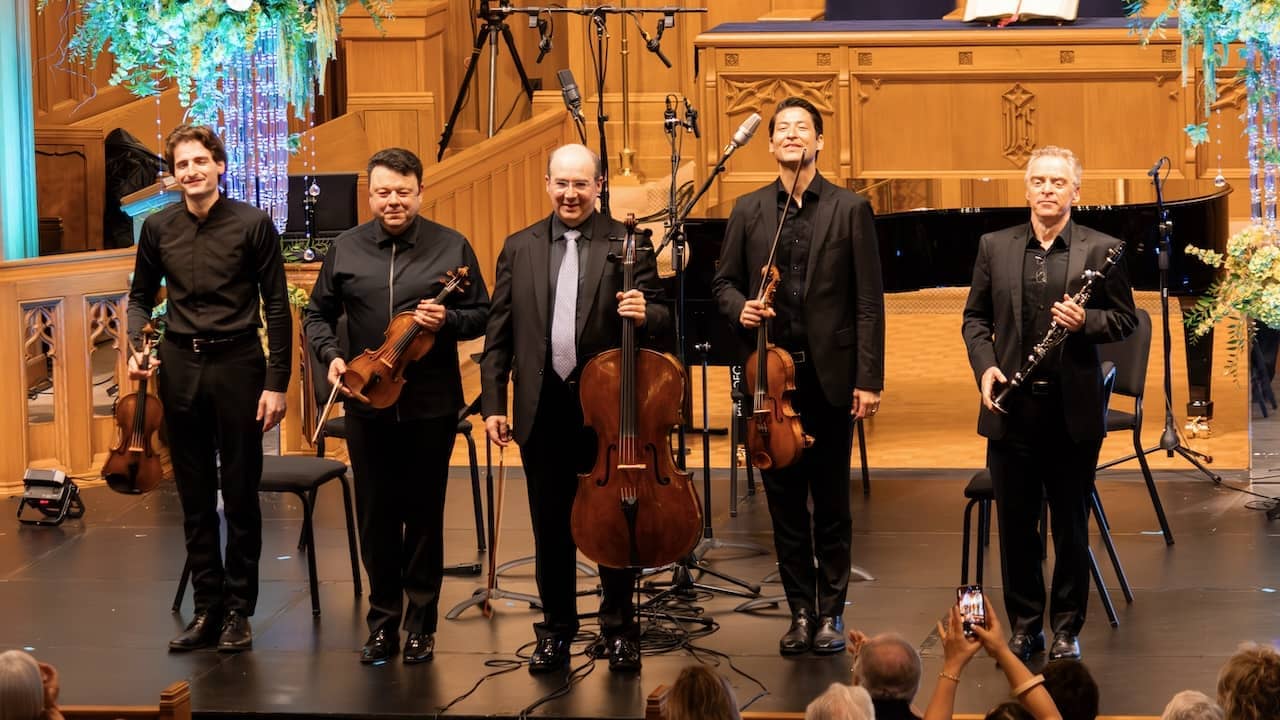
NSCMF clarinetist Ilya Shterenberg introduced the next piece: Mozart’s Clarinet Quintet in A major, K 581, saying that “Mozart’s Clarinet Quintet can be described as ‘sublime’ or ‘iconic,’ but tonight, I would like to describe it as ‘an old friend.’ And here on stage, we are all old friends — some older than others!” The music, “like a good friend, even after all this time — can still surprise you in remarkable ways.”
So what exactly is a good friend? As they played, I thought about it.
A good friend is reliable, always answering your call or text, always on time to meet you. A good friend brings you interesting stories — but gives you the floor when you want to tell your interesting story. This friend listens attentively, laughs easily but also feels your pain. It’s a friend who understands you – maybe even finishes your sentences.
It occurred to me that musical friendship works the same way.
Performing this work was a dream team of great players – clarinetist Shterenberg of the Winnepeg Symphony Orchestra, violin virtuosos Vadim Gluzman and Joshua Brown, Cleveland Orchestra principal cellist Mark Kosower and Grammy-winning violist Masumi Rostad.
Their mastery made this an impressive show of skill, accuracy, and great intonation. But their musical friendship is what made it a joy to witness.
Each of these players was poised and attentive to one other — ready to deliver, ready to respond. Especially in the second movement, they took great care in the quieter moments, bolstering Shterenberg as he sculpted an ever-flowing clarinet melody, showing him to be a master of breath control and placement. There is a certain vulnerability in turning the volume that low, and they went there together, with a lot of care.
In the third movement they bounced the melody between each other like it was a game. Gluzman and Shterenberg played with time, pushing forward and holding back, and everyone came along for the ride. Their communal push-and-pull felt as natural as a person’s changing pulse rate on a walk — but an interesting walk, where you might suddenly see a rabbit.
Kosower’s placement of phrase-ending notes seemed like audible punctuation marks, both proper and humorous.
The last movement was a set of variations that had the clarinet floating over spiky up-bows, eventually evolving into a flurry of fast notes that had the musicians literally coming off their seats.
This was some brilliant Mozart, a highlight of the Festival.

Mozart Clarinet Quintet: Joshua Brown, Vadim Gluzman, Mark Kosower, Masumi Rostad and Ilya Shterenberg. Photo by Jose Viera.
A reading of Josef Suk’s “Elegy for Piano Trio” featured the married pair Yoffe and Gluzman as well as Kosower – another display of high-level chamber playing, with Yoffe finding beautiful colors in the poignant piano writing, and a lovely dialogue between violin and cello.
In introducing the “American Quartet,” Escher cellist Speltz shared that the work was written by Dvorak in 1893 in the Czech expat community of Spillville, Iowa, saying (perhaps a little controversially!) that “it’s so clearly Czech music, though one cannot help but hear a train rolling through the American countryside in the last movement.” (Speltz later posited that “most of it was inspired by the fact that Dvorak wished he was back home” – I won’t argue with that!)
Nonetheless, the piece has become “American” for us – by now perhaps its “Czech-ered origin” doesn’t matter!
As happens with good friends, these four seemed to give each other energy as the piece went on. Speltz’s cello solos in the second movement were beautifully pure, and the foursome took the bumpy and interesting rhythms in the third movement at a nice spritely clip. By the final movement, the train was on the move, with every member shining as he got the spotlight.

The Escher Quartet: Adam Barnett Hart, Bryan Lee, Brooke Speltz and Pierre Lapointe. Photo by Jose Viera.
The third day of NSCMF served up another brilliant Mozart performance, this one featuring pianist Janice Carissa, Gluzman, Kosower and violist Masumi Rostad in the Piano Quartet in G minor, K. 478.

Vadim Gluzman, Janice Clarissa, Mark Kosower and Masumi Rostad. Photo by Jose Viera.
These four musicians locked in on the music and on each other, producing a performance that was at times conversational, or argumentative, or even in unison or echoing one another. There was a great deal of ease, joy, and thrilling music making.
The night culminated in everyone from the whole week joining in Tchaikovsky’s “Serenade” for strings, Op. 48. This was a group that included a lot of soloistic players whose regular gigs involve playing concertos, so its bold beginning was especially bold.
Led by Gluzman, these 13 musicians gave a vigorous and committed performance, made especially exciting by some very fast tempos and time-melding that challenged everyone to be 100 percent dialed in, 100 percent of the time. In fact, at times it felt like these friends were actually flying, reminding me of a quote from the Hitchhiker’s Guide to Galaxy on the topic, explaining that “flying” is simply the ability to “throw yourself at the ground and miss.”
These musicians repeatedly defied gravity, particularly in the final “Allegro con Spirito,” which they played with such daring, crackle and spark — it truly felt like a fireworks-show finale!

NSCMF Grand Finale. Photo by Jose Viera.
You might also like:
* * *
Enjoying Violinist.com? Click here to sign up for our free, bi-weekly email newsletter. And if you’ve already signed up, please invite your friends! Thank you.
Replies