
The audience is broader and more female than you would expect, and LGBTQ+ viewers reward the brands that show up for them.
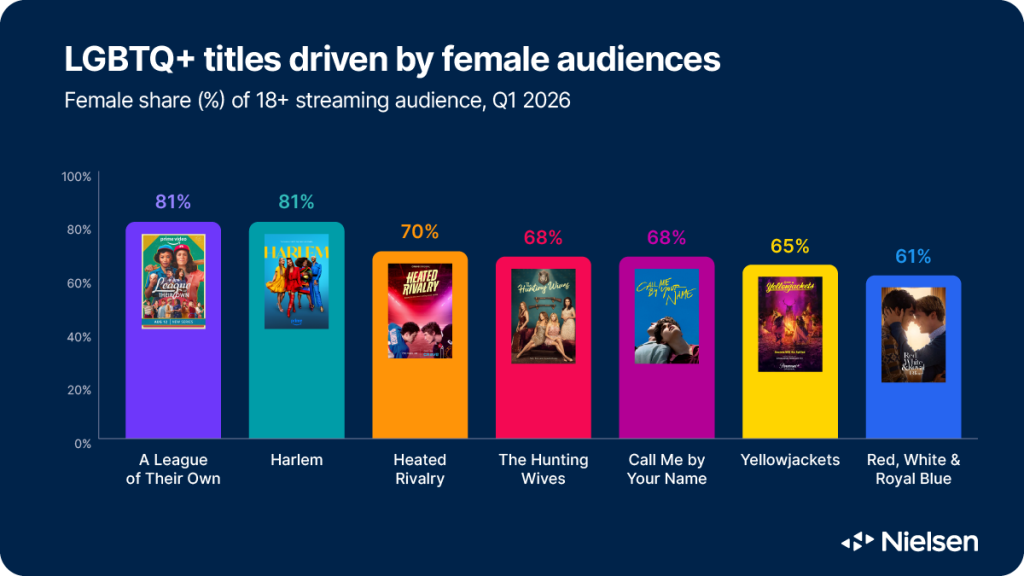
Last year, a story about two rival hockey players falling in love became one of the most-buzzed about titles of the season. But the audience that showed up for Heated Rivalry may be surprising to some: seven in ten viewers were women. And on what is seemingly the opposite side of the spectrum, The Hunting Wives, featuring gun-toting women from Texas who also fall in love, reaches a similarly female-skewing audience, at 68%. This turns out to be the rule rather than the exception. Across the streaming titles built on LGBTQ+ themes, or with prominent LGBTQ+ characters, the audience is younger, more female, and more mainstream than one might expect.
In the first quarter of 2026, the Call Me by Your Name audience was 68% female, and nearly half of them under 35. Red, White & Royal Blue’s audience was 61% women. The pattern doesn’t depend on whose love story is being told. A League of Their Own (the Prime Video streaming series) and Harlem each reached audiences that were 81% female, and Yellowjackets, a critically-acclaimed thriller which includes a queer storyline, came in at 65% female viewership.
No matter the dynamic of the love story, romance is a popular genre across media, and it’s mostly driven by women, who are 46% more likely to be fans of the genre according to a recent Nielsen study. Further, 44% of women aged 18-34 are seeking out content with identities different from their own. LGBTQ+ content is increasingly mainstream content, and it over-delivers an audience brands are already working hard to find.
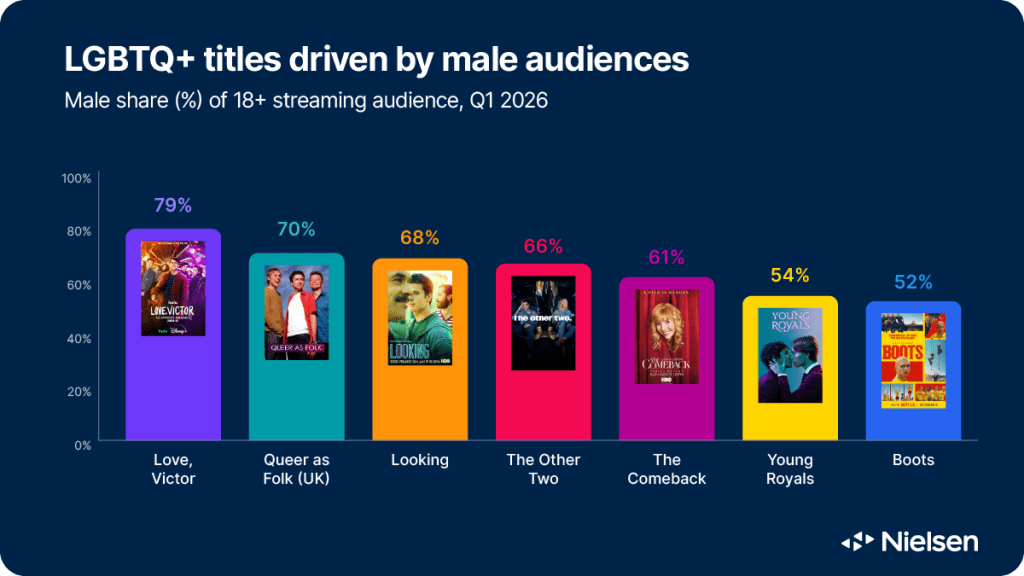
At the same time, it’s not a monolith. While romance heavily attracts women, a core group of highly engaged male viewers anchors another major segment of queer storytelling, offering brands a direct line to a deeply loyal male demographic.
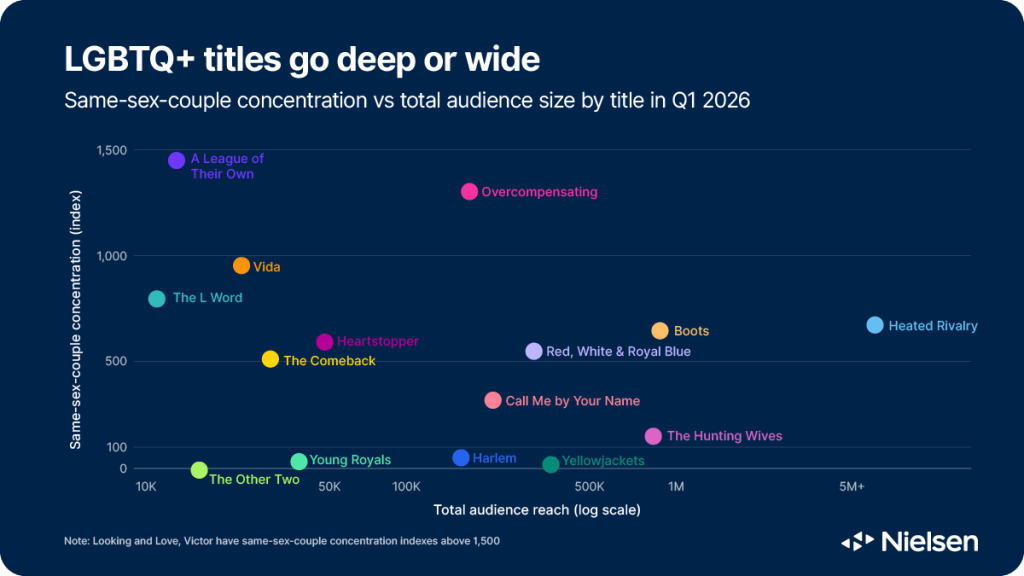
Look at these streaming titles through the lens of same-sex-couple households, and a deeper story appears. The more a title centers its queer storyline, the more it gains concentrated viewing. Standouts like Heated Rivalry, Boots, and Overcompensating all manage a rare feat: they capture broad, mainstream audiences while simultaneously over-indexing among core same-sex-couple households.
Reflecting on these audience dynamics, GLAAD President and CEO Sarah Kate Ellis notes that capturing these mainstream, highly engaged viewers is both a cultural milestone and a commercial necessity:
“Nielsen continues its leadership in researching the changing audience demographics as the entertainment industry continues its rapid evolution. High viewership of LGBTQ-inclusive stories is powerfully driven by younger women, as younger demographics are far more likely to identify as, know, or support LGBTQ people. Beyond Gen Z, inclusive brands capture real purchasing power from key growth demographics that actively buy from companies supporting the community, specifically over-indexing with Gen Z (+19), Black (+18), and Hispanic (+15) consumers. As these viewership statistics show, mainstream audiences actively seek out LGBTQ stories. To drive growth, producing inclusive content and investing in dedicated advertising support to drive broad market awareness are vital business practices. LGBTQ inclusion and LGBTQ-led stories are a proven growth engine and should no longer be considered a niche play.”
How LGBTQ+ audiences respond to advertising
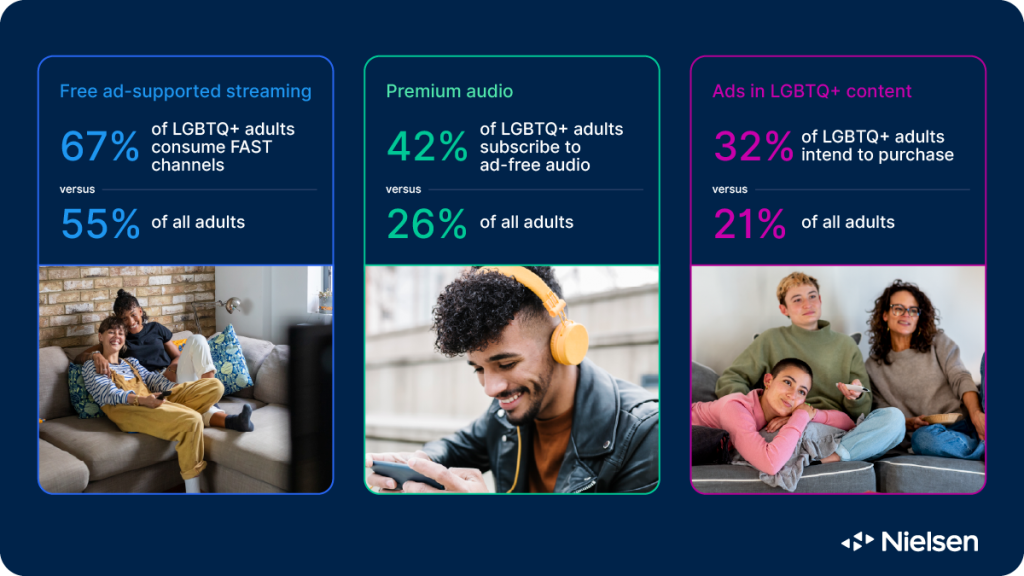
LGBTQ+ adults already live in the streaming-first, socially native, ad-supported world. Free ad-supported streaming reaches 67% of the community compared to 55% of all adults, ad-supported audio and topic-based subscriptions run above average, and on social media the community indexes higher on usage of Tumblr, Snapchat, Reddit, and TikTok. LGBTQ+ people, in short, are exactly where advertisers are trying to be. Their relationship with advertising rewards effort. LGBTQ+ viewers buy at a noticeably higher rate when an ad earns its place. When diverse content surrounds the ad, 32% of LGBTQ+ respondents say they intend to purchase, compared to 21% of all adults. Streaming TV advertising in particular resonates with LGBTQ+ audiences. Nielsen data shows that Lesbian Women (34%) and Gay Men (33%) index significantly higher for making purchases based on Streaming TV ads than the overall general audience (28%).
Pride Month is when much of the industry turns its attention to LGBTQ+ audiences, and the more valuable story is the one the numbers tell all year around. These titles are in demand, the appetite for telling these stories is well documented, and the audience rewards the brands that show up in them in June, and every month before, and after.
Streaming audience figures are drawn from Nielsen streaming measurement, Live+7, Total US, Persons 18+, for the interval December 29, 2025 through March 29, 2026, across two title sets pulled on the same basis. Title-level gender and age figures reflect the total streaming audience for each title, all viewers, not LGBTQ+ viewers specifically. Ad receptivity figures are from the Nielsen Attitudes on Ads study. Platform and social behaviors are from Scarborough USA+ 2025. Fandom, identity and purchase behavior measures are from Nielsen Advanced Audience Attitudes, 2025. “Same-sex-couple households” reflects households with two adults of the same gender and serves as a measurable proxy for LGBTQ+ homes. It does not capture individual identity or identify which household member is viewing. Index values compare a group’s share of a title’s audience to its share of total streaming. Same-sex-couple sample sizes are smaller for several women’s-side titles, so those comparisons are best read as directional.