World War II is probably Hollywood’s favorite war because it has clear sides of good and evil, and there is nostalgia for the stories handed down to us by our grandparents.
And as filmmakers, we hear these tales and understand how to structure a narrative, add tension, and how to use the camera to capture the extremes of the human condition.
But as the greatest generation gets older and dies out, we’re losing these tales at a rapid rate. Yet we’ll always have the movies that taught us not only about right and wrong but also about filmmaking in general.
Whether you are looking to master cinematography techniques or write a spec script, WWII cinema is a great place to look to pick up a ton of lessons you’ll never forget.
Today, I want to dig into the WII movies I think are best and see what we can glean from them.
Let’s dive in.
1. Saving Private Ryan (1998)
– YouTube www.youtube.com
- Director: Steven Spielberg
- Writer: Robert Rodat
- Cast: Tom Hanks, Tom Sizemore, Edward Burns, Barry Pepper, Vin Diesel, Giovanni Ribisi, Matt Damon
You cannot talk about war cinema without talking about the opening 27 minutes of Saving Private Ryan. It’s the gold standard and sets the bar high for every movie that came after it. I mean, you had veterans experiencing PTSD while watching it because it felt so real.
To make it feel that way, Spielberg and cinematographer Janusz Kamiński reduced the shutter timing to 45 and 90 degrees. This gave the flying sand, blood, and explosions a jarring crispness that made it feel like you were really there on Omaha Beach.
But this movie was more than just its opening scene. It became a humanist journey across France, looking for one man that we could save; a person’s life became the perfect metaphor for the war and why we forget.
It also has an ending and an examination of sacrifice we’d never forget.
2. Letters from Iwo Jima (2006)
– YouTube www.youtube.com
- Director: Clint Eastwood
- Writers: Iris Yamashita, Paul Haggis
- Cast: Ken Watanabe, Kazunari Ninomiya, Tsuyoshi Ihara, Ryo Kase, Shidō Nakamura
I don’t think this movie would have worked if it were made earlier. Taking the point of view of “The Enemy” as an extremely bold choice for Clint Eastwood’s companion piece with Flags of Our Fathers.
Eastwood’s decision was one of the boldest narrative swings in modern cinema. Iris Yamashita’s script strips away the “faceless enemy” trope of classic Hollywood war films. Instead, we meet people with real motivations and families who want them to come home alive, too. They used actual historical correspondence to humanize soldiers who knew they were sent on a suicide mission.
Cinematographer Tom Stern uses a heavily desaturated color palette that isolates the characters in their tunnels, sort of burying them before death, and making them empathetic, even on the other side of the lines
3. Das Boot (1981)
– YouTube www.youtube.com
- Director: Wolfgang Petersen
- Writer: Wolfgang Petersen (Based on the novel by Lothar-Guenther Buchheim)
- Cast: Jürgen Prochnow, Herbert Grönemeyer, Klaus Wennemann
If you want to know how to direct a thriller inside a single, enclosed location, look no further than Das Boot. This is a great film that I feel like not enough people have seen.
There’s something worldly about submarine movies. They take us places we’ve never been before, and Wolfgang Petersen traps the audience inside this U-96 German submarine and turns the heat all the way up.
We have no romantic version of war here. Just a gritty amount of panic and duty as men scramble to survive. Again, this is a point of view we’d never usually get to see.
Petersen had a custom camera rig designed to sprint through the tiny, circular hatches of the sub alongside the actors in order to capture the chaos inside.
4. Come and See (1985)
– YouTube www.youtube.com
- Director: Elem Klimov
- Writers: Ales Adamovich, Elem Klimov
- Cast: Aleksei Kravchenko, Olga Mironova, Liubomiras Laucevičius
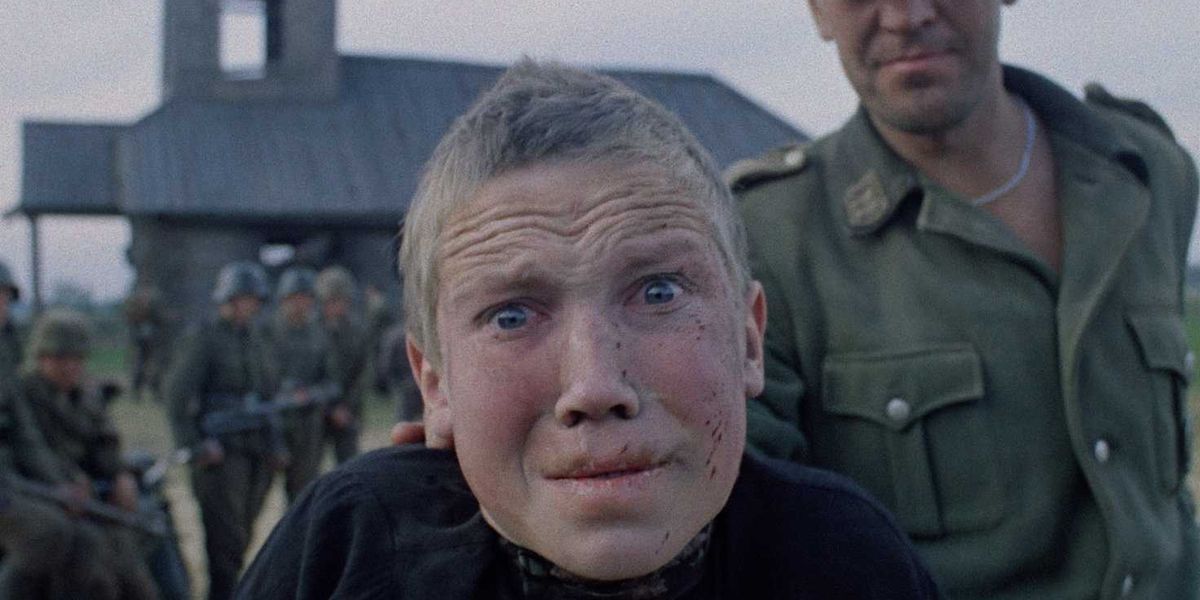
Not enough people have seen this movie. I legitimately think if they did, a lot of wars would stop. This is the ultimate empathy machine, a film that does not glorify any part of combat, just shows you the fallout and devastation.
It is widely regarded by critics and filmmakers as one of the most harrowingly accurate war movies ever put to film. This is a Soviet masterpiece that truly is a psychological descent into hell. Does that sound like fun to watch to you?
Klimov tracks the Nazi occupation of Belarus through the eyes of a young boy named Florya. The film relies heavily on intense, direct-to-camera close-ups that break the fourth wall and force the audience to bear witness to the trauma on the screen with no filter.
You will not forget the sound design. There are explosions and ringing ears and crunching soil and the psychological breakdown of a child.
5. The Thin Red Line (1998)
– YouTube www.youtube.com
- Director: Terrence Malick
- Writer: Terrence Malick (Based on the novel by James Jones)
- Cast: Sean Penn, Jim Caviezel, Nick Nolte, Elias Koteas, Ben Chaplin, John Cusack, Adrien Brody
I think to its detriment, this cameo was released the same year as Saving Private Ryan, and it cost this movie a lot of press and discussion, which it deserved. I mean, this is a Terrence Malick film where we look at the very heart of WWII and its visceral theater of the Pacific.
The Thin Red Line is a deeply philosophical, poetic meditation on nature, divinity, and the absurdity of violence juxtaposed with a flawed humanity.
Malick cuts away from intense shootouts on Guadalcanal to focus on a bleeding bird or sunlight filtering through jungle leaves. There are casualties of our humanness itself, and we feel judged for having to wage war in general.
6. The Best Years of Our Lives (1946)
– YouTube www.youtube.com
- Director: William Wyler
- Writer: Robert E. Sherwood (Based on the novella by MacKinlay Kantor)
- Cast: Myrna Loy, Fredric March, Dana Andrews, Teresa Wright, Virginia Mayo, Harold Russell
Okay, this is a cheat since it’s really about how we deal when the war is over, but I had to include the bold choice to show PTSD and physical trauma on screen, from veteran William Wyler, who went to WWII and saw what it took to come back.
Wyler delivered a brutally honest look at three returning veterans trying to fit back into their old civilian lives and not fitting in right away.
Cinematographer Gregg Toland, who also worked on Citizen Kane, employed his deep-focus techniques to show how characters are isolated and removed from society.
7. Casablanca (1942)
– YouTube www.youtube.com
- Director: Michael Curtiz
- Writers: Julius J. Epstein, Philip G. Epstein, Howard Koch
- Cast: Humphrey Bogart, Ingrid Bergman, Paul Henreid, Claude Rains, Conrad Veidt
Why did the United States enter WWII? Well, the answer is a mixture of Pearl Harbor and pressure, but the cultural consensus at the time was a real war at home between isolationists and interventionists.
One of the things that helped the argument for going to war was a little Hollywood movie about why the fight was noble. Casablanca is the gold standard for blending studio-era romance with political espionage, plus some all-time great lines.
Rick Blaine’s progression from a cynical, self-serving character (“I stick my neck out for nobody”) to a man willing to sacrifice his happiness for the greater Allied cause directly mirrored America’s own shifting geopolitical stance at the time.
8. Inglourious Basterds (2009)
– YouTube www.youtube.com
- Director: Quentin Tarantino
- Writer: Quentin Tarantino
- Cast: Brad Pitt, Christoph Waltz, Mélanie Laurent, Michael Fassbender, Eli Roth, Diane Kruger
As I mentioned in the opener, I think WWII is a war Hollywood loved because of the ease of drawing lines from good and evil. And no genre rejoices in that as much as the revenge genre.
Tarantino’s revisionist historical epic is a love letter to the power of cinema to give people that vengeance, even literally at the end of it.
Structurally, the movie is a masterclass in how to build tension across long, dialogue-heavy scenes.
The opening scene in the farmhouse is a textbook on how to use a classic “Mexican Standoff” dynamic through subtext before a single gun is drawn.
9. Dunkirk (2017)
– YouTube www.youtube.com
- Director: Christopher Nolan
- Writer: Christopher Nolan
- Cast: Fionn Whitehead, Tom Hardy, Mark Rylance, Cillian Murphy, Kenneth Branagh, Harry Styles
Leave it to Christopher Nolan to turn a historical evacuation into a non-linear structural experiment. This movie feels like the auteur is firing on all cylinders, playing with time and never getting too emotional about a rescue mission that changed the course of the war.
Dunkirk tells its story through three distinct timelines that eventually converge: One week on the land (The Mole), one day on the sea (The Sea), and one hour in the air (The Air). It’s a study in how time is spent at war and how things can change.
This is pure visual storytelling.
10. The Bridge on the River Kwai (1957)
– YouTube www.youtube.com
- Director: David Lean
- Writers: Carl Foreman, Michael Wilson (Based on the novel by Pierre Boulle)
- Cast: William Holden, Alec Guinness, Jack Hawkins, Sessue Hayakawa
A personal favorite that is so much more than its epic ending scene, although that’s fantastic, too. This is David Lean doing a fascinating character study wrapped inside a massive studio blockbuster.
The film focuses on the psychological battle of wills between a British colonel (Alec Guinness) and a Japanese camp commander (Sessue Hayakawa) over the construction of a railway bridge needed to resupply the Axis forces, which the British captors are forced to build.
You have a back-and-forth here that’s like people taking or driving in their work, and the enemy inching closer to hurting their friends, which then escalates into a standoff later as reinforcements arrive and the bridge has to go.
What’s Your Pick?
The war genre will continue to evolve as we see conflicts, foreign and domestic, but I have a hunch they’ll be making WWII movies forever.
Whether you’re shooting a low-budget indie or writing a sprawling historical pilot, I think these ten films serve as foundational texts for blocking, pacing, and thematic structural design for bayone diving into that conflict.
What are your favorite WWII movies?
Let us know in the comments below!